

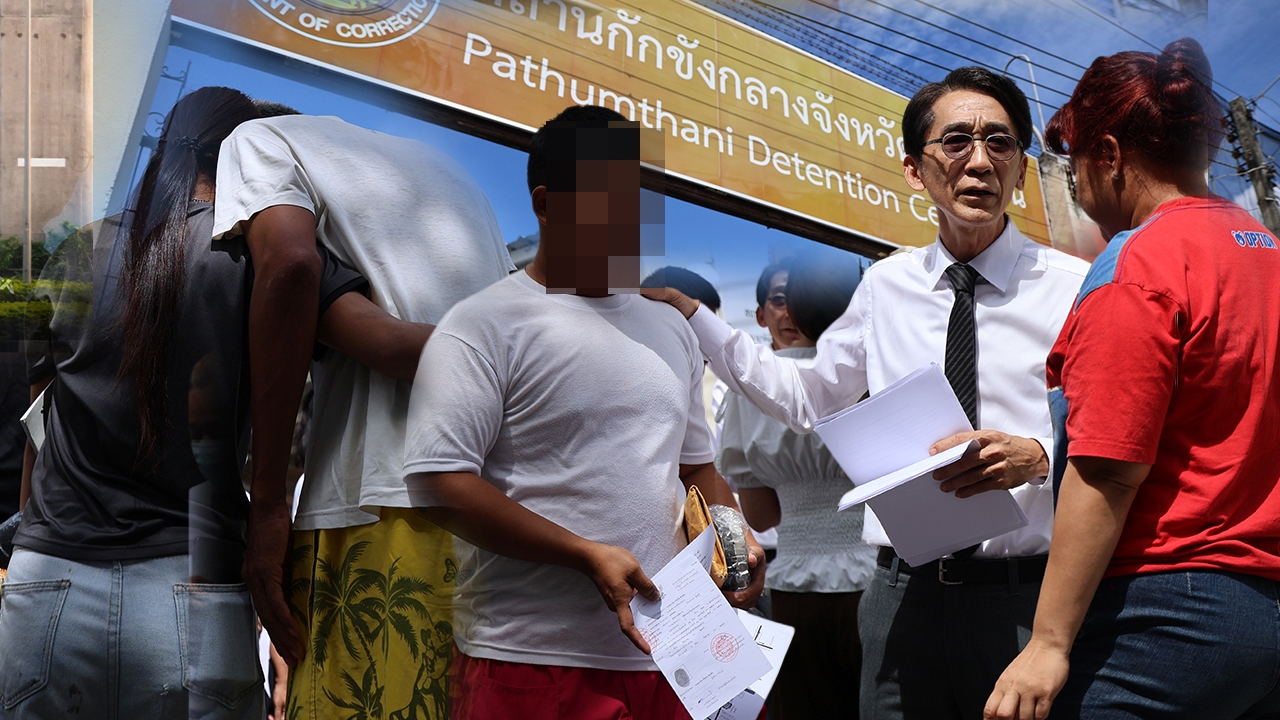
The "Redemption Fund" has provided its second round of aid by redeeming 12 more inmates fined but unable to pay. Associate Professor Dr. Prinya revealed that Thailand's justice system generates inequality by detaining even those who cannot pay fines for minor offenses, averaging around 3,000 people daily. He urges legal reforms and court compassion to allow community service. One beneficiary shared their story.
The Redemption Fund, officially named the "Self-Redemption Work Fund from Detention Facilities," was initiated by Associate Professor Dr. Prinya Thewanaruemitkul, Director of the Forensic Science Center at Thammasat University, to help fine-imposed prisoners lacking funds to pay their fines and thus detained instead.
The fund began with Associate Professor Dr. Prinya Thewanaruemitkul’s personal donation of 98,500 baht to redeem four inmates in the first round. Currently, the fund has accumulated over 300,000 baht from public support and donations recognizing the importance of this issue.

Among the first group, one person now works as a cleaner at Thammasat University's Property and Sports Administration Office, and two others work with the "New Beginnings" project. All three have fully repaid the fund and continue working due to good performance. Another individual, despite minor work difficulties, is gradually repaying the fund as well.
The project then accepted 12 more fine-imposed inmates in its second round, with two already working. On 9 Sep 2025 GMT+7 at 10:00, the fund visited Pathum Thani Central Detention Center to redeem and take in eight more inmates. Among them, one borrowed from the fund to pay fines, already employed and planning to repay the fund through work. The other seven were assigned work: one as a cleaner at Thammasat University and six with the "New Beginnings" project of the Thailand Institute of Justice (TIJ). Two more will join next week to work at the Social Enterprise Institute. This redemption round totaled about 280,000 baht. Associate Professor Dr. Prinya expressed gratitude to "New Beginnings" for facilitating job placements to help these individuals earn a living.

Associate Professor Dr. Prinya reflected that Thailand's justice problem lies in excessive imprisonment, even for minor offenders unable to pay fines. This creates clear inequality since offenders who can pay fines avoid detention and return home immediately. Detaining those without funds benefits society little; short-term detainees receive no serious vocational training, unlike long-term prisoners. Currently, about 3,000 people are detained daily instead of paying fines, totaling approximately 30,000 annually. The state gains about 500 million baht from this but at the cost of citizens' freedom and livelihood opportunities.

Current law sets detention for unpaid fines between up to 1 year, with a conversion rate of 15,000 baht per month or 500 baht per day. For fines of 200,000 baht or more, detention can extend up to 2 years, regardless of fines reaching millions. Other fines are calculated by dividing by 500 baht; for example, a 15,000 baht fine equals 1 month detention, 20,000 baht equals 2 months, and fines between 500 to 1,000 baht without payment result in 1 to 2 nights detention.

Associate Professor Dr. Prinya proposes long-term legal reforms allowing those unable to pay fines to perform "community service" or work for government agencies like provincial or municipal offices—such as removing water hyacinths, garbage collection, or drainage cleaning—according to skills, including private sector work, to earn money to repay the fund for its revolving use. The initiative has submitted requests to five major political parties to promote this. He also appeals for court mercy to permit community service since Supreme Court regulations and supporting laws allow four hours daily service (e.g., a 15,000 baht fine equals 30 days of service, 5,000 baht equals 10 days, supervised by probation officers). However, in practice, 95% of applicants are denied court permission and must be detained instead.

Finally, Associate Professor Dr. Prinya revealed that the Redemption Fund project is planned to operate for only two years, aiming for systemic resolution within this timeframe. Any remaining budget or funds will be used to assist other impoverished groups affected by the justice system.
Ms. Warunee (surname withheld), accused of transnational human trafficking, was initially fined 90,000 baht by the court. After confessing, her sentence was reduced to 45,000 baht.
In the first round, she paid half the fine—22,500 baht—and was to pay the remaining 22,500 baht in installments with the court. However, she did not follow up, assuming the court would notify her of the remaining amount and payment date, so she neglected the matter until a warrant was issued.
On 16 Jul 2026 GMT+7, Ms. Warunee boarded a train, where officials checked her ID and found the warrant, leading to her arrest. The court sentenced her to 88 days in detention. The initially paid 22,500 baht was forfeited, and she had to pay the full fine of 90,000 baht anew.

Ms. Warunee described prison life as very difficult, with no work offered and days spent idly. She followed strict schedules: eating and bathing within 15 minutes; lunch at 11:00; another meal and bathing at 14:00 before returning to her cell; and prayer at 18:00.
There are about 49 women inmates currently, including foreigners. Prison society is such that without relatives or friends, inmates are isolated. Food is unappetizing, causing mental distress and self-harm. Outside prison, she communicated and engaged in activities, but inside, everything follows strict rules.
If she had relatives able to post bail, it might provide some hope. However, hope from the court is minimal since if the court intended her to perform community service to redeem her sentence, it would have ordered that initially rather than detaining her.
Upon learning of this project’s assistance, she felt very happy and sleepless, applying for selection. Being outside prison means earning money; inside, she gains nothing but consumes prison resources. There are no vocational training centers. If allowed to perform community service, she could repay about 500 baht daily.
Her goal if selected is to dispel the stigma of being a "prisoner" by working diligently as a good example, inspiring fellow inmates who all hope to leave prison and gain future project selection opportunities. Currently, 60 people have been selected to leave prison, representing the hope entrusted by those still inside.