

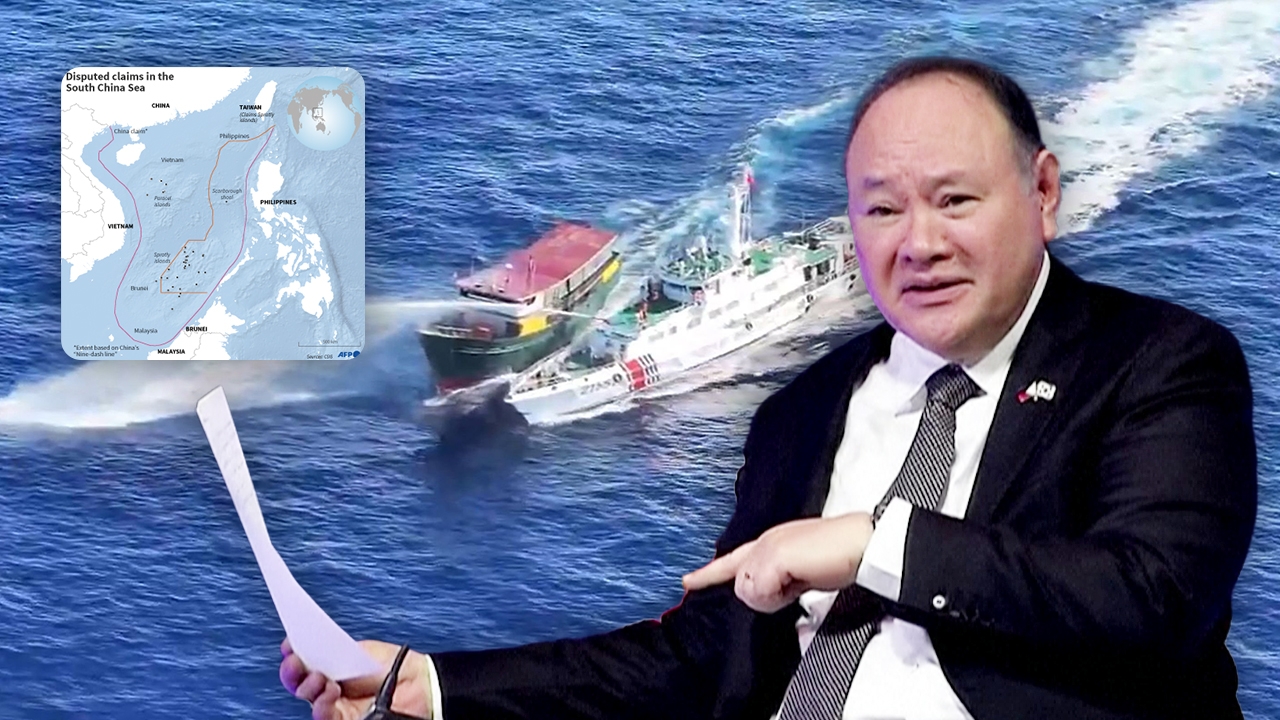
A review of the UNCLOS case concerning the dispute over the Spratly Islands reveals deep fractures in the South China Sea, leading to the latest heated clash where the Philippines accuses China of bullying and shamelessness during an international conference in South Korea.
Amid the heated dispute at the Seoul Defense Dialogue in South Korea on 8 Sep 2026, while Gilberto Teodoro, Philippines' Defense Minister, was addressing the maritime security challenges facing the Philippines and emphasizing the importance of adhering to the United Nations Convention on the Law of the Sea, UNCLOS, which the Philippines has with China over overlapping territorial claims in the South China Sea, he underscored the need to uphold the 2016 arbitration ruling that stated China's claims lack legal basis.
While speaking, the Philippine Defense Minister received an anonymous letter reaffirming China's rejection of the 2016 arbitration ruling. He read aloud from the letter: “China’s position on the South China Sea arbitration is clear, consistent, and firm. The arbitration violates fundamental principles of international law.”
After reading the letter, the Philippine Defense Minister described it as “ intimidation, harassment, and aggression.” He said there should be more decorum and some shame if the letter truly came from China, calling it disrespectful to the conference host South Korea, the other participants, and a sign of disregard for international law and a trampling of UNCLOS. He concluded,
“I will keep this paper as a reminder of how cornered China is and how ineffective their position is when facing a free audience.”
It is unclear who sent the letter. Although Chinese representatives attended the meeting, none were main speakers. Some reports suggest it came from a military attaché at the Chinese embassy in South Korea.

On 9 Sep 2026, Chinese authorities responded. Mao Ning, spokesperson for China’s Foreign Ministry, stated she was unaware of the incident's details but reiterated China’s clear and firm position on the South China Sea arbitration, calling on the Philippines to stop seeking attention and undermining China-Philippines relations.
“We urge those involved in the Philippines to stop seeking attention, cease causing trouble, and stop undermining China-Philippines relations and stability in the South China Sea,”she said.
The South China Sea is an important sea linking East Asia to the western Pacific Ocean, covering over 3.5 million square kilometers. It is a crucial shipping route accounting for one-third of global maritime trade value and is rich in natural resources, yielding over 16 million tons of fish annually, as well as estimated reserves of more than 11 billion barrels of oil and 190 trillion cubic feet of natural gas.
Its northern shore borders China and Taiwan, the east borders the Philippines, the south and southeast border Brunei, Malaysia, Indonesia, and Singapore, while the west borders Vietnam. Each country claims sovereignty over parts of the area, especially key reefs and island groups such as the Spratly Islands and the Paracel Islands, for strategic trade, security advantages, and marine natural resources. Besides regional countries, major powers like the United States also show interest and seek to balance power in the region.

China claims sovereignty over more than 90% of the South China Sea, citing historical records that it has governed the area since the Han Dynasty 2,000 years ago, and officially declaredsoin 1947, when China was still a republic, drawing an eleven-dash line in a U shape covering the claimed area.
Later in 1952, after Mao Zedong established the People's Republic of China and the communist government, two dashes in the Gulf of Tonkin were removed as a goodwill gesture toward Vietnam, reducing the claim to nine dashes, known as the “9 Dash Line,” which China has used to this day (before unveiling a 10 Dash Line map in 2023 adding dashes east of Taiwan to reinforce the One-China policy). China has continuously pushed its interests in the South China Sea through construction, military technology, land reclamation, and patrol deployments.
Meanwhile, the Philippines, after gaining independence from the US in 1946, asserted claims overlapping China's nine-dash line in the South China Sea. In 1949, it enacted a Petroleum Act supporting sovereignty claims over the Spratly Islands and in 1961 established territorial sea baselines declaring natural resources on the continental shelf as Philippine property, provoking China's displeasure. The Philippines leveraged strong ties and military bases with the US as support.
Following the 1982 United Nations Convention on the Law of the Sea (UNCLOS 1982), which is regarded as the constitution of the oceans and the primary legal framework for maritime disputes worldwide, China signed immediately and ratified in 1996, while the Philippines ratified in 1984. In 1992, the US withdrew troops from the area, prompting the Philippines to both revive ties with the US and pursue diplomacy with China. In 1995, China took advantage of this gap to build structures on reefs and islands in the Spratly Islands and increased naval patrols.
Later, the Philippines-US relationship was restored, with the 1999 ratification of the Visiting Forces Agreement (VFA) and joint military exercises starting in 2000.
Meanwhile, ASEAN engaged China to establish a code of conduct in the South China Sea, resulting in the 2002 ASEAN-China Declaration on the Conduct of Parties in the South China Sea, a non-binding framework to manage tensions and prevent military conflict.
During this time, under President Arroyo, the Philippines improved relations with China, allowing investment in infrastructure such as transportation and railways, and signed the 2005 Joint Marine Seismic Undertaking (JMSU) for joint oil and gas exploration in the
Spratly Islands. However, in 2008, the Arroyo government was accused of violating the constitution by permitting foreign companies to explore national resources. The agreement was not renewed, and the Philippines shifted to asserting rights within a 200 nautical mile exclusive economic zone per UNCLOS, causing a downturn in relations with China and continued tension in the South China Sea. A critical turning point came in 2012 with the Scarborough Shoal standoff,which the Philippines claims lies within its exclusive economic zone about 160 km from Luzon Island. Philippine patrols found Chinese fishing vessels anchoring there and attempted to inspect and detain them. China then deployed ships to blockade the area, preventing Philippine control. Both sides increased patrols and maintained presence for over two months.
The US mediated a mutual withdrawal, but while the Philippines pulled back, China maintained its presence, effectively taking control of Scarborough Shoal and barring Filipino fishermen.

Following this, the Philippine government filed arbitration proceedings on 22 Jan 2013, not to decide ownership of islands but to address key issues: whether China's nine-dash line claims comply with UNCLOS; the geographic nature of the Spratly Islands and their entitlement to maritime zones; and whether China's actions infringed Philippine sovereignty, violated UNCLOS, and caused environmental damage. The Permanent Court of Arbitration (PCA) ruled on 12 Jul 2016 that China's historic rights claims within the nine-dash line lack legal foundation; that features in the Spratly Islands do not generate 200 nautical mile exclusive economic zones; and that some Chinese activities violated Philippine rights and harmed the marine environment. Despite the ruling, conflict persists.
China has consistently rejected the arbitration, denying PCA jurisdiction and legitimacy, asserting the core dispute is territorial sovereignty, not maritime law, and advocating bilateral negotiations. China called the ruling “a piece of paper worthless” and insisted it would not affect its maritime sovereignty or historic rights in the South China Sea.
Over the past decade, tensions between China and the Philippines have remained high. China has not withdrawn forces but expanded influence, with ongoing skirmishes escalating after President Marcos Jr. assumed office in 2022, adopting a tougher stance.In 2023, clashes occurred at Thomas Shoal 2 and Scarborough Shoal, where Chinese coast guard used water cannons and lasers against Philippine patrols, temporarily blinding crew members, with multiple collisions between ships.Thomas Shoal 2, about 194 km from Palawan Island, has been a recurrent flashpoint. In July 2026, the Philippines accused Chinese personnel of assaulting Filipino sailors during an encounter, causing injuries, which China denied, countering that the Philippines provoked and rammed Chinese vessels.
This case offers lessons for Thailand as it approaches maritime dispute resolution with Cambodia under UNCLOS 1982. Despite differences in mechanisms and conditions, a key takeaway is that rulings alone may not end disputes immediately; mutual will, acceptance, and adherence to processes by both parties are crucial.References:https://digital.car.chula.ac.th/cgi/viewcontent.cgi?article=8901&context=chulaetd

https://www.bostonpoliticalreview.org/post/china-s-new-map-the-10-dash-line