

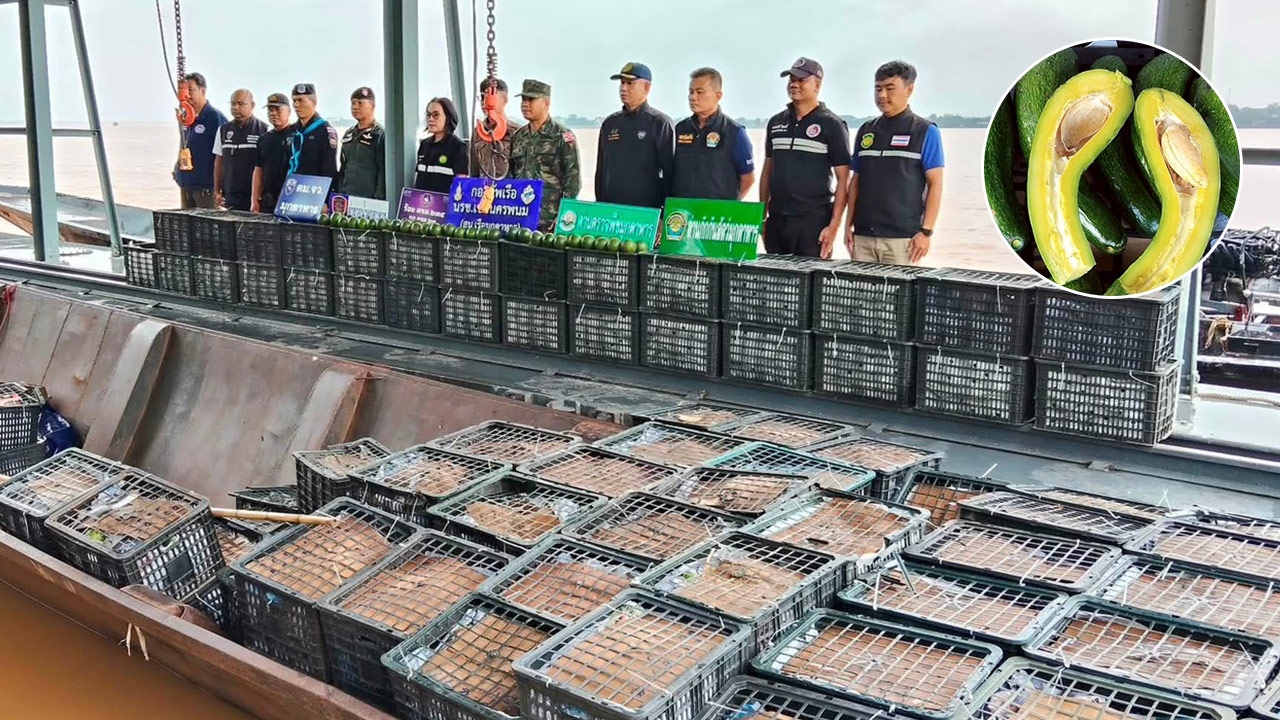
Revealing the illegal avocado smuggling route across the Mekong, flooding Thailand over six months with 41 tons seized. The avocados come from Vietnam, temporarily held on the Laos side before being secretly shipped by boat and brought ashore in Thailand. Chemical test results are still unclear and may impact health. The avocados are notably long, resembling cucumbers.
Since April 2026, illegal avocado imports into Thailand have been rapidly spreading in the market. The latest case in August 2026 involved highway police intercepting a six-wheel truck carrying over 6.5 tons of fresh avocados evading taxes.
Government agencies and experts have repeatedly warned against consuming illegal avocados, as they have not passed safety inspections by the Food and Drug Administration (FDA) and the Department of Agriculture, posing high risks of chemical, pesticide, or fungicide residues. Improper temperature control during transport and use of substandard ripening agents to hasten sale may cause digestive and long-term health problems.

Thairath Online's special team spoke with a source at Mukdahan Plant Inspection, Plant Quarantine Control Division, Department of Agriculture, about illegal avocado imports into Thailand. Since 2024, various foreign fruits have been smuggled in mixed shipments. In 2025, about 40 tons of the Vietnamese A034 avocado variety were seized. From April to September 2026, seizures reached 41 tons, coinciding with the season, though actual amounts are likely higher.
The Vietnamese A034 avocado is a popular variety originating from Vietnam, characterized by elongated fruit, golden-yellow flesh, and a slightly sweet, rich flavor. It is commonly eaten fresh or used in smoothies.

Information remains unavailable on arrests of avocado smugglers, so the scale of the operation is unknown. The smuggling network transports fruit by boat, each carrying about 3–20 tons in containers from Vietnam to the Laos side, then repackaged into boxes and moved along the Mekong to the Thai side. The avocados are unloaded at warehouses in Mueang Mukdahan district along the Mekong, extending to Ban Yai district and further north, but inspections are hindered as these warehouses serve as residences. Most are loaded onto pickup trucks for market distribution.
Market avocado prices range from 120 to 140 baht per kilogram. However, information from small sellers to smugglers is unavailable. Thai avocados differ from Vietnamese ones in shape: Thai avocados are round to oval, relatively large, with smooth or slightly rough greenish skin that may develop brown spots when ripe, and pale yellow flesh with a large seed.
Vietnamese A034 avocados are elongated like cucumbers or bitter melon, with thin, dark green, relatively smooth and shiny skin, yellow-green flesh inside, and fruiting season earlier than Thailand's.

The source stated the estimated damage from illegal avocado imports into Thailand is over 3 million baht, representing only the portion seized, which is believed to be just 10% of the total smuggled due to multiple entry points that evade control. Surveillance via social media monitors videos from Vietnam showing fresh avocados from farms. Security agencies including the Surasak Montri task force coordinate to watch cargo boats, shifting from chasing smugglers to delaying crossing by about a week so the avocados spoil.
The source added that specific chemical substances used in Vietnam have not been clearly identified, but are suspected to exceed safety standards. No plant pests were found since seized shipments were already spoiled, preventing testing. Chemical analysis is costly and part of legal proceedings.

Decoy boats are used to divert authorities' attention during inspections. Once avocados are brought ashore, escort and blocking vehicles operate in coordinated steps.
The reason Vietnamese avocados and certain fruits are currently prohibited from entering Thailand is that they have not undergone Task Risk Assessment (TRA), which the Department of Agriculture or Ministry of Agriculture must conduct. Afterward, inspections ensure compliance with standards; for example, if pests unfamiliar to Thailand are detected, they must be eliminated before import.
TRA (Task Risk Assessment) involves calculating or grading risk levels. It is a legal requirement for import (customs/plant quarantine), food safety (chemical residues), and supply chain management (spoilage), enabling importers and wholesalers to operate safely and correctly while minimizing losses.

Illegal importation of fruit violates customs laws and the Plant Quarantine Act, which carries lighter penalties. If caught, the offense is illegal importation without customs clearance, a serious crime. Authorities document arrests, report to customs, and confiscate goods. Customs then decides on further action, but the Plant Quarantine Act requires destruction of the goods.
Under the Customs Act B.E. 2560, smuggling offenses (Section 242) involve bringing goods into or out of the kingdom without customs clearance or unauthorized removal from vehicles, bonded warehouses, secure storage, ports, or free zones. Penalties include imprisonment up to ten years, fines up to four times the value including duties, or both, along with confiscation of goods regardless of conviction.
The offense of buying or selling smuggled goods (Section 246) applies to anyone concealing, selling, buying, or receiving goods knowing they were imported without customs clearance. Penalties include up to five years imprisonment or fines from half to four times the goods' value, or both.
Tax evasion offenses (Section 243) occur when goods declared at customs are misrepresented, partially concealed, or other methods are used to pay less tax than owed. Penalties include up to five years imprisonment or fines from 0.5 to 4 times the unpaid duties.
Most water transport seizures involve military personnel, while land transporters are often hired carriers. The true smugglers remain unidentified. Some suspects flee, abandoning the goods.

The source said security agencies coordinate primarily to educate involved parties but cannot enforce strict measures because efforts must align with drug control operations. They can only pressure to prevent cross-border loading to cause fruit spoilage. Approval of TRA is necessary; once passed, imports can proceed legally.
Currently, some fruit has already reached the market. Identification, seizure, and arrests are difficult and require cooperation among multiple agencies.