

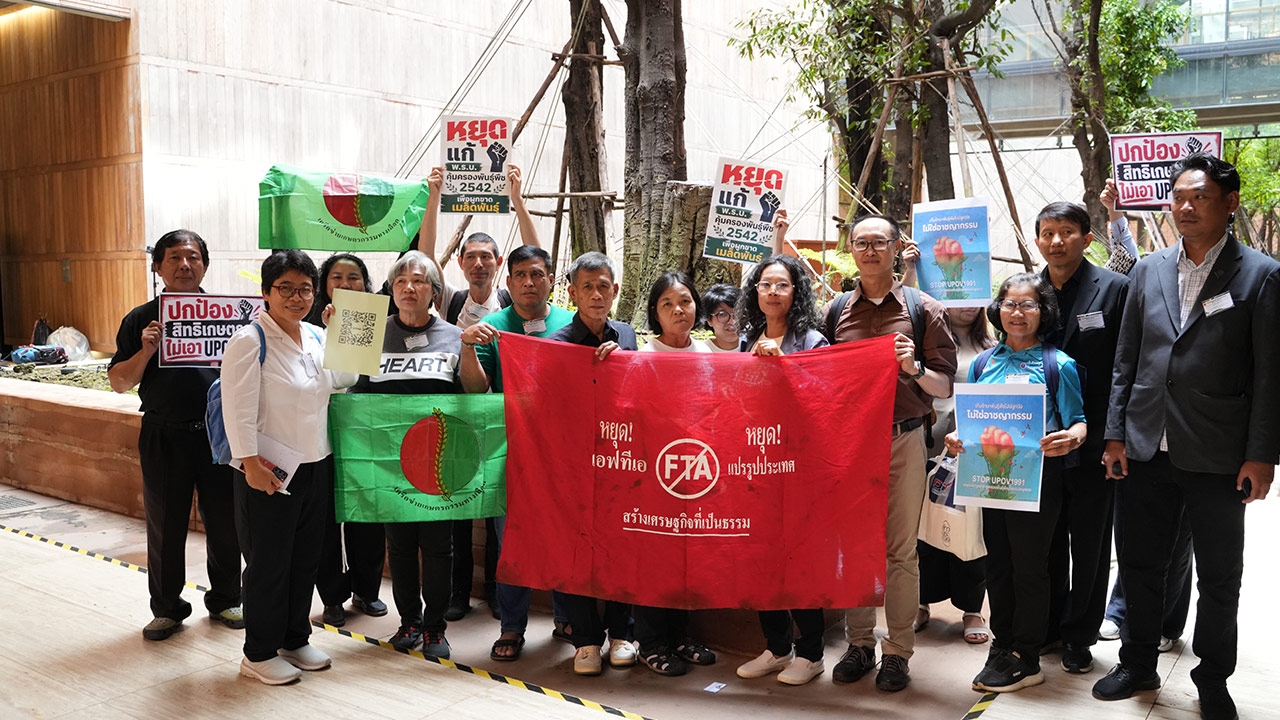
Civil society groups are closely monitoring the 10th round of the Thailand–EU FTA negotiations, emphasizing their rejection of UPOV 1991 due to concerns it would impact farmers’ rights, access to medicines, and public benefits.
A coalition of 146 civil society organizations and NGOs submitted a letter to political leaders and Parliament, urging them to monitor, scrutinize, and pressure the government and negotiation team to prioritize public interest and citizens’ rights in the Thailand–EU Free Trade Agreement talks before the 10th round from 28 September to 6 October 2026 in Phuket, a critical phase that could lead to concluding the negotiations.
Civil society warns that although 15 of 24 chapters have been provisionally concluded, many crucial and sensitive issues remain on the negotiation table. These could have long-term impacts on the economy, society, health, agriculture, citizens’ rights, and Thailand’s policy space. Therefore, they caution against rushing to close the talks by trading off farmers’ rights, medicine access, health, environment, or consumer protection for trade benefits in other sectors.

The most important demand from civil society is that Thailand must not accept binding commitments to join the UPOV 1991 Convention, must not amend domestic laws to comply with it, and must reject any other provisions that would effectively require compliance with UPOV 1991.
Civil society points out that Thailand’s Plant Variety Protection Act of 1999 already strikes a balance between protecting plant breeders and safeguarding the rights of farmers, communities, indigenous plant varieties, and benefit-sharing from genetic resources. Being forced to join UPOV 1991 or amend laws accordingly would exceed World Trade Organization obligations and diminish the country’s policy space.
UPOV 1991 expands the scope and duration of breeders’ rights while restricting farmers’ rights to save seeds for replanting. Studies presented by civil society to negotiators indicate that implementing UPOV 1991 could increase Thai farmers’ seed costs by 2 to 6 times over the long term and affect food prices.
Yupin Kasena, a leader of the Alternative Agriculture Network, warned that the impact goes beyond seed prices to affect farmers’ traditional practices of saving, selecting, exchanging, and developing seeds, biodiversity, protection of genetic resources and community wisdom, as well as national food security and sovereignty.
Reject TRIPS-plus measures; warn of increased medicine monopolies with costs potentially reaching 3.7 trillion baht over 30 years.
Chalermsak Kittikraikul from the Thai Network of People Living with HIV/AIDS affirmed that Thailand must not accept intellectual property measures beyond the TRIPS Agreement, known as “TRIPS-plus,” including data exclusivity, market exclusivity, patent term extensions, or other measures delaying generic medicine entry and prolonging monopolies.
A 2025 joint study by the Food and Drug Administration, National Health Commission Office, and academic networks found that the EU’s intellectual property proposals could delay generic drugs entering the market by at least two years, possibly up to eleven, increasing Thailand’s medicine costs by approximately 130 billion baht in 10 years, 770 billion baht in 20 years, and up to 3.7 trillion baht in 30 years. This would impact patients, health insurance systems, domestic pharmaceutical industries, and medicine security.

Teera Watcharapranee, Director of the Network of Alcohol-Free Organizations, urged the government not to rush tariff reductions or elimination on alcoholic beverages if it would increase access and consumption. He emphasized the need to preserve government powers on taxation, pricing, marketing controls, advertising restrictions, warning labels, sales time and place limitations, and other public health measures. According to data cited, economic damages from alcohol consumption in Thailand in 2021 amounted to approximately 165.45 billion baht, or 1.02% of GDP.
Regarding digital trade, Nisara Kaewsuk, a consumer council academic, called on Thailand to reject commitments limiting the state’s ability to enact or update future laws on personal data protection, cybersecurity, digital taxation, AI regulation, platform product and service safety, and consumer protection—especially provisions on cross-border data flows and restrictions on domestic data processing or collection measures.
Another key issue civil society demands the government clearly protect in policy space is controlling agricultural chemicals, remanufactured products, plastic waste, electronic waste, and materials potentially contaminated with hazardous substances. They must reject commitments that ease imports of these goods or limit Thailand’s authority to set standards, inspect, authorize, or ban imports.
Simultaneously, civil society urges Thailand to push the EU to stop exporting banned, cancelled, or unapproved hazardous pesticides and agricultural chemicals—prohibited within the EU due to health or environmental risks—to Thailand. Prachara Usub, Director of BioThai Foundation, emphasized this, stating that shifting risks onto farmers and consumers in partner countries contradicts sustainable food system goals.

The 146 organizations call on political leaders and relevant parliamentary committees to monitor government and negotiation team positions before and after the 10th round, and summon responsible agencies to explain negotiation outcomes and proposals Thailand has accepted or not, especially concerning UPOV 1991, intellectual property and medicine access, digital trade, alcoholic beverages, agricultural chemicals, remanufactured products, plastic waste, and electronic waste.
They also demand sufficient public disclosure of negotiation information and stances on issues affecting the public, and meaningful consultation processes with farmers, consumers, patients, academics, civil society organizations, and stakeholders before the government agrees to critical binding commitments.
Ms. Kannika Kittivechkul, Vice-Chair of the Civil Society Free Trade Agreement Study Group representing the 146 organizations, stated, “Speeding to finalize the agreement should not be prioritized over securing a fair deal for the Thai people. Short-term gains from exports or investment should not be exchanged for farmers’ rights, food security and sovereignty, access to essential medicines, public health, biodiversity, environment, consumer protection, or the policy space the Thai government needs to address future challenges.”
Civil society reiterates that decisions made in this negotiation will bind Thailand and its people for decades. Therefore, the government should not rush to close the talks unless it can secure agreements that protect Thailand’s and its citizens’ interests on these key issues.