

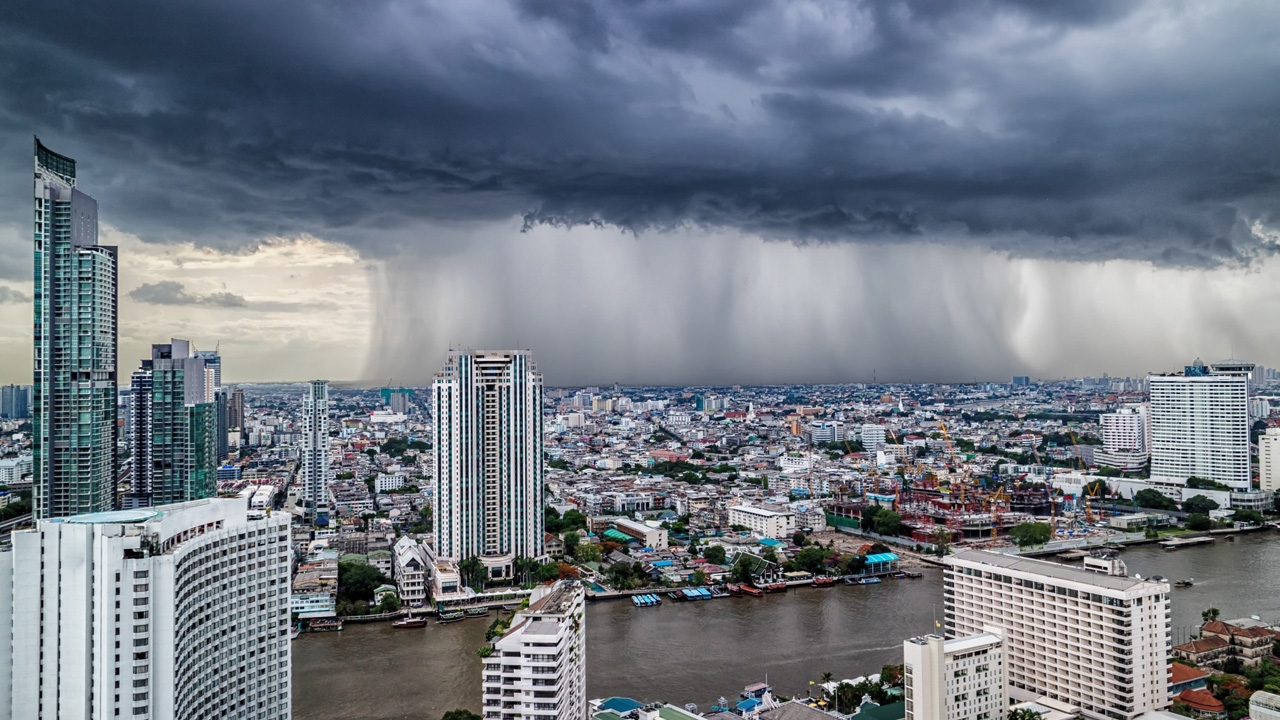
Overnight rain is causing recurring flood hazards. Bangkok is preparing for localized heavy rainfall on the 26th-27th. Experts note that heavy nighttime rain is hard to control and raises the risk of flash floods.
Accumulated heavy rain has led to high water levels in some central region areas, such as Ayutthaya, which experiences repeated flooding. Although this year’s total rainfall is forecast to be less than last year, the rain pattern involves "overnight rain" with alternating heavy and light showers in some areas causing floods.
The latest data from the Meteorological Department reports accumulated rainfall over 24 hours (23 Sep 2023, 07:00 to 24 Sep 2023, 07:00) showing light to moderate rain with some heavy showers. The highest recorded rainfall was 171.4 mm in Pattaya City, Bang Lamung District, Chonburi Province.
The 24-hour accumulated rainfall report for Bangkok from the Drainage Department (23 Sep 2023, 07:00 to 24 Sep 2023, 07:00) indicates light to moderate rain and some heavy showers, with the highest rainfall measured at 67.0 mm at the Phra Khanong District Office monitoring station.

Dr. Seri Supharat, Director of the Climate Change and Disaster Center at Rangsit University, explains that this year’s phenomenon involves continuous but intermittent heavy overnight rain, caused mainly by two factors combining.
These factors are the monsoon trough and a low-pressure cell moving from Cambodia, which work together to draw in and induce moisture.
Moisture from the Gulf of Thailand feeds the system continuously when the monsoon trough passes over land. Cooler air from high pressure above meets this moisture, resulting in prolonged or "overnight" rainfall characterized by alternating heavy and light showers.

Regarding direction and vulnerable areas, the first affected provinces are in the east, including Sa Kaeo, Prachinburi, Chonburi, Rayong, Chanthaburi, Trat, and parts of lower northeastern provinces like Buriram, moving toward Nakhon Ratchasima (Korat).
For Bangkok and its vicinity, rainfall will begin entering from the eastern side before spreading westward, with localized heavy rain expected mainly on 26-27 September.
The rainfall pattern will not be a brief shower but rather alternating light and heavy rain lasting throughout day and night.

Dr. Seri analyzes that overall, this year’s accumulated national rainfall is about 10% below average.
So why does flooding still occur? The problem is not rainfall volume alone but also physical conditions and urban planning in affected areas. Dense communities, inadequate drainage systems, and constructions blocking waterways mean that heavy localized rain of just 100–140 millimeters can cause immediate flooding due to insufficient drainage.
For residents in heavy rain-prone areas, advance forecasting is difficult because monsoon trough rain is highly variable and long-term forecasts cannot precisely specify districts or subdistricts.
Therefore, it is crucial for government agencies, local authorities, and the public to monitor hourly weather radar images to stay alert and prepare for sudden flood situations promptly.
Regarding nighttime risk, overnight rain poses higher dangers especially near foothills or water runoff areas, as water levels are harder to see and flood flow is more difficult to detect than during daytime.
Experts have highlighted chronic flooding problems in low-lying areas such as Sena District, Phra Nakhon Si Ayutthaya, describing it as a long-standing structural issue that past governments over the last 30–40 years have failed to resolve. If dams release over 700 cubic meters per second, low-lying areas like Sena immediately flood.
Currently, water discharge has increased to 1,700 cubic meters per second, causing higher flood levels and wider flood expansion.
Historical records over more than 40 years show only four years with releases below 700 cubic meters per second, meaning residents face flood hazards nearly every year with no escape unless serious structural water management reforms are undertaken.