

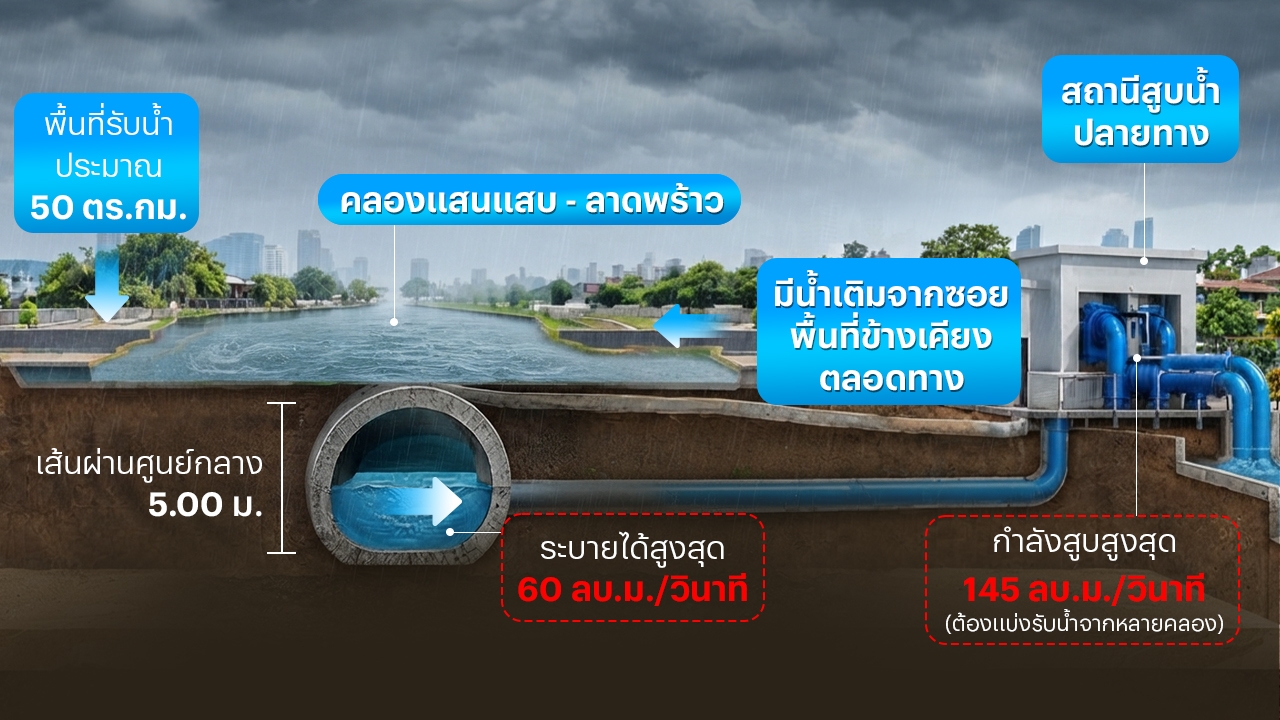
Despite the giant tunnel at Khlong Saen Saeb-Ladprao, why can't floodwater drain quickly enough? The Engineering Council points to the unusually heavy rainfall as the root cause, explaining the water retention mechanism and the underground tunnel's process of channeling water out to the Chao Phraya River.
Flooding in the Ramkhamhaeng and Ladprao areas partly stems from Khlong Saen Saeb's drainage system being unable to keep pace. Although the area beneath Khlong Saen Saeb has a giant tunnel, it still cannot expedite drainage during heavy rainfall fast enough.
Due to continuous heavy rain over several days starting 26 Sep 2016, Bangkok and its suburbs have faced flooding in many areas, especially Ramkhamhaeng, Bang Kapi, Khlong Chan, Romklao Housing, and Ladprao. These areas face drainage system limitations compounded by critical water levels in Ladprao and Saen Saeb canals overflowing their banks.
Thairath Online's special task force interviewed Mr. Somkiat Chusangsuk, a member of the Engineering Council, to clarify the background of this situation.

Mr. Somkiat described the overall situation, noting that although many areas experienced flooding, this event differs from the 2011 floods because the Chao Phraya River's water level was not as high, allowing water to still drain out. Locals report that after previous flooding, water levels have receded and roads have dried, including main roads and nearby areas where the situation is improving.
This flooding was not caused by flaws in drainage system design but primarily by unusually heavy, continuous rainfall throughout the day and night. The rainfall volume was so high it caused what is called "water waiting to drain," resulting in temporary water accumulation on roads and in communities.
Bangkok's basin-like topography means heavy rainfall collects in low areas. Locations near pumping stations or tunnel entrances see faster water reduction. However, areas farther away, like Khlong Chan, require water to flow gradually through canal networks before entering the tunnels.
From an engineering perspective, drainage design is based on rainfall frequency statistics over periods such as 5, 10, up to 100 or 1,000 years. Designing systems to handle extreme 1,000-year rainfall events would require enormous pipes or tunnels, which is impractical due to high costs and severe impacts on construction and residents along the routes. Therefore, underground drainage tunnels are designed with a water retention period: when rainfall exceeds capacity, water temporarily pools on roads or low areas before gradually being pumped and drained.

The main drainage tunnel in this area includes the large underground Khlong Saen Saeb tunnel. Decades ago, severe flooding in Ramkhamhaeng prompted the government and Bangkok Metropolitan Administration to build this tunnel to channel water from the area to Phra Khanong. The tunnel starts at Rama 9 Pond, has a large diameter of 5 meters, and functions by receiving and pumping water from various canals directly through the underground tunnel to the Chao Phraya River and Khlong Phra Khanong rapidly.
Bangkok does not have only one drainage tunnel; there are other projects like the Khlong Prem Prachakorn tunnel and additional BMA projects built after 2011 to enhance drainage efficiency.
Regarding solutions and managing the situation, preparing by releasing or pumping water from canals before rainfall can help reduce and mitigate flooding severity. However, in practice, this approach cannot completely prevent temporary flooding during abnormal heavy rain.
