

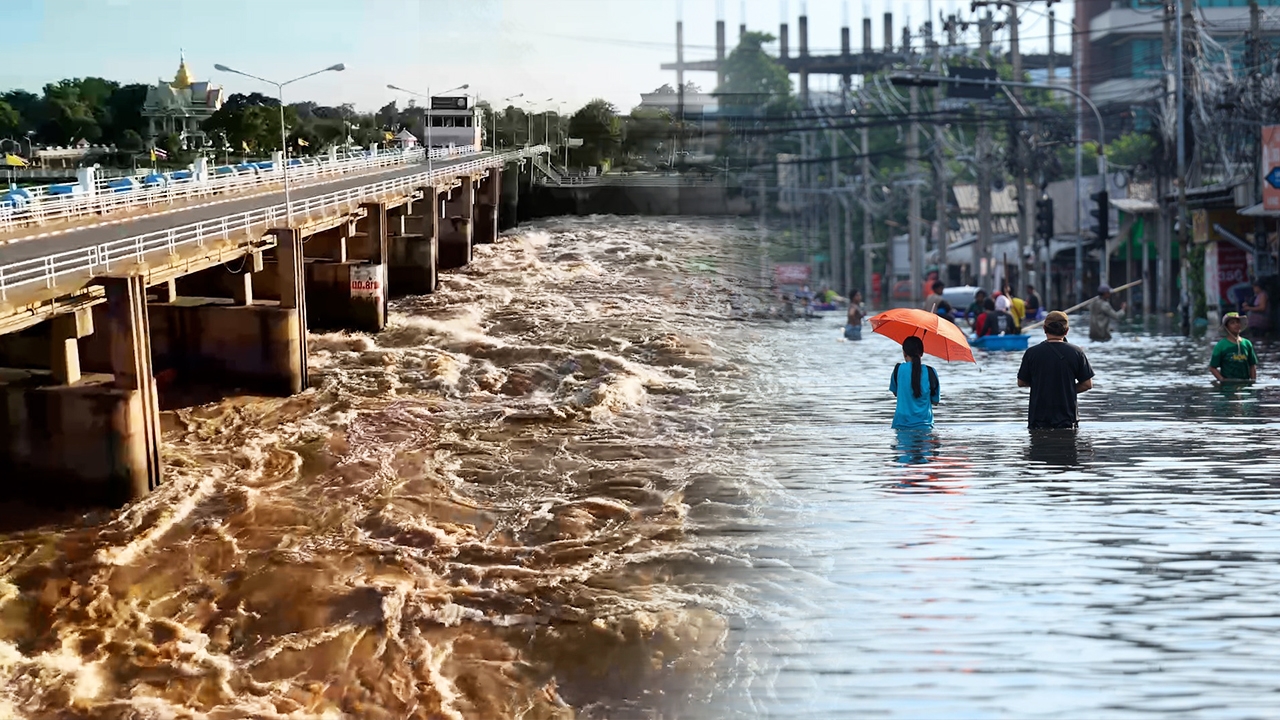
Comparing northern floodwaters of 2011 versus 2026, there is a difference in water volume. Focus is on Bang Sai District bearing the heaviest load from two sources. The northern water mass is expected to reach Bangkok on 6-7 October 2026. The cause is explained for why the damage in Bangkok this time is nearly as severe as in 2011.
The flooding in Bangkok has caused waterlogging in many areas. Although water levels have receded, attention must remain on the incoming northern floodwaters along with monitoring rainfall that could worsen the situation again.
Thanaroj Waratusprasert, Director of the National Water Command Center at the Office of the National Water Resources, said that as of 1 October 2026, the highest floodwater from the Ping River has reached Nakhon Sawan Province and is expected to arrive at the Chao Phraya Dam within one day (by 2 October 2026). Meanwhile, water from the Sakae Krang River is approaching its peak but efforts are underway to hold back the flow to manage water traffic through the Chao Phraya Dam.

The Chao Phraya Dam is expected to discharge up to 2,500 cubic meters per second. Currently (1 October 2026), it is releasing 2,300 cubic meters per second and plans to increase to 2,400 cubic meters per second. Further assessments will determine whether downstream areas can be controlled.
At the Pasak Chonlasit Dam, which previously held back water, as of 1 October 2026, water has started to overflow with plans to increase discharge. Previously releasing 400-500 cubic meters per second, inflow has begun to decrease, indicating successful retention to allow downstream flooding. Discharge will be reduced to 300 cubic meters per second.
However, water from both the Pasak Chonlasit Dam and northern inflows from Nakhon Sawan will merge at Bang Sai District, Phra Nakhon Si Ayutthaya Province, with flows not exceeding 3,000 cubic meters per second. This will impact riverside and embankment areas flooding up to Bangkok, but water levels will remain about 40 centimeters below Bangkok's embankments.
"This northern flood will severely affect Ayutthaya Province, especially Bang Sai District, where water levels may rise about 70 centimeters, but government agencies are trying to reduce this as much as possible. Around 3–5 October, water will reach Ayutthaya, and on 6–7 October, the northern water mass will reach Bangkok," he said.
Water levels in the Tha Chin Basin have stabilized and are not expected to rise further. The highest water flow in Mae Klong has passed, moving towards Ratchaburi and Samut Songkhram Provinces, with a decreasing trend. The Vajiralongkorn Dam in Kanchanaburi Province will increase discharge after holding back water to aid lower areas, planning to raise discharge today (1 October 2026) by about 40 cubic meters per second. This increase will not cause higher water levels than before.

When asked about differences between the major 2011 flood and the 2026 situation, Thanaroj said they differ greatly. For example, in 2011, the Chao Phraya Dam discharged a maximum of 3,700 cubic meters per second, in 2025 it was 2,900 cubic meters per second, and this year (2026) is expected to release a maximum of 2,500 cubic meters per second. This shows a significant difference in dam discharges, so the northern water impacting Bangkok this year is expected to be less.
Although the northern water impact on Bangkok is less than in 2011, 2026 will see more accumulated rainfall locally and more water waiting to be drained.

Associate Professor Dr. Sujarit Koonthanakulwong, Chair of the Water Management Research Program at the Thailand Research Fund, analyzed differences between northern floodwaters in 2011 and 2026. He said the water volumes differ greatly. In 2011, 4,000 cubic meters per second entered the Chao Phraya River at night, while now only 2,000–2,500 cubic meters per second enter, but Bangkok can handle 3,000–3,500 cubic meters per second.
The causes of the water mass differ considerably. In 2011, there were five storms, but in 2026 only a low-pressure trough, not a storm. The current flooding is mainly from local rainfall in Bangkok, unlike 2011 when the floodwater came from northern Thailand. This year, flooding may occur around Ayutthaya but is unlikely in Bangkok.
Regarding water drainage into the sea, October sees a rapid drop in sea levels, unlike November, when sea levels remain high longer than any other month.