

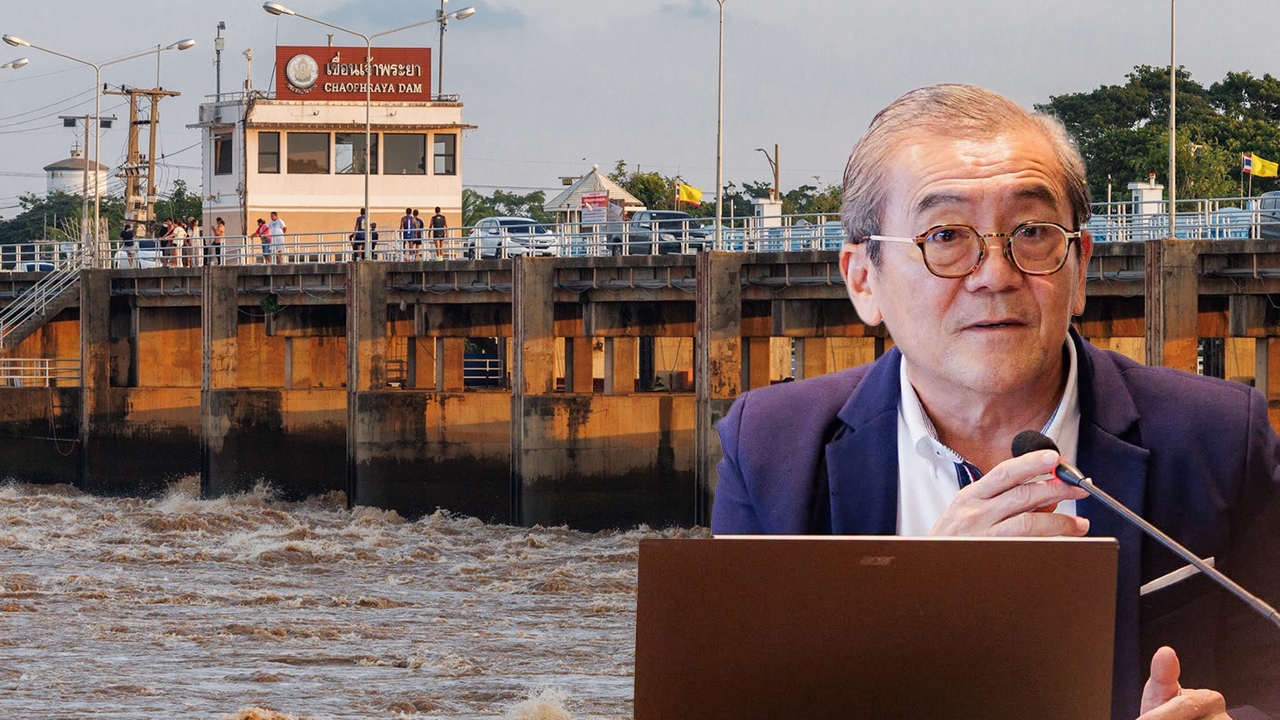
The northern flood crisis: Assoc. Prof. Dr. Seri confirms that Bangkok will not face a repeat of the 2011 flood disaster this year, emphasizing the need for careful management of the Chao Phraya Dam and recommending the “3 Help” approach to handle disasters effectively.
Amid heavy rainfall and rising water levels in many areas requiring close monitoring, on 2 Oct 2026 from 13:00 to 14:00 GMT+7, the Climate and Disaster Center of Rangsit University, in collaboration with the National Disaster Warning Council Foundation, held a press conference titled "Preparing for Incoming Northern Floods: Will Bangkok and Its Vicinity Survive?" to analyze the situation and provide accurate information to the public.

Dr. Arthit Urairat, President of Rangsit University, opened the press conference by expressing concern for the country’s situation and highlighting key issues during crises: every major flood event causes confusion due to conflicting information. People don't know which authorities to trust, and the government cannot fully guarantee safety. As a result, many turn to online sources mixing facts and fake news, leading to chaos and uncertainty about when and how severe the floods will be. To address this, Rangsit University teamed up with leading expert Assoc. Prof. Dr. Seri Supharat, director of the Climate and Disaster Center, to provide accurate analysis and information.
Assoc. Prof. Dr. Seri Supharat revealed in-depth insights into current flood crisis management, starting with an explanation of Thailand’s two main warning systems designed to cover various scenarios:
T-Alert (Thailand Alert) is a central system that issues wide-area national warnings for events like earthquakes, tsunamis, or storms.
Local Alert (L-Alert) is the crucial flood warning system based on localized data. Local agencies use initial information from central sources to conduct detailed assessments of their areas, such as identifying evacuation points and escape routes, enabling precise warnings to residents. Central authorities cannot match the local knowledge of agencies in Bangkok or each province.

Regarding rainfall and water volume analysis, flooding severity varies by area. For example, eastern Bangkok areas like Bang Na, Lat Krabang, and Khlong Sam Wa face flooding due to accumulated rainfall exceeding 300 millimeters, while Thonburi side receives less rain and thus has less severe flooding. This difference is not due to better drainage systems but directly related to rainfall volume. Meanwhile, the northern flood volume from Nakhon Sawan moving downstream, currently around 2,400–2,500 cubic meters per second, requires strict management through the Chao Phraya Dam and coordinated water control.
When asked if this year's situation will be as severe as the 2011 Great Flood, simulations and comparative data analysis clearly confirm that it will not. This is because accumulated rainfall in northern and central regions is significantly lower than in 2011. Also, flood volume passing Nakhon Sawan in 2011 reached 15,000 million cubic meters, while this year it is only about 4,300 million cubic meters, showing a substantial difference in size and volume.

To help Thai society sustainably cope with disasters that are becoming more frequent and severe, Assoc. Prof. Dr. Seri shared key recommendations through the "3 Help" concept as follows:
Self Help (helping oneself and family) means understanding risks and preparing to care for oneself and family assets without solely relying on government assistance.
Community Help (mutual aid within the community) involves building community strength and mutual support at the local level.
Country Help (government assistance) refers to integrating aid from the government and all sectors nationally, enabling Thai society to sustainably manage and coexist with increasingly frequent and severe disasters in the future.