

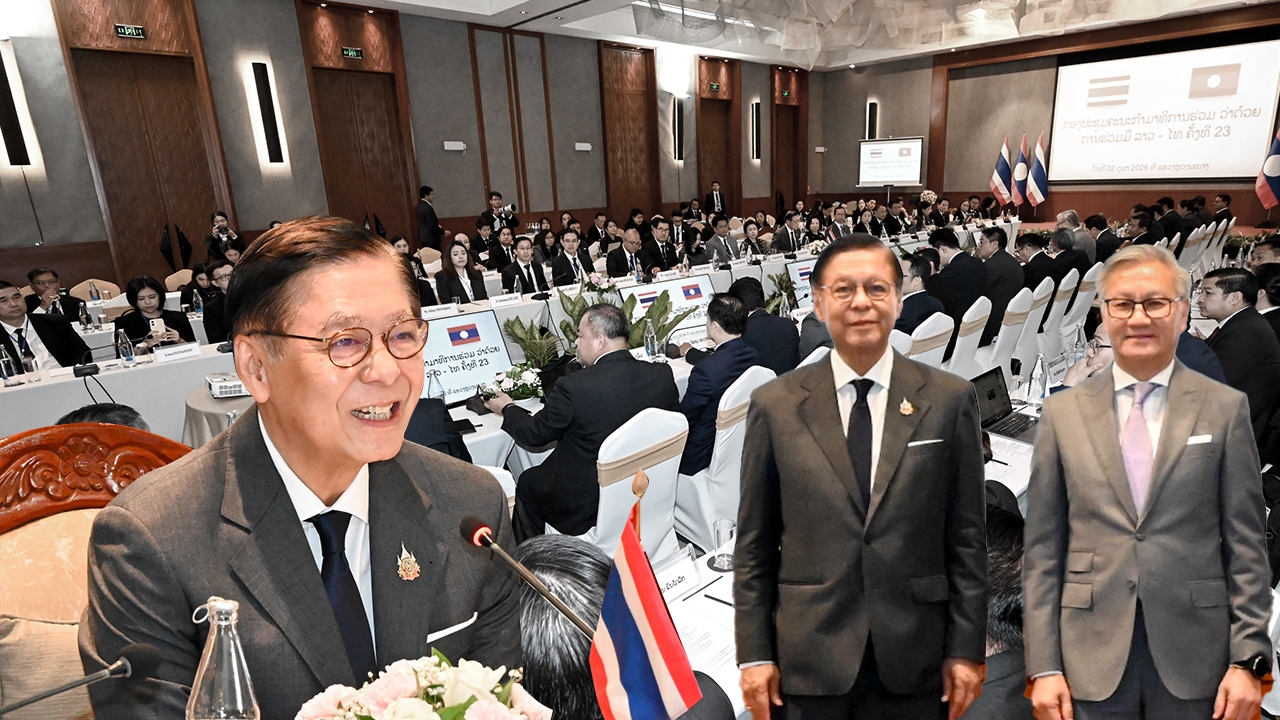
Thailand and Laos held their 23rd JC meeting. Sihasak revealed satisfactory results, promoting comprehensive cooperation to combat drugs and crime, enhance economic and logistics connectivity, and establish twin cities Nan and Luang Prabang, along with building a new bridge. Thailand approved a 1.7 billion baht loan to boost tourism and travel.
Today (2 Oct 2026), Thailand and Laos held the 23rd meeting of the Joint Commission on Bilateral Cooperation, or JC (Joint Commission) 23rd session, at the Pullman Hotel in Luang Prabang, Lao People's Democratic Republic (Lao PDR), with Mr. Sihasak Puangketkaew, Deputy Prime Minister and Minister of Foreign Affairs, co-chairing with Mr. Thongsy Thammavong, Deputy Prime Minister and Minister of Foreign Affairs of Lao PDR.

The 23rd Thai-Lao JC meeting aimed to promote comprehensive bilateral cooperation. Both sides agreed to strengthen their strategic partnership towards shared security and development goals as neighboring countries, through cooperation mechanisms at all levels, especially at border provinces and districts. The cooperation covers three main pillars:
During the meeting, a memorandum of understanding was signed to establish twin city relations between Nan province and Luang Prabang province, announce financial assistance for the Chiang Khan-Luang Prabang bridge construction project, and exchange operational plans for constructing eight Thai-Lao border markers, with Mr. Sihasak and Mr. Thongsy witnessing the signing.

After the meeting, Mr. Sihasak stated that the meeting was highly successful, reviewing overall relations and progress on agreed cooperation. The cooperation between Thailand and Laos covers all areas, reflecting the good relations between neighbors. Thailand's main policy is to promote relations with neighboring countries based on security, progress, and shared future outlooks, including people-to-people relations.
“Therefore, all cooperation aims towards these goals. The important thing is to look forward. The key cooperation is how to ensure border security and progress. This requires addressing challenges such as drugs and transnational crime, with both countries needing to work more intensively.”
Border demarcation is also significant. The Thai-Lao border demarcation has progressed greatly, with over 98% completed. River boundaries may take longer due to shifting river courses and islands.
Regarding border connectivity, five bridges have been built so far, with another under construction: the Chiang Khan-Luang Prabang bridge project, which Thailand is fully supporting. These projects must bring economic benefits, and a key discussion point is how to reduce regulations and improve customs procedures, including ideas for a single checkpoint to streamline processes.
Additionally, digital connectivity will facilitate smoother trade, investment, and other activities.
In the future, energy cooperation will be important. Lao PDR is already a key energy producer with hydropower, transmitting electricity via ASEAN grids from Laos through Thailand to Singapore. It is believed Laos will expand clean energy capacity, including hydropower, solar, and wind. Thailand and Laos should closely cooperate in this area, with a proposal to establish working groups on connectivity and energy cooperation.

After the meeting, the Deputy Prime Minister visited the construction site of the Chiang Khan-Luang Prabang bridge project, which, once completed, will facilitate travel between Nan province and Luang Prabang, a famous tourist destination.
This bridge, approved bythe Cabinet (Cabinet),has been granted financial assistance to the Lao government for construction amounting to 1,783,671,500 baht. It will enhance connectivity between Thailand and neighboring countries, promoting economic cooperation in the Greater Mekong Subregion.
It will boost border trade benefits, expand opportunities for trade between Nan province and Luang Prabang, reduce travel time by at least 30-45 minutes, ease transportation of goods safely across the river, and promote tourism and cooperation in various sectors.

Mr. Chainarong Wongyai, Governor of Nan province, said today that he participated in signing the memorandum of understanding between Luang Prabang and Nan to jointly develop tourism, society, public health, and education, establishing a sibling city and twin city relationship, with plans to promote Nan as a future World Heritage city.
Currently, travel from Thailand to Luang Prabang requires passing through Huai Kon checkpoint and a ferry across the Mekong River, taking three hours. Upon completion, the Chiang Khan-Luang Prabang bridge will make travel from Nan to Luang Prabang more convenient, shorten travel time, increase tourists and vehicles crossing, and strengthen the economy, trade, and investment at the border and along the route.
“Today is just the beginning. Nan province will continue to develop detailed plans for economic, social, tourism, and investment growth.”