

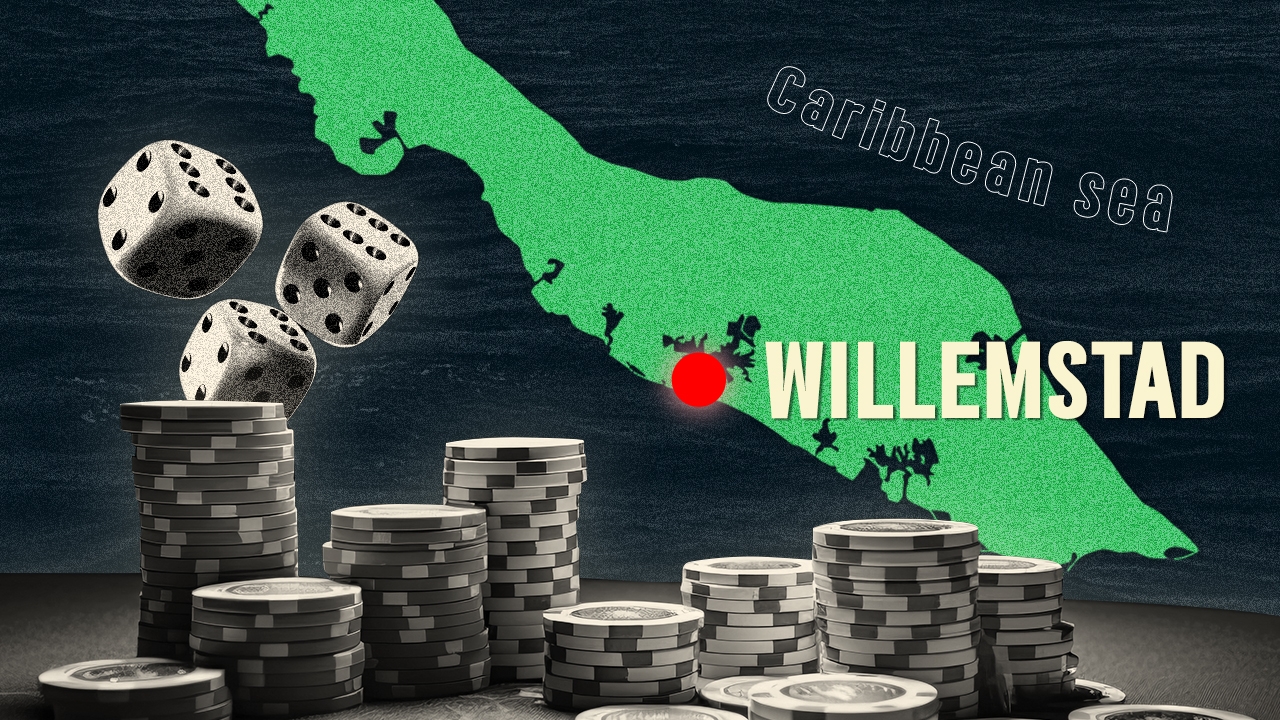
Getting to Know Curaçao, a Small Caribbean Nation in the Caribbean Sea One of the world's leading centers for issuing online gambling licenses, recently linked to the husband of MP Idier Suchada
The country's name "Curaçao" is currently widely discussed online following the case where Mr. Rangsiman Rome, a party-list MP from the People's Party, raised concerns that Mr. Taiyang Sang the husband of Ms. Suchada Sang Thanthap or Idier MP for Chaiyaphum province from the Bhumjaithai Party, might be connected to scammers.
Before October 5a popular Facebook pagerevealed information accusing Mr. Sang of being listed as an investor in Shuffle.com, an online gambling platform accepting cryptocurrency bets. It was found that this website is operated by Natural Nine B.V., a company registered in Curaçao with registration number 160998 and holding a gambling license from Curaçao's regulatory authority, license number OGL/2024/1337/0628.
Most recently, today (6 Oct 2026) Police Lieutenant General Rutthaphon Naowarat, Minister of Justice, gave an interview at the Government House regarding the matter, stating that concerning scammers and online gambling websites, the Department of Special Investigation (DSI) has reviewed preliminary information but no complaints have been filed yet. He encouraged those with evidence to come forward so that if the case falls under Thai law, authorities will expedite action. If it involves foreign jurisdictions, cooperation will be pursued accordingly.
He added, “Regarding the connection to the online gambling website Shuffle.com, it is an online gambling company legally licensed in Curaçao. This licensing is fully lawful under Curaçao’s jurisdiction and outside our operational area. However, if any illegal actions occur within Thailand, the Ministry of Justice and DSI are prepared to take action.”

Curaçao is a small island nation in the southern Caribbean Sea, located approximately 60–65 km north of the Venezuelan coast. The island covers about 444 square kilometers, with its capital named Willemstad.
Historically, Europeans first visited the island in 1499. The Spanish began settling there in 1527, before the Dutch West India Company seized control in 1634. Curaçao was placed under Dutch rule according to the 1815 Treaty of Paris.
Today, Curaçao is an autonomous country within the Kingdom of the Netherlands, alongside the Netherlands, Aruba, and Sint Maarten. It gained separate status in 2010, with independent domestic governance, its own laws, and business regulatory system.
Curaçao has approximately 157,100 residents. Its official languages are Dutch, Papiamento, and English. The currency is the Netherlands Antillean guilder (ANG). Its main industries include refining crude oil from Venezuela and tourism.
Curaçao is one of the world’s leading centers for issuing online gambling licenses. Companies can establish under island law and operate gambling businesses offshore. According to a September 2026 report by The Guardian, Curaçao licenses over 8,000 online casinos. However, holding a valid Curaçao license does not necessarily mean the operation is legal in all countries.
Since 1993, Curaçao has enforced the National Ordinance on Offshore Games of Hazard (NOOGH), which uses a master license and sub-license system. A few master license holders can issue sub-licenses to online casino operators worldwide, lowering market entry costs. However, this system lacked direct government oversight, causing inconsistent regulatory standards.
Starting in 2020, the Curaçao government adopted a policy exempting businesses from taxes on income generated from foreign customers, creating tax benefits for online casinos whose revenues mostly come from international players.
In December 2024, Curaçao enacted a new law called the National Ordinance on Games of Chance (LOK), effective from 24 December 2024. This law abolished the previous sub-license system and established the Curaçao Gaming Authority (CGA) as a centralized regulator responsible for licensing and oversight.
LOK introduced several new measures, including local substance requirements such as maintaining a real office in Curaçao with key personnel based on the island (this requirement's enforcement was postponed until 1 April 2027).
Additional measures strengthened anti-money laundering controls, player protection, and required use of regulator-approved domain names.
Nevertheless, questions remain about the new system's rigor. The September 2026 “Casino Secrets” report by Follow the Money, citing leaked CGA documents, revealed that CGA had issued licenses without verifying whether the declared owners actually controlled the operations. CGA confirmed unauthorized access to its system and disputed some report claims.

Regarding Shuffle.com, it is identified as a crypto casino using cryptocurrency for deposits, withdrawals, bets, and payouts. Its main offerings include online casino games such as slots and live dealer games, as well as platform-specific games and sports betting.
Australian broadcaster ABC News reported on 30 June 2025 that Shuffle operates an office in Melbourne but is licensed and registered in Curaçao. Under Australian law, online casinos cannot legally serve Australian customers.
Data from analytics service Tanzanite indicates that Shuffle processes about $2 billion USD (approximately 67 billion baht) in deposits monthly and has risen into the global top five crypto casinos within just two years of launching.
Many Curaçao-licensed online casinos have been warned by Australia’s media regulator (ACMA) for illegally providing services to Australians. Several such sites have been blocked by Australian internet providers at ACMA’s request.

Sources:abc,theguardian,britannica