

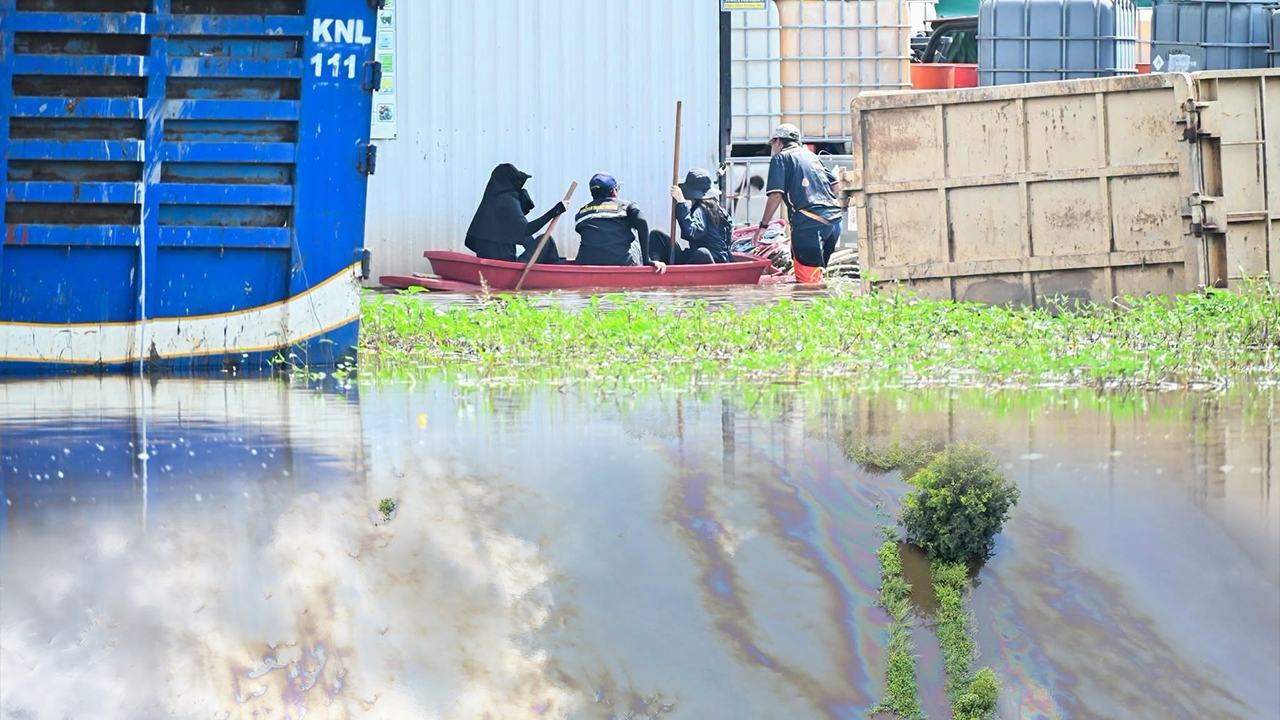
Prachinburi residents suffer yet another misfortune as toxic floodwaters leak, with nominees and transnational Chinese capital seemingly escaping accountability. The Burananivej Foundation observes chemicals surfacing as waters recede, revealing many more toxic factories in the area. They stress it is time to amend the Factory Control Act, as past investigations have never reached the major perpetrators.
The floodwaters in Prachinburi Province have not yet receded, but the so-called “rainbow-colored” pollution mixed with the floodwaters has spread into local water sources, causing concern. The Department of Industrial Works has inspected the site and reported today (15 Oct 2026) that the rainbow-colored contamination in Si Maha Phot District, Prachinburi, has led to the installation of oil containment booms to limit the spread, and the factory responsible has been temporarily ordered to cease all operations.

Pornyos Klankrong, Director-General of the Department of Industrial Works, stated that officials collected water samples from three key points. Overall, pollutant levels mostly did not exceed legal standards. The detected pollutants were at levels unlikely to cause severe or acute harm. Measurements included physical parameters such as color, electrical conductivity, salinity, total suspended solids (TSS), total dissolved solids (TDS), heavy metals potentially toxic long-term, and organic compounds measured by BOD, COD, oil and grease (FOG), and hydrocarbons. However, oil and grease levels exceeded wastewater standards.
Although test results indicate no severe or acute danger, residents are warned to avoid using or inhaling air above the water surface, refrain from ingestion, and avoid prolonged direct contact to prevent possible long-term health effects. The Department of Industrial Works, Prachinburi Provincial Office, and local administrative agencies will continue close monitoring and inspections in the area.

The Thairath Online special team interviewed Phenchom Saetang, Director of the Burananivej Foundation, who said multiple government agencies are collecting contaminated water and affected residents' samples in Prachinburi. The factory at the center is in Si Maha Phot District. The cause is believed to be improper burial of industrial waste and hazardous chemicals or poor storage practices at a recycling factory, coupled with no flood prevention measures, leading to leakage and spreading of pollutants.
The Prachinburi Industrial Office must further investigate the exact cause of the flood-related leakage. It has authority to review documents detailing industrial waste the factory brought into the area and its relation to pollutant dispersion types. The visible rainbow-colored residue mixed with floodwaters is apparent, but some chemical contaminants may be invisible to the naked eye. Current data cannot fully specify all pollutants; detailed official test results are awaited.

It is expected that the rainbow-colored residue originates from petroleum-based oily waste. The company holds a license to recycle used oil waste but handles other types as well. The foundation urges the Prachinburi Industrial Office to disclose this information publicly.
Volatile compounds from industrial waste emit strong odors that, when inhaled, trigger human bodily reactions varying by individual. Symptoms include dizziness, vomiting, fainting, or skin rashes. In cases of heavy inhalation, these substances may affect the kidneys, liver, and hormonal systems.
The recent Prachinburi floods have exposed hidden problems, prompting calls for the Ministry of Industry to address these issues, including amending the Factory Act. Investigations should determine whether nominees are involved, as Chinese capital has increasingly entered Thailand, often via Thai nominees. Establishing factories requires cooperation from officials who facilitate such setups.
Meanwhile, the Ministry of Commerce should enforce stricter controls because current registration systems have many weaknesses. Companies violating laws often use their legal entity status to shield themselves. Thai law heavily protects corporate entities, allowing them to evade liability by declaring bankruptcy or closure without holding directors personally accountable for environmental or public property damage.
In Prachinburi, many factories pose environmental pollution risks, especially recycling and smelting plants.

Many residents question why numerous recycling and toxic waste factories have been established in Prachinburi over the past 3-4 years. Reasons include strong opposition and inspections in places like Samut Sakhon and crackdowns on polluting factories in Chonburi. Local officials may be enabling investors despite community resistance.
The flood and contamination reveal a lack of flood and disaster prevention measures by authorities. Future agencies under the Ministry of Industry must incorporate such units. Authorities should collaborate on plans to eliminate the generated toxic substances.
The new Governor of Prachinburi is expected to oversee and enforce strict measures on these matters. Prachinburi is a key food source and holds historical significance; development should not harm these valuable assets long-term.

Photo credit: Burananivej Foundation