

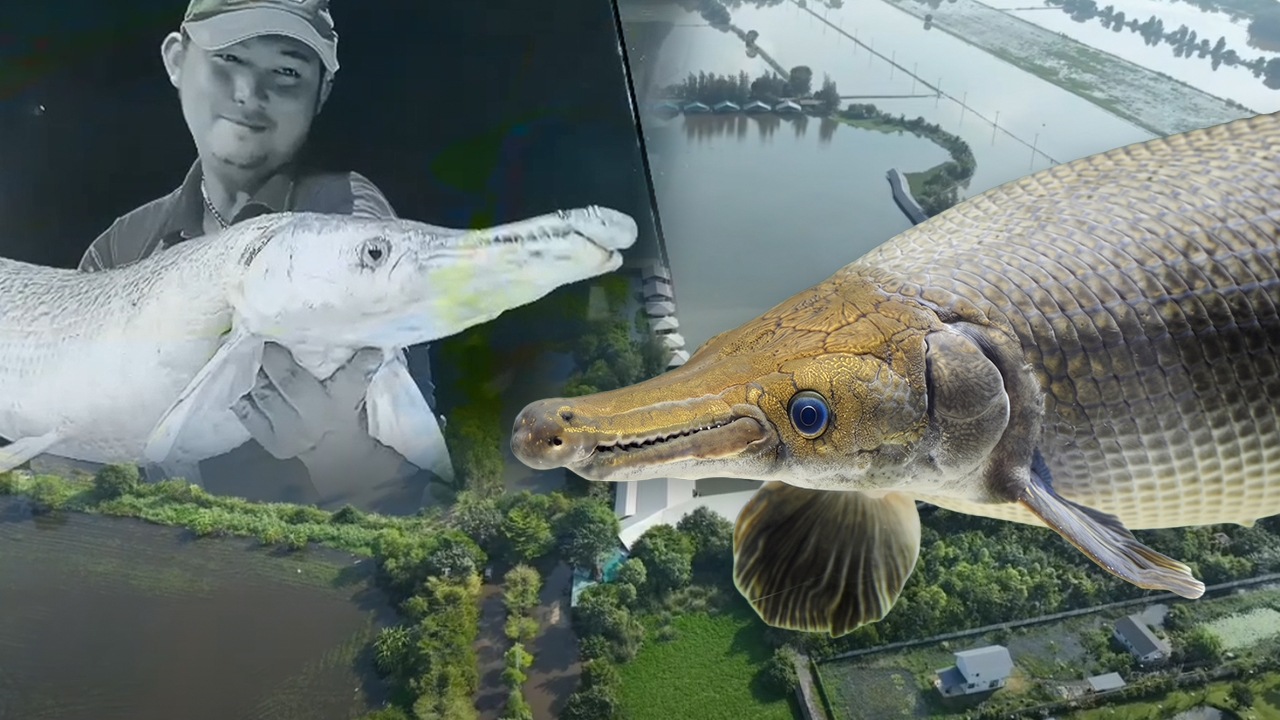
Over 300 alligator fish weighing 3 to 60 kilograms escaped from Bueng Samran in Chachoengsao Province. The caretaker warned that their eggs are poisonous and have spread into natural water sources. More than 30 fish have been bought back at prices ranging from 500 to 1,000 baht each. They appealed to the Department of Fisheries for help in recapturing the fish. Experts noted that improper handling can lead to severe bites with deep wounds caused by their sharp teeth.
Bueng Samran in Bang Nam Priao District, Chachoengsao Province, was completely submerged after nearly four weeks of continuous flooding. Over 300 alligator fish, measuring 2 to 3 meters long, escaped from their pond during the first three hours of flooding as water rushed in, carrying the fish away with the current. The total weight of escaped fish is estimated at 20 to 30 tons. These alligator fish, raised over 17 to 18 years, were almost entirely lost, totaling about 300 fish.

Thairath Online’s special news team contacted a representative from Bueng Samran in Bang Nam Priao District, Chachoengsao Province, who said today (16 Oct 2023) that the alligator fish escaped into natural water sources due to recent flooding entering the pond. When the fish encountered floodwaters, they swam against the current to escape. The pond’s net barrier was insufficient to contain them. Current surveys found escaped alligator fish and Nile tilapia, while other fish species remain intact.
The escaped alligator fish weigh between 3 and 60 kilograms. These alligator fish are usually non-aggressive if left undisturbed. The main concern is that people might consume them, as their eggs are poisonous and can cause itchy skin rashes. The caretaker warned that uninformed people might try to eat them, but these alligator fish are ornamental fish kept for display.
Efforts to capture the escaped alligator fish in natural waters are complicated by ongoing flooding, making it difficult to search in local water bodies. Therefore, an announcement was made offering to buy back any caught fish. Locals who catch fish can return them to Bueng Samran. Recently, villagers caught and returned two fish from Lam Phak Chi area in Chachoengsao Province.

Fish have been caught in areas including Sangkh Santi Suk, Bang Nam Priao, and Lam Phak Chi. These locations are still close to Bueng Samran. More than 30 fish have been bought back so far. Initially, the buyback price was 1,000 baht each. Even though this incurs losses, the pond management continues to buy them back because the fish belong to the pond. Some locals who caught fish agreed to sell at 500 baht each due to the heavy flooding affecting everyone.
The escaped alligator fish can reproduce and spread their offspring, which are preyed upon by other fish when small. Currently, there is a request for the Department of Fisheries to assist in recapturing the escaped fish. They also ask water management authorities to help drain the flooded areas to allow residents to resume normal life.

Professor Dr. Sornnat Sirisue, Faculty of Fisheries at Kasetsart University, stated that alligator fish are predatory carnivores. When released into natural waters, they prey on local animals. Even with several hundred fish escaping, the impact may not be severe or critical because large fish of similar types have historically lived in Thai waters.
Alligator fish cannot reproduce or spawn in Thailand’s natural waters because they originate from America and require cold temperatures and water for breeding. Most alligator fish found in Thailand were imported as juveniles for enthusiasts who enjoy fishing or keeping exotic fish.
Regarding behavior and danger to humans, this species is aggressive. If people try to catch, tease, or handle them improperly, they may suffer severe bite wounds due to the fish’s sharp teeth and large mouth.
Their habitat includes all water types, whether still or in flooded areas, where they can swim and hunt for food.

Although not conclusively confirmed, there are rumors that the flesh of this fish may be poisonous. Therefore, consumption is not recommended.
For the general public, there is no need to panic. If these fish are spotted, they can be caught using methods such as large nets, fishing gear, or spearguns commonly used by locals to fish near bridges.
If left in natural waters, the current will eventually carry them to the sea where they cannot survive in saltwater. Some may remain in rivers and canals temporarily, where they can be captured as needed.
