

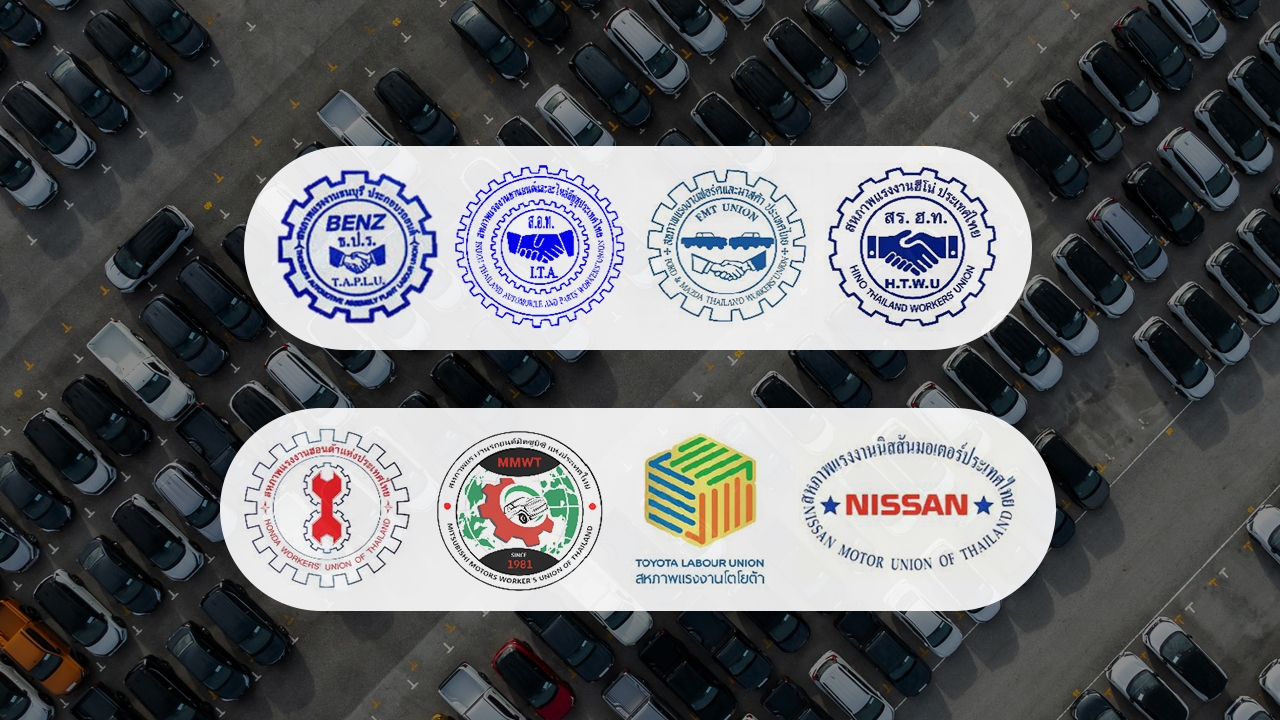
The Thai automotive labor network is preparing to demand the government address the risk of 24% layoffs as imported electric vehicles gain market share. They propose immediately raising excise tax on fully imported EVs to 35-50% and implementing measures to protect the domestic pickup truck production base.
With the arrival of electric vehicles, Thailand's automotive manufacturing industry—which employs many Thai workers—has suffered a significant downturn. Although the labor network previously submitted demands to the government, there has been no clear progress. To have their demands considered and translated into concrete action, 23 representatives from various automotive companies will meet with the government. The meeting, chaired by Mr. Siripong Angkasakulkit, Deputy Minister of Transport, is scheduled for Tuesday, 20 Oct 2026, in the third-floor conference room at the Damrongtham Center, Government House.

Thailand’s automotive and parts industry, a key economic pillar employing over 850,000 Thai workers across the entire supply chain, is facing its most severe crisis in history due to the transition to electric vehicles (EVs), competition from imported cars, supply chain changes, and economic contraction.
Recent statistics show continuous declines in automotive and parts production, with layoffs reaching 24% of the manufacturing sector. Without proactive government measures to address this promptly, many automotive manufacturers may shut down, putting a large number of skilled Thai workers at immediate risk of unemployment.
On behalf of the Thai automotive labor network, we express deep concern over the automotive industry’s situation and labor security. To ensure government support leads to employment, value creation, technology development, and skill enhancement, enabling Thailand to maintain long-term competitiveness, we urgently propose the following measures for the Prime Minister and government to consider and implement immediately.
The government should restructure investment incentives and taxes to clearly differentiate between fully imported vehicles and those produced domestically that create Thai jobs. We propose the government to:
Revise the tax structure for internal combustion engine (ICE) vehicles, hybrid electric vehicles (HEV), plug-in hybrid electric vehicles (PHEV), and domestically produced electric vehicles (EV) to ensure fair and appropriate taxation that reduces cost disparities and promotes fair competition.
Immediately increase excise tax on fully imported electric vehicles (CBU) to 35-50% to create a distinction between imports and domestically produced cars, reducing the cost disadvantage of local production and mitigating ongoing impacts on Thailand’s automotive manufacturing industry. This proposal aligns with suggestions already submitted by the automotive and parts industry.
Review incentives for promoted vehicles by linking them to Thai employment, use of domestic manufacturers, and real value added in Thailand, to encourage manufacturers to invest and build production bases in the country.

Protect and maintain the entire supply chain system.
Raise the Local Content requirement to reflect Thai Value Added, not just assembling imported parts, by requiring at least 70% of parts to be produced in Thailand.
Carefully consider future trade liberalizations under free trade agreements (FTAs), especially the Thailand-EU FTA, to prevent negative impacts on domestic industry and Thai supply chains similar to those seen under the ASEAN-China FTA.
Require EV manufacturers receiving state benefits to develop plans to partner with Thai parts producers and procure components from capable local manufacturers—such as chassis, body, metal parts, and common parts—to enable existing Thai parts producers to enter the EV supply chain and preserve domestic employment.
Prioritize Thai parts producers, especially SMEs and those in existing supply chains, supporting upgrades in standards and technology to meet EV manufacturers’ requirements.
Establish monitoring and evaluation systems for benefits; if recipients fail to meet production, employment, use of Thai manufacturers, or supplier development conditions, benefits should be reduced or suspended.
Thailand must not abandon its decades-old production base, especially pickup trucks, which are a product champion along with their entire parts supply chain, a critical strength of the Thai automotive industry. We propose the government to:
Designate pickup trucks as a strategic product for Thailand’s automotive industry, maintaining production and employment within the country.
Support research and development of HEV, EV parts, and related technologies to enable Thai manufacturers to extend their capabilities into new markets and technologies.
Promote internal combustion engine vehicle production by incentivizing investors through budget support and/or tax measures to keep producing ICE models in Thailand as the last country in the world (using Thailand as a production base during the transition), leveraging existing infrastructure to sustain long-term employment.
Support the replacement equipment manufacturer (REM) parts industry: the government should provide budget and tax incentives to establish Thailand as the regional center for replacement parts for ICE and HEV vehicles, as older vehicles worldwide will still require parts for maintenance over the next 10-20 years, extending the lifespan and income for Thai factories and workers.
Subsidize R&D for hybrid parts by co-funding 30-50% with Thai parts manufacturers to develop components for hybrid systems (HEV), which still use internal combustion engines with electric motors, thereby extending the existing supply chain lifespan.
The industrial transition must not mean workers bear the burden through unemployment, income loss, or skills mismatched to market needs. We propose the government to:
Establish a labor transition fund to support job retention, training, and transition to new jobs.
Provide wage subsidies to traditional automotive and parts factories (ICE/HEV) conditional on maintaining employment and upskilling/reskilling, with labor and union participation.
Develop skills aligned with real labor market needs, not limited to EV, electrical systems, or automation, but also including digital, electronics, advanced manufacturing, quality control, maintenance, logistics, green technology, and new industries.
Create a system to certify workers’ skills and experience to facilitate their employment in other industries.
A just transition means government and employers must share transition costs and not push the burden solely onto workers.
Relax criteria for pickup truck loans (Pick-up Loan). The government should coordinate with the Bank of Thailand and state financial institutions to ease loan approval for commercial vehicles and pickups, for example by subsidizing down payments or offering rebates to customers who pay on time, or a one-year half-payment scheme to boost pickup demand.
Implement a “trade-in old for new vehicles for the environment” program. The government should promote exchanging pickups over 15 years old—which emit high pollution—for newer, fuel-efficient, emission-standard-compliant pickups, including HEVs, with subsidies or VAT/excise tax reductions.
We do not ask Thailand to halt change but to not abandon what has been built. When the state grants benefits, it must create jobs, add value, and restore Thailand’s competitiveness. We do not demand EV makers buy everything from Thais, but we urge the government not to let Thai parts makers who built the automotive industry for decades be cut out of the supply chain just because Thailand is transitioning from ICE to EV. We call on the government to ensure this transition benefits Thailand and its people. Foreign investment must create Thai jobs; parts must add value to Thai producers; technology must build Thailand’s capabilities; and the transition must create new skills and opportunities for workers.
We believe that driving demand through the proposed measures will shield Thailand’s automotive industry from collapse and help preserve this valuable supply chain foundation alongside the economy and Thai workers sustainably.