

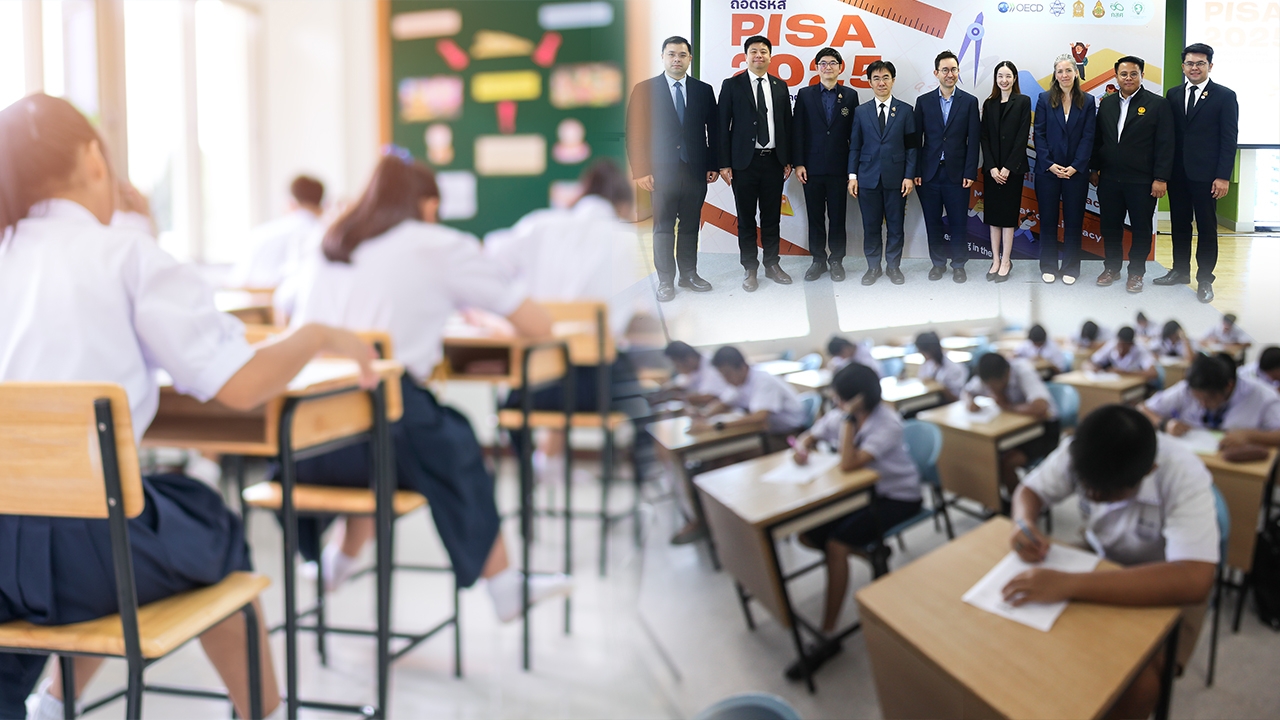
An in-depth look at the PISA 2025 results by the Equitable Education Fund (EEF) indicates that while scores have risen, inequality over the past decade remains stable. Thai students show a low Growth Mindset, and although the number of talented poor children has increased, they still lack opportunities to advance.
Today (20 Oct 2026 GMT+7) The Equitable Education Fund (EEF) Through the Institute for Equitable Education Research (IEER) and the Organisation for Economic Co-operation and Development (OECD), an analytical report on PISA 2025 results was released, focusing on implications for educational inequality and system development in Thailand.
Dr. Kraiyas Pattarawat, Manager of the EEF, said that according to the assessment results, PISA 2025 (Programme for International Student Assessment), Thai students' scores increased in all three subjects—science, mathematics, and reading—compared to the previous 2022 assessment. Science scores rose by 23 points (5.62%), while reading and mathematics each increased by 13 points (3.43% and 3.3%, respectively).

The EEF manager noted that Thailand's PISA 2025 results, especially in science where the country improved 11 ranks to 53rd among 91 countries and economies, up from 64th in 2022,
are a positive sign despite 59.3% of Thai students scoring below basic proficiency in mathematics and reading, and 36.9% below basic proficiency in all three subjects. Only 0.1% of Thai students achieved high proficiency in all three areas. By comparison, the OECD average is 2.6%, indicating Thailand needs to urgently develop skills and abilities to apply knowledge effectively.
The EEF manager added that beyond assessing the three core competencies, the OECD includes a special focus area that changes with each PISA cycle, and for 2025 it was digital learning assessment, measuring computational problem-solving and self-regulated learning skills. These are essential for advancing learning and working in the digital world, including technology fields. Overall, Thai students scored an average of 476, just 24 points below the OECD average of 500, ranking 40th out of 91 countries and economies.
When analyzed by "socioeconomic status", interesting data show that over two-thirds of poor students have proficiency at or above the basic level. This highlights the potential of this group, which, if nurtured and supported continuously, could become "gems" to help fill the technology industry's labor shortage and high demand.

The PISA 2025 analysis also found that 95.5% of Thai students use AI to assist with school assignments—such as summarizing reading materials and aiding learning—higher than the OECD average of 86.3%. However, high AI usage does not always mean higher academic achievement. The key lies in applying AI to enhance learning, foster analytical thinking, and encourage students to build their own understanding rather than just receiving ready answers.
Economic and social inequality remain key factors affecting academic achievement. The assessment found that about 17% of students from the poorest households scored in the top 25% in science. This group is considered academically resilient students, indicating that underprivileged children have learning potential if given appropriate support and sufficient access to educational resources.
This proportion exceeds Thailand's 2022 figure of 15% and the OECD 2025 average of 12%, reflecting the hidden potential of poor Thai students.

According to the PISA 2025 student questionnaire about "aspirations", over 85% of poor students expressed a desire to study and work at levels higher than their parents, rising to over 90% among academically resilient students.
Therefore, if poor students receive adequate support to graduate and pursue better careers than their parents, they will become "replacement generations" for their parents, likely boosting national productivity and enabling social mobility that reduces intergenerational poverty.
Asst. Prof. Dr. Sawaratch Polhan, Director of the Institute for Equitable Education Research (IEER), said inequality has not just appeared in PISA 2025 but is a long-standing trend.
Analyzing the average score gap between the poorest 25% (Quartile 1 or Q1) and the richest 25% (Quartile 4 or Q4) households in Thailand, the gap narrowed by about 11 points compared to PISA 2022, as poor students’ scores increased by 29.36 points while rich students’ scores rose by only 18.53 points.

However, over the past decade (2015–2025), the overall score gap has decreased by only 2 points, a statistically insignificant change, indicating persistent inequality. The recent score improvements mainly reflect recovery from COVID-19's impact on student competencies rather than a real reduction in inequality.
Asst. Prof. Dr. Sawaratch pointed out that while Thai children show high perseverance compared to the OECD average, their Growth Mindset is low at just 36%, lacking confidence that their abilities can change. Additionally, Thai students experience online bullying at twice the OECD average, which may negatively affect their Growth Mindset.
Moreover, Thai students report lower family support than the average, with a decline since 2022, despite family involvement being crucial to learning. Students whose parents interact regularly tend to perform better.
One in three students attend schools with limited resources—insufficient teaching materials, lacking digital resources, or poor-quality resources. Insufficient resources negatively impact science scores; for example, inadequate digital resources lower science scores by over 31%.

Asst. Prof. Dr. Sawaratch emphasized that raising education quality should not focus solely on test scores but on developing a learning system that enables all children to reach their potential, including fostering Growth Mindset, creating safe learning environments, ensuring family and community support, and allocating budgets based on students’ needs and school contexts.
He added that continuous teacher development is essential, linking professional growth to classroom teaching. Appropriate use of technology and artificial intelligence (AI) should be promoted to enhance learning effectiveness without neglecting the development of critical thinking, information literacy, and the ability to evaluate content credibility.
The PISA 2029 assessment will emphasize reading skills, including media and AI literacy, which are increasingly vital in a world where information and technology deeply influence daily life.
Asst. Prof. Dr. Sawaratch stressed that using PISA data to inform policy requires empirical evidence alongside addressing structural inequality to sustainably improve both education quality and equity, ensuring all children genuinely have access to quality learning opportunities.
