

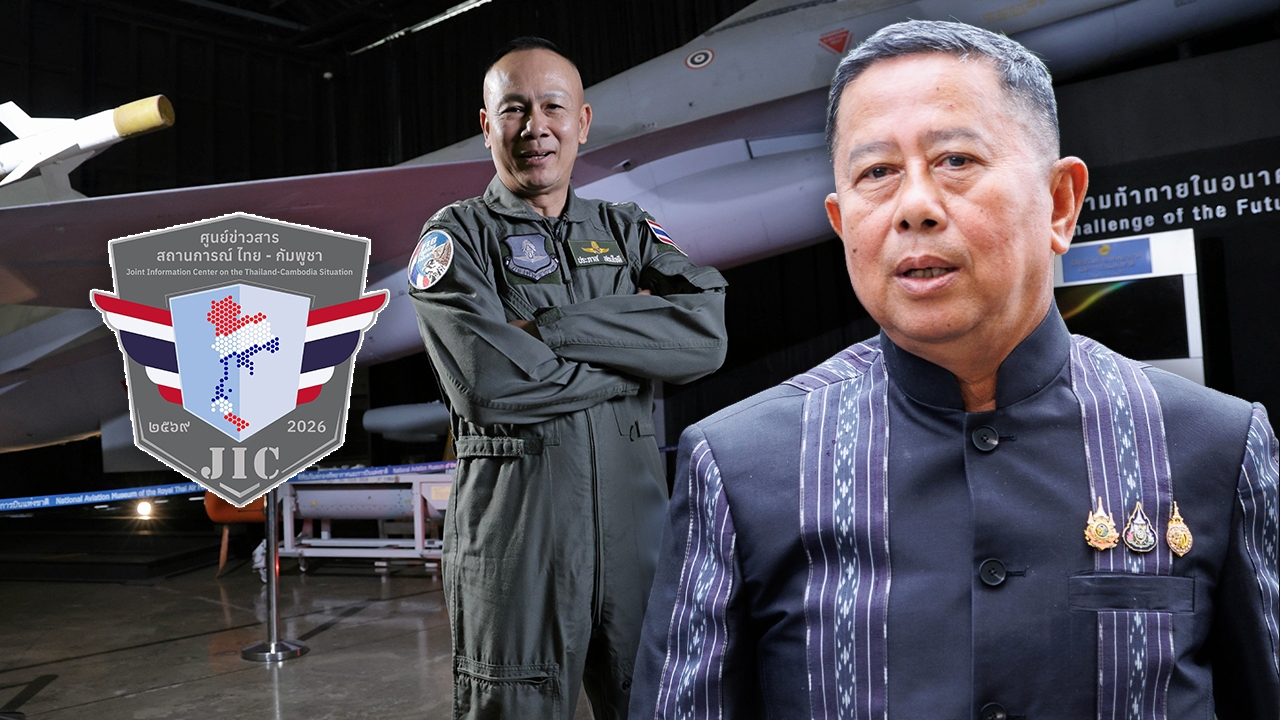
The Defense Minister has tightened control by appointing "Big Ko" to lead the Thai–Cambodian Joint Information Center (JIC), strengthening information efforts in response to opposition censure challenges. Observers watch closely for role divisions to avoid mission overlaps—whether this is an external battle or a move to cover internal issues?"","tags":["defense ministry","Thai-Cambodian relations","information operations","political scrutiny"]},{
The appointment of Air Chief Marshal Praphas Sonjaidee, known as "Big Ko," as head of the new Defense Minister’s task force, alongside his responsibility for communication and directing the Thai–Cambodian border situation information center (JIC), raises notable issues regarding strategic communication, agency role division, and efficient use of public resources.
Military sources note that reports of this task force preparing information for upcoming no-confidence debates mean scrutiny should extend beyond appointment reasons to mission clarity, coordination with existing communication mechanisms, and the outcomes expected from this organizational restructure.
The question remains whether this personnel shift is intended to enhance the state’s communication efficiency and unity or if further explanations on roles, responsibilities, and resources from the Defense Ministry are necessary for public understanding.
The order took effect on 1 Oct 2026 but was only publicly announced on 19 Oct 2026.
The Defense Ministry’s specific order appointing the new task force for the Defense Minister states the appointment is effective from 1 Oct 2026 onward.
However, news of the appointment was published on 19 Oct 2026, eighteen days after the effective date stated in the document.

These two facts should be clearly distinguished: 1 Oct is the effective date of the order, while 19 Oct is when it was publicly reported. The later publication does not automatically imply retroactive signing or legal irregularities.
Nonetheless, the time gap raises questions about why the news was released then, whether the task force began work on 1 Oct, and what activities occurred during that period.
Clear explanations of the timeline and work commencement would help the public understand Defense Ministry operations without prematurely speculating on involved parties’ intentions.

Introducing the nine-member task force.
Based on the names and ranks listed in the order, the new task force comprises:
• Air Chief Marshal Praphas Sonjaidee as task force head
• General Kitti Somsanan as a member
• General Komkrit Rattanachaya as a member
• General Prommongkol Phuengsema as a member
• Air Chief Marshal Nipon Phocharoen as a member
• Air Chief Marshal Ninart Mooljanabat as a member
• Lieutenant General Pornchai Mahalin as a member
• Major General Nopasit Sitthipongsophon as a member
• Rear Admiral Chayut Chat-itsarakul as a member
Reports highlight the task force members' experience in communications, coordination, and preparing information for parliamentary briefings. However, evaluating the task force’s effectiveness should consider role division, workflow, and actual results rather than positions or individual experience alone.

According to Section 2.2 of the order, the task force’s duties include studying information, advising, and making recommendations related to the Defense Minister’s missions, plus other tasks as assigned by the Minister.
Section 3 states that Defense Ministry units and military branches must support the task force’s operations upon coordination.
These statements set a broad operational framework but lack detailed task breakdowns or defined performance indicators within the published text.
Key follow-up points include how responsibilities are divided among task force members, coordination with relevant agencies, reporting systems to the Minister, and measurable targets.
When personnel from multiple agencies support the task force, clearly defined roles are vital to reduce duplication, avoid command confusion, and enable tangible performance evaluations.
The JIC functions as a coordinating body for information on the Thai–Cambodian border situation. It communicates facts to both domestic and international audiences to foster correct understanding, reduce misinformation, and support government communication in sensitive contexts.
In border situations, rapid and unified communication is crucial, as inconsistent information among agencies can confuse the public and affect understanding both domestically and abroad.
The Defense Ministry, Thai Armed Forces Headquarters, Army, Navy, Air Force, and Ministry of Foreign Affairs already have communication missions and channels within their scopes.
Important questions include the JIC’s level of central coordination, who verifies and certifies facts before release, and how conflicting information from different agencies is corrected and communicated uniformly.
If JIC’s role is clearly defined, it could reduce redundancy and enhance government communication efficiency. If unclear, questions about role division and responsibility among agencies will arise.
This issue is not about questioning the need for border situation communication but examining whether the established mechanism performs effectively and integrates with existing structures.
Reports mention preparing information and talking points to handle an expected no-confidence debate against the government, anticipated in late October, referencing Defense Minister Lieutenant General Adul Boonthamcharoen in this context.
Information from news reports should be separated from the appointment order text, which only generally assigns duties to study information, advise, and recommend on the Minister’s missions, without explicitly mentioning preparation for no-confidence debates.
If such a task is assigned, it should be clarified whether it involves compiling facts and ministry achievements to answer parliamentary questions or specifically preparing information to support the Minister’s explanations.
Preparing information for parliamentary scrutiny is one mission, while communicating border situations via JIC is another. Though related by information gathering and verification, their goals and audiences differ.
Thus, responsibilities, workflows, and outcomes should be distinctly separated to avoid mixing security communications with political briefing preparations, enabling the public to fairly assess government agency performance based on facts.
Another important point is the resources supporting the new task force, especially as the order requires Defense Ministry units and military branches to assist operations upon coordination.
The order document does not specify the task force’s separate budget, so there is insufficient data to conclude if the appointment increases government spending or causes duplicate costs.
With multiple agencies providing personnel, questions arise about additional budget allocation, personnel, meetings, travel, content production, and information dissemination costs—what budgets cover these, and how are shared resources managed with existing units?
Also, there should be transparent data on how the Minister’s task force and JIC separate financial responsibilities and what performance indicators evaluate operational efficiency.
Having a new task force does not necessarily mean higher budgets if existing resources are used. Transparency about funding sources, support methods, and verifiable results is crucial for the public to assess necessity and cost-effectiveness with evidence.
- Transparency about timing: why was an order effective from 1 Oct only reported on 19 Oct, and what tasks has the task force performed so far?
- Clarity of authority: how do the Minister’s task force, JIC spokesperson team, and intelligence agencies divide responsibilities?
- Fact-checking: who certifies information before release, and what processes correct inaccuracies?
- Budget and resources: is there additional funding or shared use of existing resources, and what evidence shows cost-effectiveness?
- Measurable outcomes: how much does the new structure improve government communication speed, accuracy, and unity?
A task force coordinating information and supporting the Minister’s work can be beneficial, especially in border situations requiring accurate, rapid communication.
However, the new structure’s effectiveness should be judged not by titles or headcount but by clear missions, speed and accuracy of information, reduction of duplication, efficient use of resources, and verifiable results.
Regarding suspicions about links between the restructure and no-confidence debate preparations, more data on task assignments and actual work is needed; conclusions should not be drawn from appointment timing alone.
Ultimately, the key question is not just who is appointed but how this structure enhances state efficiency, what budget it entails, and what evidence confirms the public benefit of its operations.