

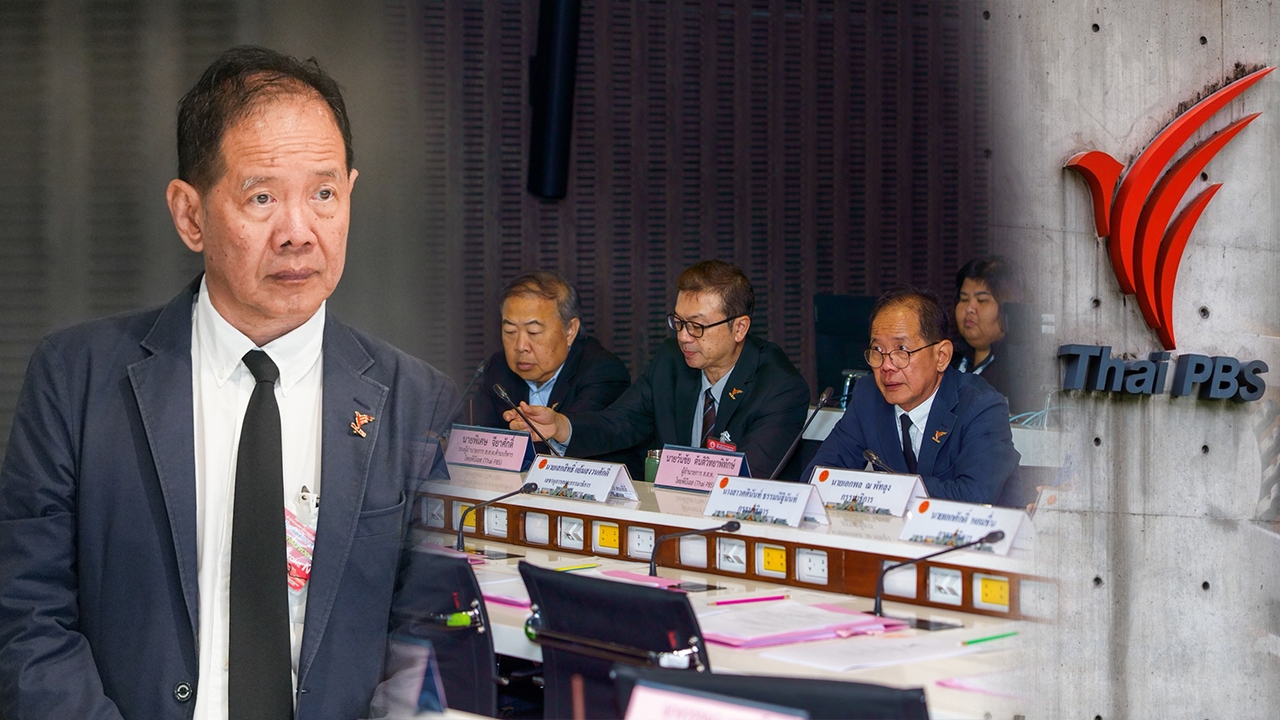
Thai PBS explained to the Political Development Committee on Political Development, Mass Communication, and Public Participation that its existing revenue structure, which uses sin taxes, is appropriate and does not increase fiscal burdens. It emphasized its importance for the independence of public media and expressed concern that changes could affect its role as a voice for the people.
On 22 Oct 2026 at 09:30 GMT+7, the Public Broadcasting Organization of Thailand (PBO) or Thai PBS led by Mr. Wanchai Tantivitayapitak, director of PBO, along with management, presented explanations to the Committee on Political Development, Mass Communication, and Public Participation, chaired by Ms. Pakamon Noon-anun, a party-list MP of the Prachachon Party. The meeting considered the revenue structure concerning proposed amendments to the Public Broadcasting Organization of Thailand Act B.E. 2551 (2008) or Thai PBS Act. Representatives from related agencies also provided information, including directors from the Fiscal Policy Office, Budget Bureau, Comptroller General's Department, Excise Department, Secretary-General of the Council of State, and Secretary-General of the National Broadcasting and Telecommunications Commission.

Mr. Wanchai Tantivitayapitak, director of PBO, explained that Thai PBS was established in 2008 following societal lessons recognizing the limitations of media dependent on advertising and state-controlled media. It was thus designed as an advertising-free media outlet with legal mechanisms ensuring independence to provide news, knowledge, and entertainment, prioritizing the public interest.
After thoroughly reviewing the key points of the proposed amendment, the opinion is that it should not be endorsed for submission to the House of Representatives, for the following reasons and considerations.
Regarding financial burdens and the state budget, The current source of operating funds, though classified as an ear-marked tax, is a surcharge of 1.5% on excise taxes for alcohol and tobacco payers. This surcharge is not deducted from the normal tax base and does not use the annual state budget, thus it does not impose financial burdens on the government.
Conversely, amending the law to have PBO receive funding from the annual state budget would directly increase the government's fiscal burden. This is because it would allocate general tax revenues, which are meant for various ministries and government agencies, to PBO, effectively diverting and fragmenting the overall state budget. Therefore, such a legal amendment would turn PBO's funding into a national budgetary burden.

Regarding cost-effectiveness, The funding ceiling and increased responsibilities: although the additional excise tax fund is capped at 2 billion baht per year (with provisions to request increases if necessary), over the past 18–19 years, while the state budget has grown from 1.66 trillion to 3.8 trillion baht, and government agencies have seen budget increases averaging 40–60%,
PBO has never requested additional budget despite significant expansion in public service tasks such as digital media services, live broadcasts of royal and state ceremonies, media personnel development, research promotion for public media development, and public media duties during disasters and national emergencies. All these additional responsibilities have been managed within the existing funding framework, demonstrating clearly that the capped surcharge funding does not create extra fiscal burdens or impair financial discipline.
Regarding impacts on management efficiency and long-term planning, In the digital technology era, public media operations require investments in infrastructure, innovation, and strategic multi-year content planning. Dependence on fluctuating and uncertain annual budgets directly affects continuity in technology investments and public service, especially in the current environment where communication relies heavily on foreign platforms, leading to significant revenue losses and critical data falling into multinational corporations' hands. Annual budget support would reduce public media agility and its ability to respond to rapidly changing media landscapes.

Regarding intent, independence, and promotion of democracy in a liberal world, The primary intent of establishing the Public Broadcasting Organization of Thailand under the 2008 Act was to create a public media institution independent from state or commercial interference, as clearly stated in the Act. Shifting to annual state budget funding could lead to loss of editorial independence.
Moreover, protecting public media independence directly influences the government's credibility internationally, especially under the principles and standards of the Organisation for Economic Co-operation and Development (OECD), which emphasize good governance, transparency, respect for independent institutions, and support for participatory democracy. This allows citizens to access comprehensive information, promotes equality and fairness, and enables free public discourse, which are core values of survival in the modern liberal world.
Lessons and international standards for public media worldwide show that having dedicated, independent revenue sources outside government budgeting processes is international best practice for leading public media, such as the BBC (UK) and NHK (Japan), which use a TV licence fee system to avoid political government decisions.
PBS/NPR (USA) rely on a mix of federal, state, and local funding plus donations, managed through a semi-private Corporation for Public Broadcasting to prevent executive pressure. ARD/ZDF (Germany) employs an independent external body (KEF) to assess and set media fees, with no government or parliament power to reduce budgets.
International case studies show that countries requiring public media to rely on annual government budgets often face political interference and loss of public trust, negatively impacting the Press Freedom Index, and the country's democratic image internationally.

Regarding protection of vulnerable groups' rights and public participation, Public media have a crucial mission to reflect issues and amplify voices of vulnerable, disadvantaged, and marginalized social groups, often directly affected by expansion of business interests or unfair government power. If public media financial structures depend on annual state budget allocations, this will directly impact the security of protecting rights and cause these groups’ voices to be neglected or unheard in the public sphere.
It is evident that networks of civil society, disadvantaged groups such as persons with disabilities, ethnic groups, journalists, academics, professional media organizations, citizen journalist networks, and the Thai PBS Audience Council have all expressed serious concerns about potential impacts and have widely opposed this proposed legal amendment.
For these reasons, the Public Broadcasting Organization of Thailand believes maintaining the current revenue sources under the existing Act is appropriate, aligns with fiscal discipline principles, does not burden the state budget, and protects public media independence as intended by the law. Therefore, it recommends not endorsing the proposed bill for submission to the House of Representatives.
Thai PBS is ready for audits and operational improvements to ensure budget spending benefits the public effectively. However, any consideration to change the funding source must consider impacts on independence, continuity of long-term missions, and public services that cannot generate commercial revenue.