

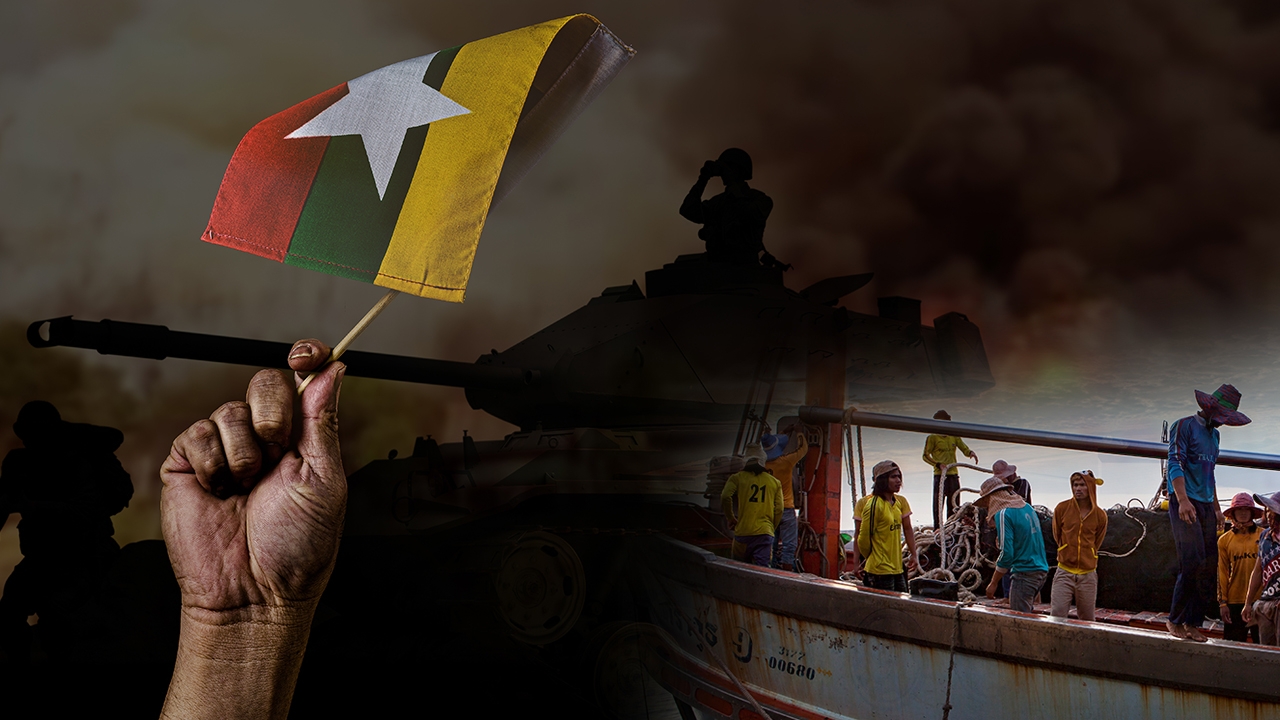
Myanmar war refugees entering Thailand face pressure as the Thai state's system lacks support, ultimately pushing them into informal labor. Each time work permit registration reopens, 300,000 to 400,000 neighboring country workers disappear from the system.
After the latest military coup in Myanmar in 2021, more Myanmar nationals have entered Thailand. Besides coming as workers, many are fleeing war. However, the Thai government has yet to establish a concrete system to care for these groups, resulting in many neighboring country residents falling out of the system when renewing their permits.
At a seminar updating the situation on managing migrant populations in Thailand—covering employment, public health, and education rights—Adisorn Kerdmongkol, coordinator of the Migrant Workers Network Group (MWG), analyzed that there are currently an estimated 5.3 million migrant workers in Thailand, possibly up to 6 million. Among them, 2.7 to 3 million are economic migrant workers, with 73.2% being Myanmar nationals.

Regarding seasonal migrant workers, there are about 5,089 individuals mainly along Thailand's borders, consisting only of Myanmar and Cambodian nationals. With Cambodia now closing its borders, Cambodian workers have disappeared from the system, impacting border agriculture. This shortage began affecting sugarcane plantations in November.
A key challenge for Thailand is managing approximately 1.5 million conflict and war refugees who have flooded in since 2021. They are dispersed along border areas and major cities, including about 70,000 people remaining in nine refugee camps.
There are 5,000 to 10,000 urban asylum seekers hiding in major cities without legal status.
Originally, Thailand managed mostly migrant workers from neighboring countries coming for employment. However, in the modern era, there is an increasing number of people fleeing war. The main problem is that Thailand lacks policies addressing these groups, forcing war refugees to struggle for survival, overlapping statuses as political refugees who must become laborers to live, unable to return home, and residing long-term or permanently in Thailand without options.
A factor driving more neighboring country nationals to Thailand is Myanmar's conscription law targeting youth aged 18 to 35. Those conscripted face life-threatening risks; many are forcibly taken even if they try to stay put. Civil society estimates that about 10% of those conscripted have fled to Thailand, around 2 million people, including workers, students, and small entrepreneurs.
A common issue among Myanmar workers is the use of passport conditions that force interaction or risk contact with Myanmar's military government. For example, obtaining a Certificate of Identity (CI) for migrant workers requires complete documentation and sending 25% of earnings back home through state-designated channels, including paying taxes. Some younger Myanmar nationals feel their taxes fund violence against their people.
Over 90% of Thailand's migrant workers are from Myanmar. While the Thai government demands migrant labor, there is no intermediary to keep workers within the system, causing unclear status for neighboring country populations fleeing war.

Each time work permits are renewed, 300,000 to 400,000 neighboring country workers drop out due to registration problems. Despite having an online registration system, it is not user-friendly; for instance, new migrant workers must have email accounts to access it. Many lack emails or have forgotten passwords, leading them to hire brokers to create emails at a cost of about 1,000 baht each.
Meanwhile, Myanmar's government has tightened passport policies. Thai authorities have urged their Ministry of Labor that if Myanmar continues exploitative policies, Thailand should adopt unilateral management measures.
With increasing numbers of neighboring country nationals, especially Myanmar war refugees, entering Thailand without clear government management as for workers, these people seek temporary safety. For example, along the borders, local village heads issue temporary IDs, but if central authorities intervene, people are arrested. Some become migrant workers, but when renewing passports, they cannot prove their identities or reveal themselves out of fear of control. This reliance on certain authorities complicates border management systems.