

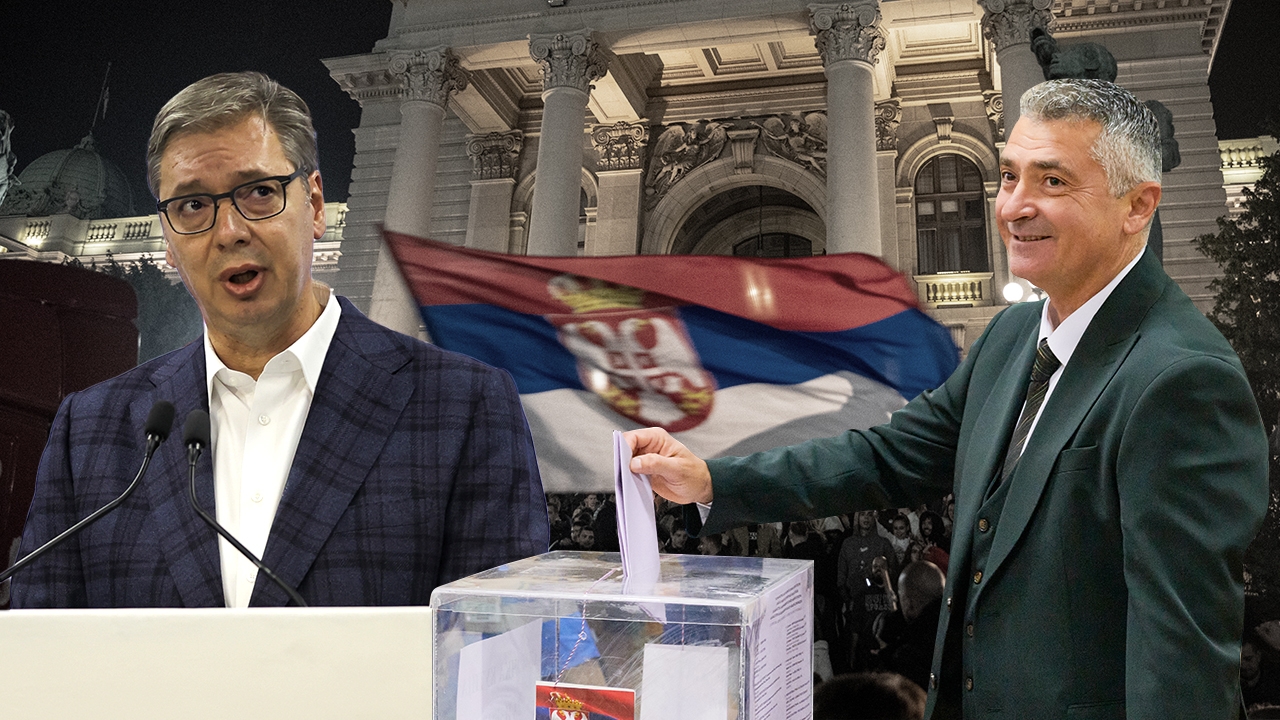
From the streets to parliament: tracing the Serbian student movement's journey as it led anti-corruption protests before winning the election and ending former President Vučić's 14-year rule.
Foreign news agencies report on the political situation in the country. Serbia After nearly two years of prolonged protests, Serbia held an early parliamentary election on Sunday, 25 October 2026, contested between the Student List group (Student List), a grassroots movement led by university students,
and the opposing group, United Serbia, led by the Serbian Progressive Party (SNS) of Mr. Aleksandar Vučić, the former president, who had governed Serbia for over 14 years. He resigned before completing two terms to run for prime minister.
Preliminary results showed the student movement winning decisively with 52.9% of the vote, approximately 141 seats out of 250 in parliament, allowing them to form a majority government on their own. Vučić's group received 38.8%, about 103 seats. The election saw a voter turnout of 68.78%, the highest in more than 30 years.
On the evening of 25 October 2026, former President Vučić acknowledged defeat but expressed dissatisfaction with the election results, claiming they were due tothe 'dirty work'of influential U.S. groups (the deep state) opposing policies of President Donald Trump and several European leaders, adding, "We will see how long these results last."

The protests led by the student movement began in November 2024 after the glass and concrete roof of the Novi Sad train station collapsed, killing 16 people. Questions arose that the incident was not merely an accident but a result of corruption, budget mismanagement, patronage systems, negligence, and poor construction oversight by the government. This sparked protests demanding accountability and integrity, which expanded to broader issues with hundreds of thousands participating.
Over nearly two years, the student movement continuously pressured the political establishment nationwide through demonstrations, blockades, and strikes. Clashes with authorities occurred sporadically. The movement also officially demanded early elections.
On 9 September 2026, President Vučić dissolved parliament, scheduling early elections for 25 October 2026. He resigned on 27 September 2026 to run for prime minister. PBS News noted this was a power-switching strategy similar to Russian President Vladimir Putin's to maintain control.

Meanwhile, the student movement officially announced its election candidates on 14 September 2026 under the name "Student List," comprising individuals from diverse fields including professors, academics, doctors, activists, and laborers, led by Dr. Ilija Srdanović, a cardiology expert and faculty member at Novi Sad Medical School, campaigning on anti-corruption, combating organized crime, restoring media freedom, and improving citizens' quality of life.
Following unofficial election results, Student List supporters celebrated in the streets of Belgrade with dancing, car horns, fireworks, and chants of "victory." A student told reporters, "Serbia is free now. This is a miracle."
Professor Dejan Pavlović, a political science professor at the University of Belgrade, posted on X that the student movement's lack of political experience and absence of involvement in gray-area businesses became their greatest strategic advantage. Conversely, former President Vučić represented "cultural backwardness" as younger generations with their own values entered politics.

Although Student List won the election and formed a majority government, the next challenge is the presidential election scheduled for 27 December 2026. They must also confront Vučić's entrenched political networks and influence across agencies. The student movement must avoid political divisions and handle sensitive issues carefully, such as relations with the European Union and Russia.
Political critic Ivan Milenković warned that Vučić's networks have spread nationwide, making uprooting them a very difficult task.
The Student List coalition did not emphasize any single leader, unlike United Serbia, which highlighted former President Vučić. Prominent candidates likely to become prime minister include Dr. Srdanović, the campaign leader, and Dejan Joskic, former central bank governor,who has voiced opinions on economic reforms and faced heavy criticism from pro-government media.
Source:PBS News,Al Jazeera,ABC News,Reuters,RFERL