

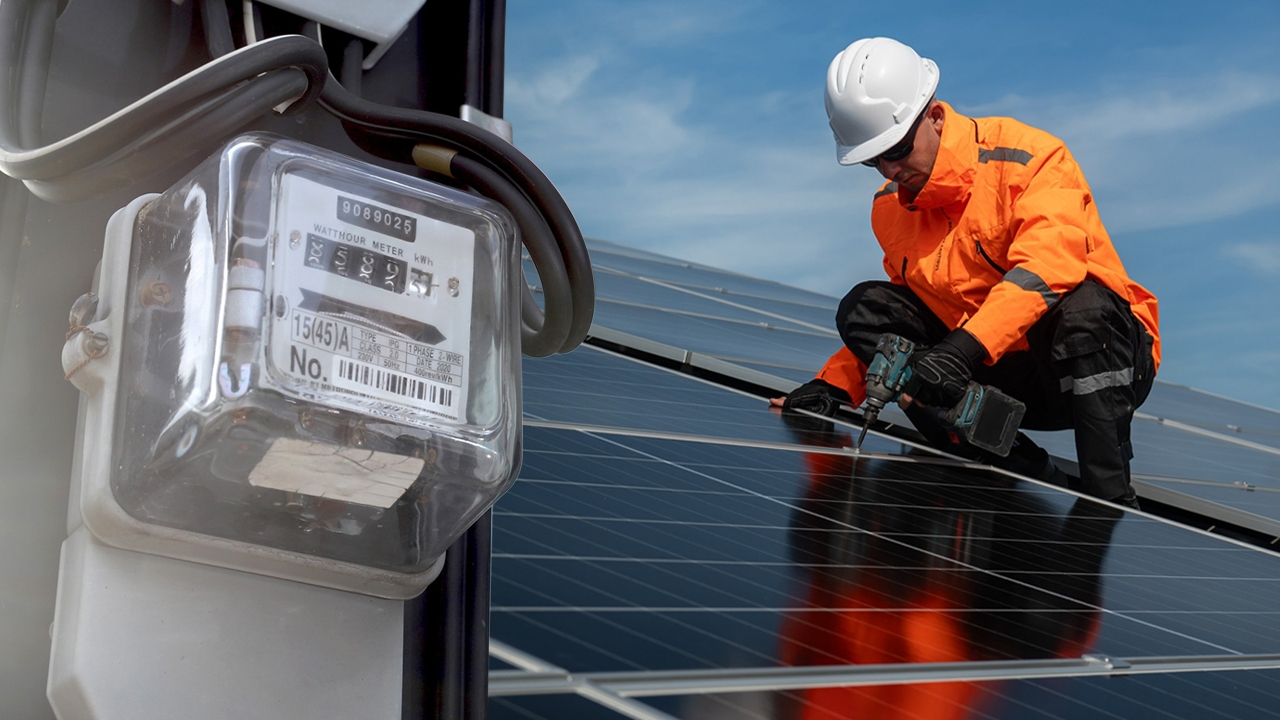
People's solar power program: 5-year payback conditions, which homes should or shouldn't participate. Guidance on checking the "daytime electricity meter"—if usage exceeds 5 units, it's cost-effective. Experts worry about government-set price caps on installation to prevent contractors from profiteering, suggest involving small community installers, and expanding solar panel standards beyond Thai Industrial Standards (TIS) to include international standards.
Today (28 Oct 2026) at the Government House, Pol.Peer Suwanchawi, Deputy Minister of Interior, discussed the People's Solar Power project. The government supports this under the 2026 Energy Crisis and Transition Act, with a total budget of 50 billion baht. It provides a 50,000 baht subsidy per household for installing solar power systems, targeting 1 million households. Citizens can install 5-10 kilowatt Solar Rooftop panels, with the utility buying back up to 5 kilowatts at 2.2 baht per unit.
A 5-kilowatt Solar Rooftop panel can generate 500-700 units of electricity and lasts 20-25 years. So far, more than 56,000 people have registered for the project, with 44,004 in Provincial Electricity Authority areas and 12,000 in Metropolitan Electricity Authority zones.
If a household’s monthly electric bill is about 5,000 baht due to day and night usage, installing a 5-kilowatt solar panel can produce about 500 units. At 4 baht per unit, this saves 2,000 baht per billing cycle, or roughly 24,000 baht annually. Households using less daytime electricity can sell excess power back to the utility, reducing expenses and freeing funds for family needs or business ventures.
For those seeking financing, three state banks—Government Savings Bank, Government Housing Bank, and Bank for Agriculture and Agricultural Cooperatives—offer low-interest loans at 2.5% for up to 7 years. Electricity sales revenue to the Metropolitan and Provincial Electricity Authorities is forwarded to these banks to help citizens repay their loans.

After the project's launch, concerns arose about mostly large companies registering. Thairath Online's special investigation team consulted Associate Professor Dr. Chalee Charoenlapnopparat of Thammasat University's Sirindhorn International Institute of Technology and a consumer council subcommittee member on public services, energy, and environment. He noted the key condition that citizens should know: a 50,000 baht subsidy supports 1 million rights, totaling 50 billion baht, and requires installing at least 5 kilowatts new or additional capacity to qualify.
Additional financing is available at a low 2.5% interest rate through the three state banks (Government Savings Bank, Bank for Agriculture, Government Housing Bank) with repayment terms up to 7 years.
Unused electricity can be sold back to the utility at 2.20 baht per unit during daytime excess production.
“Taking a loan to install solar doesn’t increase daily expenses, because the loan repayments are covered by the electricity savings. After 5-7 years of repayment, the electricity produced is essentially free,” he explained.
Associate Professor Dr. Chalee shared a simple technique anyone can do at home to assess if solar installation is suitable, focusing on electricity use during daytime hours from 10:00 a.m. to 3:00 p.m.
How to test your home meter:
1. Read your home’s electricity meter at 10:00 a.m.
2. Read the meter again at 3:00 p.m.
3. Subtract the two readings to see how many units your home used during those five hours.
Fast payback group (install and succeed): meter runs 5 units or more, such as homes with elderly people, bedridden patients, or those working from home with air conditioning all day. These households use the solar power efficiently and can expect payback in under 5 years.
Slow payback group (think carefully before installing): meter runs only 1-2 units, typical for households where members are away during the day and only return to sleep at night. Because excess power is sold back at 2.20 baht per unit while buying electricity costs 4.50 baht, these homes may take over 7 years to break even.

Though the project seems beneficial, Associate Professor Dr. Chalee pointed out major concerns the government must urgently address.
1. Specification lock-in on TIS-certified panels. The project mandates using TIS-certified panels, but many top global Tier 1 brands lack TIS certification despite high quality and lower prices, limiting citizens’ access to better, affordable products.
2. Excluding small installers by requiring certified network technicians only, preventing skilled small community solar installers from participating.
3. Risk of price gouging. With a target of 1 million rooftops in just over 10 months, hundreds of thousands must be installed monthly, yet few qualified contractors exist, creating a potential cartel or inflated installation prices.
Many may not realize solar installations benefit not only homeowners but also reduce electricity costs nationwide.
Dr. Chalee explained that if the project meets its 5,000-megawatt target, it will significantly reduce expensive LNG imports, immediately lowering average electricity prices across Thailand by 8-12 satang per unit—even benefiting households that do not install solar panels.
The government should consider loosening panel restrictions by expanding solar panel standards to include international certifications beyond TIS.
Work should be distributed to community installers, allowing skilled small installers to register and participate.
Price controls must be implemented, with clear installation price caps to prevent contractors from exploiting the program for excessive profits.