

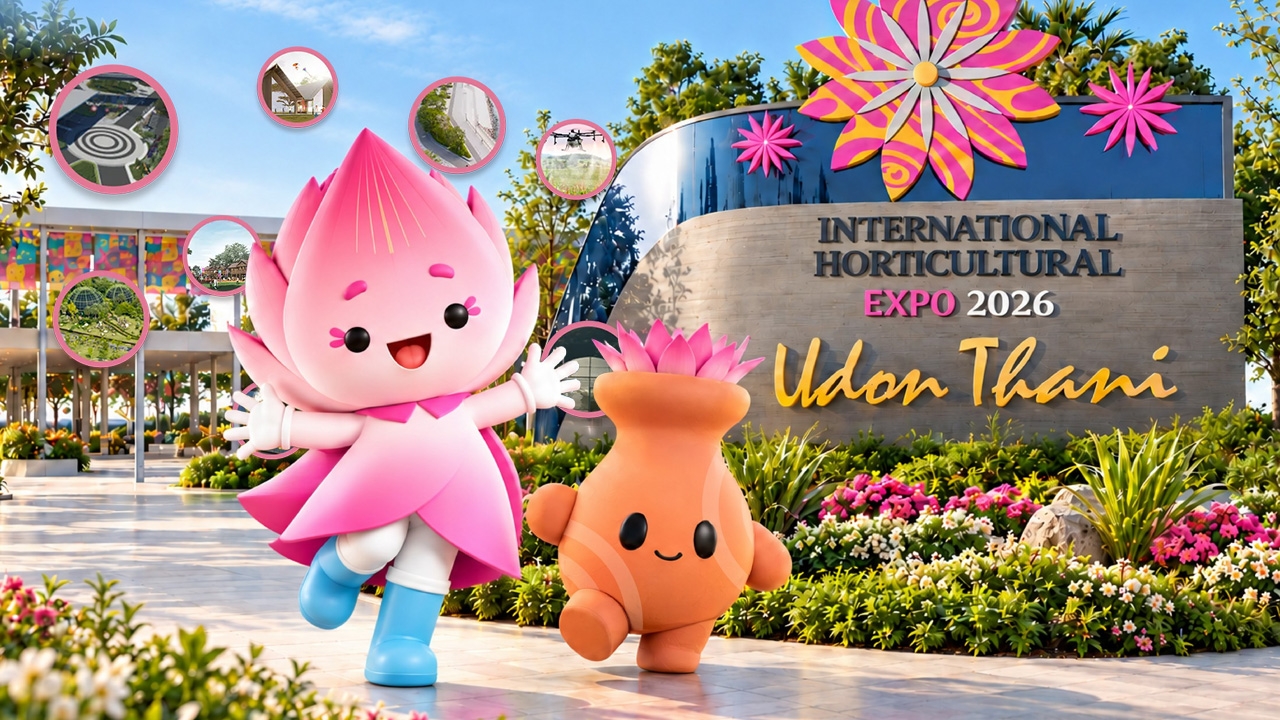
In one day, the Udon Thani International Horticultural Expo 2026 will begin, running from 1 Nov 2026 to 14 Mar 2027. Although organizers confirm their preparedness, there is criticism regarding budget efficiency due to a planned additional request of 250 million baht. Questions have arisen whether this is a duplication of the original 2.5 billion baht budget. Relevant agencies assert transparency, but close attention remains on whether the event will truly stimulate the economy in the Isan region.
The “Udon Thani International Horticultural Expo 2026” is scheduled from 1 November 2026 to 14 March 2027, lasting 134 days, at the Nong Daed wetlands in Kud Sa Subdistrict, Mueang District, Udon Thani Province. The expo covers over 1,030 rai under the theme “The Diversity of Life: Connections Among People, Water, and Plants Towards Sustainable Living.”

The origin of this expo dates back 10 years to a vision by local stakeholders in Udon Thani to transform the Nong Daed wetlands into a large public park and the city’s new green lung. Despite obstacles and long waits, with cooperation from the government, private sector, and an initial government budget approval of 2.5 billion baht, the dream became reality under certification by the International Association of Horticultural Producers (AIPH).
The expo features six main exhibition zones, welcoming visitors with 32 international gardens from 17 countries and two international organizations, 16 leading Thai corporate gardens, and over 50 displays of prominent and rare plants worldwide (such as giant cotton, variegated baobab, and olive trees). Additionally, over one million seasonal ornamental plants will be showcased, alongside spectacular Isan architectural landmarks including jar-shaped buildings (Ban Chiang/Khong), silo-shaped structures, and twin houses. The event aims to attract over 3.6 million visitors, forecast to generate more than 20 billion baht in economic circulation for upper Isan and create over 81,000 jobs.
Although preparations are progressing well, converting this large wetland presents challenges, including soft soil conditions and water management issues at Nong Daed, requiring extensive foundational improvements. Additionally, inflation has increased construction costs.
A major public concern is the request to increase the budget by an additional 250 million baht (about 10% of the original 2.5 billion baht), sparking debate over whether this represents redundant spending, particularly on publicity.
Clarification from the Department of Agriculture: Mrs. Sasina Panthan, Deputy Director-General, explained that the original budget contracts included two parts.
1. The 2024 PR project with a budget of 48.3 million baht (procured via e-bidding).
2. The management and publicity project with a budget of 290 million baht (procured via selection), covering the international gardens and overall management.
The additional 250 million baht budget request arose after the AIPH committee’s site inspection recommended increasing the budget to meet international standards per AIPH requirements. This extra funding is not solely for publicity but also allocated for international garden maintenance, security, utilities, traffic management, and overall site care.
The budget increase request underwent thorough review and was approved by the Cabinet, with endorsements from the National Economic and Social Development Council, Comptroller General’s Department, Ministry of Finance, and the Budget Bureau. Anti-corruption organization observers also monitored all procurement steps to ensure transparency.
The Ministry of Agriculture and Cooperatives and Udon Thani Province recently confirmed the event is fully prepared in all aspects—exhibition space, architecture, transportation, logistics, and security. The additional budget procurement will follow a direct procurement method to allow existing contractors to continue work without interruption before the event opens to international visitors on 1 November 2026.
After the expo, the site will be handed over to the people of Udon Thani and all Thais as a “sustainable legacy,” with Nong Daed developed into a city-level public park, a biodiversity conservation center, and a long-term agricultural and environmental learning hub.