

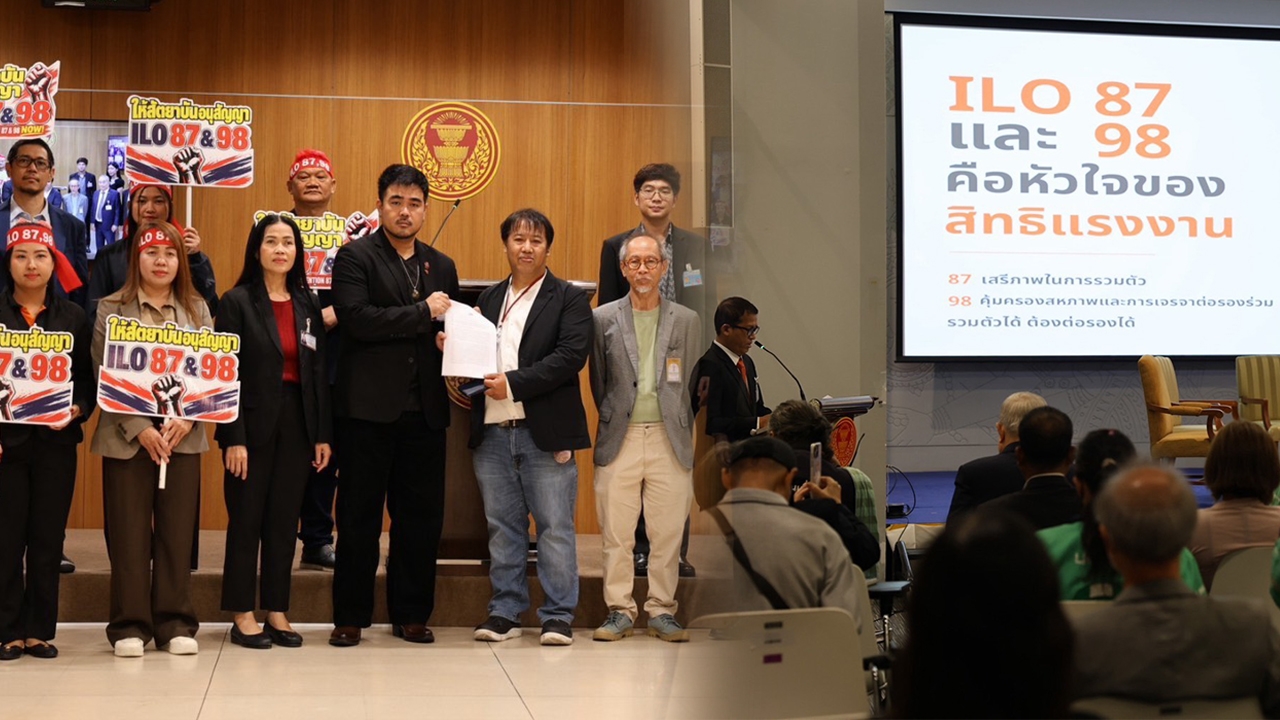
The Migrant Workers Network stormed parliament to submit six demands urging the government to ratify ILO Conventions 87 and 98, pointing out that only 1.3% of Thai workers have access to unions. They emphasized that labor rights are the foundation of the Thai-EU free trade agreement, not a barrier to competition.
30 Oct 2026 GMT+7 The Migrant Workers Network (MWG) In collaboration with the House of Representatives Labor Commission, they held a press conference and submitted a letter to the Labor Commission to promote the People's Draft Labor Relations Act and urged the government to expedite ratification of the International Labour Organization (ILO) Conventions No. 87 on Freedom of Association and Protection of the Right to Organise, and No. 98 on the Right to Organise and Collective Bargaining, at the parliament building.

Mr. Adisorn Kerdmongkol, MWG representative, said freedom of association, collective organization, and collective bargaining are fundamental rights that Thailand is internationally obligated to uphold. Thai workers have continuously urged the government to join both ILO conventions for over 20 years. Although the Thai government has pledged to act and received recommendations from the National Human Rights Commission and progress from the Ministry of Labor, no concrete ratification has occurred.
Mr. Adisorn observed that repeatedly establishing working groups to study feasibility reflects a lack of political will to upgrade labor laws, despite Thailand being a founding ILO member and currently aiming to adjust legal standards to join the OECD.
The Migrant Workers Network submitted six demands for the Ministry of Labor and government to urgently implement the Cabinet resolution dated 26 May 2026 as follows:
1. Set a clear deadline and timeframe to push Thailand to become a party to ILO Conventions No. 87 and 98.
2. Submit proposals to the Cabinet for approval and accelerate bringing the matter to a Cabinet meeting to promptly approve ratification of both conventions.
3. Review and revise domestic laws to align with international obligations and standards, ensuring the right to organize and bargain collectively for all workers without discrimination.
4. Protect migrant workers by setting a clear timeline to recognize the convention on protecting the rights of migrant workers and their families, with the Ministry of Labor as the lead agency. The National Human Rights Commission, employers, employees, academics, and civil society should participate in drafting recognition plans and legal amendments.
5. Open forums for dialogue and participatory processes with labor unions, employer organizations, and civil society to ensure effective implementation suited to the country’s context.
6. Leverage trade opportunities by using negotiations on the Thai-EU Free Trade Agreement and OECD accession as mechanisms to elevate labor rights protection, thereby building confidence in Thailand as a country that genuinely respects human rights and international labor standards.

Mr. David Welsh, Country Director for Thailand at the Solidarity Center, said negotiations on the FTA with the European Union and the OECD accession process present crucial opportunities to push labor law reforms. The government should see this as a chance to raise standards, not as an obstacle to economic development. Although Thailand is a key hub in supply chains, issues of rights violations and unpaid wages persist. Legal reforms should promote freedom of association and hold multinational corporations accountable for labor impacts.
Mr. Welsh proposed five labor law reforms: designate trade unions as the primary form of legal organization; ensure all workers have access to collective rights; abolish labor segmentation by type and employment status; simplify trade union registration procedures; and expand union forms to allow cross-industry membership.
Additionally, he urged promoting industry-level collective bargaining, fostering understanding that strikes are workers’ rights, and addressing lawsuits that silence unions, so workers can exercise their rights without fear of job loss or legal action.

Mr. Natthawut Kasem, Senior Officer at the Environmental Justice Foundation (EJF), said data from the OECD Trade Union Advisory Committee (TUAC), published on 20 Oct 2026, shows only about 1.3% of employed persons in Thailand are union members. This highlights the urgent need to foster environments conducive to unionization and collective bargaining, especially in high-risk sectors like fishing and seafood.
Mr. Natthawut emphasized that protecting labor rights is not a competitive obstacle but the foundation of fair and sustainable trade, enhancing Thailand’s credibility internationally. Ratification of both ILO conventions, alongside effective law enforcement, will raise labor standards and promote responsibility throughout supply chains.

Mr. Sahaswat Khumkhong, Commissioner and Advisor to the House Labor Commission, stated after receiving the demands that calls for Thailand to ratify ILO Conventions 87 and 98 have been made by the labor movement for decades, but each labor minister has set up study groups to delay action, despite Thailand being a founding ILO member.
“Negotiations for OECD membership and the Thai-EU FTA will make these two conventions a condition imposed by the international community. It is time for the government to stop using the excuse that domestic laws must be amended first before ratification, because Thailand ratified ILO Convention 188 first, and then ILO sent representatives to assist in law reform afterwards.”
Mr. Sahaswat further clarified that concerns about migrant workers joining unions affecting national security are untrue, as union formation must comply with Thai law and affirms fundamental rights. This is unrelated to illegal workers, mafia, or shadow capitalists. Similarly, Thai workers abroad receive union support in host countries. The claim that investors would relocate production bases is also false, since tax policies and infrastructure are the main investment factors, not labor rights.