

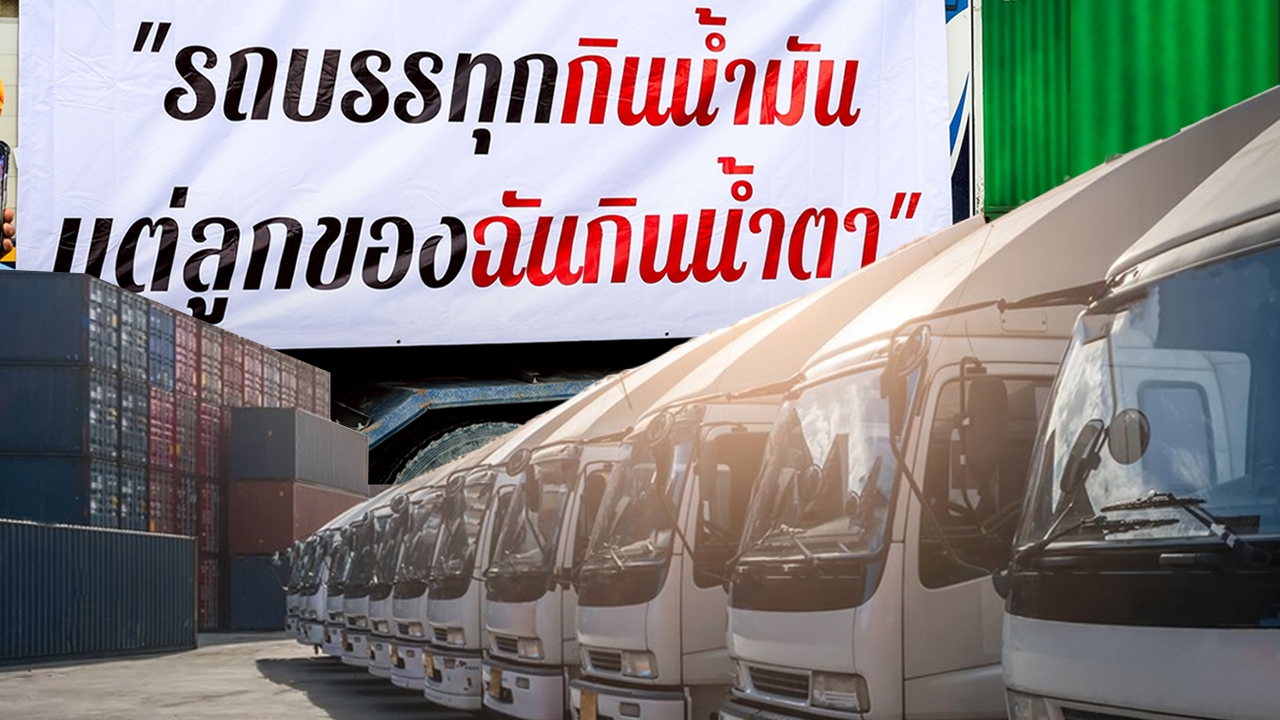
"High fuel prices" lead to price reductions, but B20 diesel fails to meet needs. The Transport Federation urges the Energy Ministry to restructure pricing after the burden of B7 diesel costs becomes unmanageable. They point out a covert price increase of nearly 20% during the floods. Tomorrow (4 Nov 2026), they will submit a letter of demands. If problems persist, the "truckers' protest" plans to escalate by storming Government House.
The Land Transport Federation of Thailand, along with a coalition of 13 associations, is preparing a symbolic rally to highlight distress over fuel prices and demand concrete government action on 4 Nov 2026 at the Energy Ministry. Despite previous proposals to resolve transport operators' issues nationwide, energy costs have not decreased.
Although the government has implemented measures to reduce prices for B20 diesel—a blend of 20% palm oil biodiesel with 80% regular diesel—operators still feel it is unsuitable for practical use.

Thairath Online's special team interviewed Dr. Thongyu Kongkan of the Land Transport Federation of Thailand, who explained that the government's push for B20 use does not align with real-world conditions and fails to address core problems for several key reasons.
Actual B20 consumption is far below targets. The government aimed for 10 million liters per day, but nationwide usage is only about 3 million liters daily. Reports citing 6–7 million liters are inaccurate compared to the total diesel demand of 40–50 million liters per day, or 60–70 million in a strong economy, showing B20’s share is minimal.
Current B20 users are mostly farmers’ water pumps and tractors, not freight trucks.
Using B20 triples maintenance costs compared to B7 diesel. Trucks using B7 change fuel and oil filters every 15,000 kilometers, but with B20, checks and filter changes are required every 5,000 kilometers, tripling maintenance expenses for operators.
Moreover, vehicle manufacturers and sellers refuse to issue warranties covering engine damage from B20 use, stating they follow government policy but do not accept liability if engines fail.
Truck drivers report that engines run sluggishly and horsepower noticeably decreases with B20, making them reluctant to use it.

Dr. Thongyu says that although B7 diesel—the primary fuel for transport—has dropped to about 42.59 baht per liter from roughly 43.95 baht, it remains too expensive for businesses to absorb.
During the floods, diesel prices were illicitly raised by nearly 8.20 baht per liter, a spike of almost 20% without justification.
Previously, diesel accounted for 45–48% of total transport costs, but recently it surged to 65%, severely hurting operators.
Operators cannot raise freight charges for key clients, such as agricultural product transporters (rice, sugarcane, cassava), because farmers already face low commodity prices. Increasing fees would harm farmers, forcing operators to share losses.
Mixing expensive palm oil to reduce excise tax and selling cheaper fuel shifts subsidies to the oil fund, effectively "taking from one pocket to fill another," failing to offer a long-term solution. The date and forum for submitting demands at the Energy Ministry have been set.

Dr. Thongyu said that on 4 Nov 2026, the federation will deliver nine demands regarding energy price structure to the Energy Ministry. They will facilitate participant registration, distribute federation shirts, provide lunch, drinking water, and mobile toilets, ensuring no disruption to official premises.
The federation has planned a two-phase approach to their actions, considering the country's situation.
First phase (during the royal funeral): respecting the solemnity, the federation will act peacefully with letter submissions and educational forums only.
If by 21 December the government remains unresponsive with no concrete solutions, the federation will escalate by leading trucks to blockade Government House—marking a historic first for trucker protests.
Diesel fuel is a fundamental energy source vital to people's lives directly and indirectly—transport, agriculture, and industry. The government must decide whether to stand with suffering consumers or side with capital interests.