

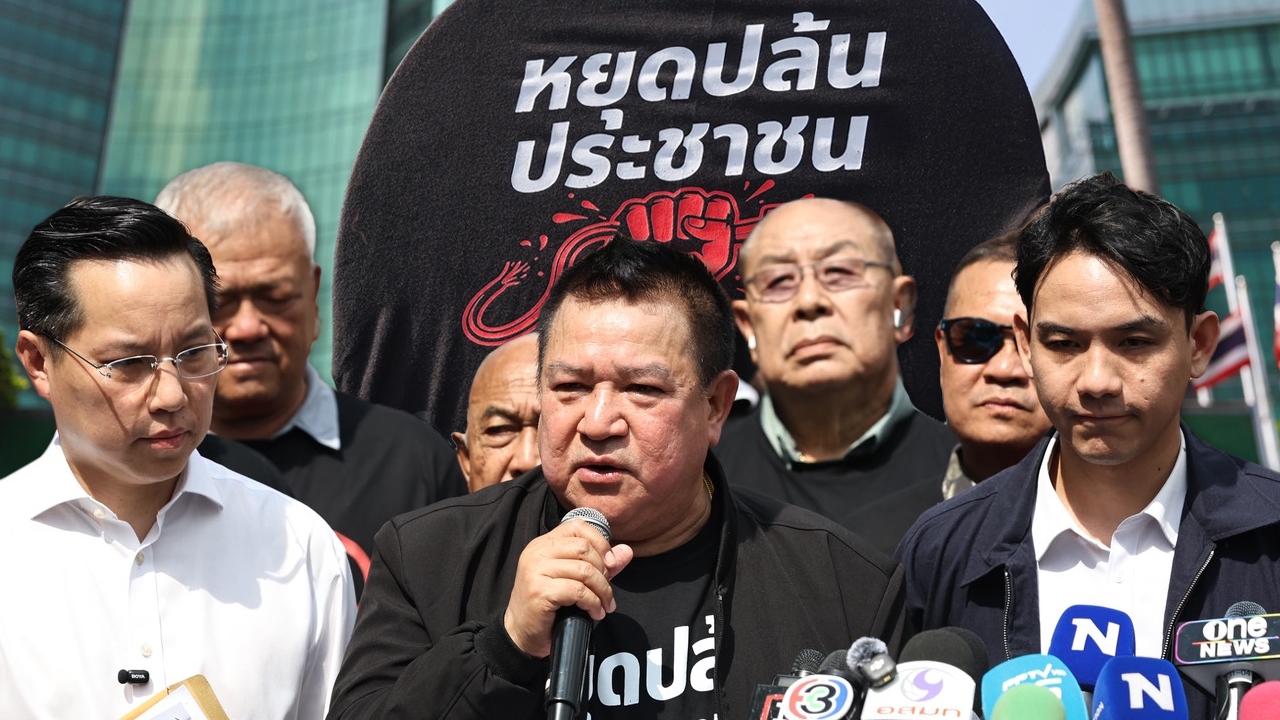
The Transport Federation has submitted 10 demands to eliminate phantom costs and fix diesel prices at 35 baht per liter. The Energy Ministry explained that cutting excise tax risks creating a binding debt that must be repaid over the long term.
Today (4 Nov 2023), representatives from the Land Transport Federation of Thailand, along with 13 allied associations and affected citizens, visited the Energy Ministry to follow up on the energy crisis. They had previously submitted a letter to the Prime Minister.
Dr. Thongyu Kongkan, chairman of the Land Transport Federation of Thailand, said the government raised oil prices by up to 8.20 baht, nearly 10 baht per liter, during the severe flooding. This caused heavy hardship for the public and operators due to rising transport costs and living expenses.
This round of demands was expanded to 10 points. The federation submitted a letter to the Energy Minister with four additional demands, totaling 10. They also sent a letter to Dr. Attawit Suwanpakdee, deputy leader of the United Thai Nation Party, asking him to question the government in parliament about solutions to these hardships.

A key issue is demanding accountability for the "masked man" and the fuel fund's negative balance. The four additional demands focus on urging the government to investigate the "masked man" involved in the disappearance of at least 700 million liters of oil, and to address the fuel fund's deficit exceeding 100 billion baht. The federation sees this fund as public money needing responsible management and calls for stopping policies that benefit energy conglomerates.
The federation set a deadline for the government to resolve the issues by November to December. If no clear response or action is taken on all demands, the federation plans to escalate protests after the royal ceremonies end in December, possibly organizing a convoy of 500 to 1,000 large transport vehicles into Bangkok.
The federation criticized the government's measures as misdirected and expressed suspicion regarding the "masked man" and the fuel fund. They viewed the government's excise tax cut on B20 fuel as ineffective, since B20 consumption is only about 3 million liters per day nationally, making a boost to 9-10 million liters unlikely. Most benefits go to the fuel fund, with little gain for the public. Meanwhile, the ministry's claim that adjusting the "phantom cost" is a new structure in 22 years is only a minor issue and fails to address the core problem that has long caused losses and benefited energy conglomerates by tens of billions of baht.

At the Energy Ministry, Mr. Pongpol Yodmuangcharoen, spokesperson, and Thitiphat Chotidachachain, secretary to the Energy Minister, received the letter. Mr. Pongpol told protesters that while the transport sector and public face severe high oil prices—diesel hitting 42.54 baht per liter—and demands to cut prices to 35 baht per liter, the ministry invites society to consider the long-term impacts if excise tax cuts are implemented universally.
To reduce diesel prices—the country's highest volume fuel—from 42.54 baht to 35 baht per liter means cutting about 7.50 baht per liter. Such a cut requires eliminating the current 7.44 baht per liter excise tax entirely.
Financially, all Thai people—including non-oil users—would share a binding debt burden of up to 180 billion baht annually.
The government questions whether the majority of citizens, who do not directly use oil, would accept such a long-term debt burden.

The ministry emphasized that citing past financial burdens, such as excise tax compensation in 2022, is not to blame previous governments but to analyze real data collaboratively to seek sustainable solutions.
Therefore, the government focuses on seriously and permanently reducing dependence on imported energy—both fuel and electricity—to prevent the country from falling into cycles of policies that create long-term debt burdens.
