

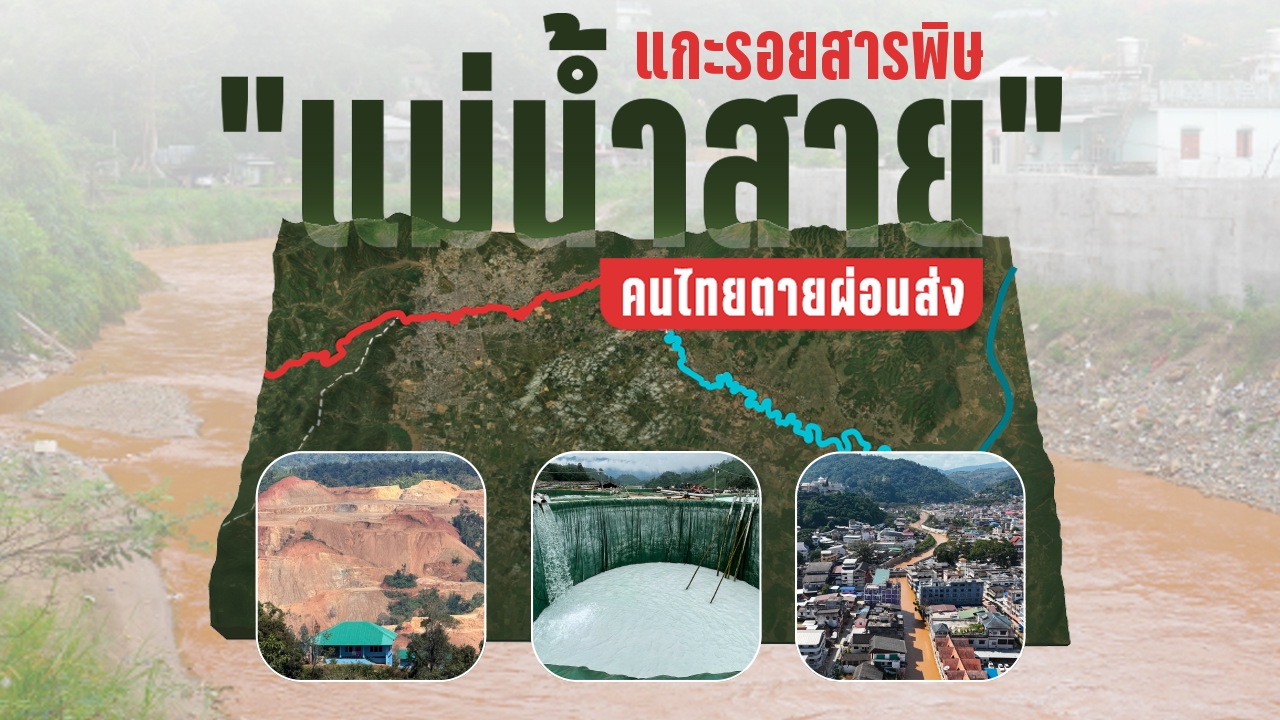
Tracing toxins in the Sai River shows that Thais are dying gradually after arsenic contamination was found up to 28 times higher than the standard, with turbidity too high for water treatment systems to handle. The source is linked to gold and rare earth mines in Myanmar, which expanded rapidly after the military coup, becoming a main rare earth production base for China.
On 5 Nov 2026, the Mae Sai branch of the Provincial Waterworks Authority (PWA) detected unusually high contamination levels in raw water that exceeded standards, forcing a reduction in production capacity to 60%, impacting many local residents.
Komsan Sanma, manager of the Mae Sai PWA branch, explained that raw water pumped from the Sai River showed abnormal turbidity, with initial tests revealing arsenic levels exceeding standards and turbidity reaching as high as 14,000 NTU, exceeding the water treatment system’s capacity. Normally, turbidity ranges from 800 to 1,000 NTU in the dry season and 3,000 to 6,000 NTU during floods.
Piyanuch Truangkham, director of the Environmental and Pollution Control Office 1 (Chiang Mai), stated that monthly water quality tests found that in early August, contaminant levels in the Sai River peaked at 28 times above the standard before gradually dropping to an average of 0.012–0.017 mg/liter, still considered high. The contamination results from rain washing chemicals from upstream into the river.
Residents in Ban Tham Pha Chom, Mae Sai district, expressed concern that locals along the Sai and Ruak Rivers have stopped consuming fish and aquatic animals from the wild, instead buying farmed fish. Additionally, groundwater pumping causes skin itching. When the tap water turns cloudy red, many families avoid bathing and have to spend money buying bottled water for temporary use.

Data from the AI CARE Research Cluster at Naresuan University reveals arsenic tests from 22 rounds between Apr 2025 and Sep 2026 all exceeded standards, with the highest level recorded in August 2026 at 28.4 times the limit at Ban Hua Fai station, Mae Sai subdistrict, Mae Sai district, Chiang Rai province.
The source of this arsenic is estimated to be mining activity in Myanmar, the Sai River’s upstream origin, where 62–73% of arsenic detected comes from sulfide mines such as gold mines, while 27–38% comes from rare earth mines.
The arsenic is mainly carried by suspended sediments or turbidity (averaging 69% of total arsenic). Therefore, arsenic levels increase during floods when heavy soil erosion and mining waste in upstream mining areas scour the riverbed sediments containing arsenic, carrying them downstream. This explains the August peak at 28 times the standard. The maximum reached 28.4 times the limit. In the dry season, levels ranged from 1.4 to 3.1 times, and during the rainy season (May–September) from 1.7 to 5.5 times.
However, this analysis estimates arsenic sources by comparing chemical characteristics of samples from four mines and cannot confirm that all arsenic in the river comes from mining, as some arsenic sources remain unidentified.

Information from the International Crisis Group — a global non-profit focused on conflict prevention — states that since the 2021 coup, rare earth and gold mining industries in Myanmar have grown rapidly. In Kachin Special Region 1 in northern Myanmar, rare earth mining area expanded from 16.22 sq km in 2018 to 35.65 sq km in 2025.
Meanwhile, in Shan State — the source of the Sai River — although the rare earth quality is lower, southern areas controlled by the United Wa State Army (UWSA) and allies such as Mongla have seen mining areas triple between 2024 and 2025. Eastern Shan State also shows rapid expansion of gold mining.
The main driver behind this mining expansion is the soaring global demand for rare earths used in clean energy industries, high-power magnets for electric vehicle motors and wind turbines, and military applications including navigation, missile guidance, and air defense systems.
Additionally, ongoing civil war after the 2021 coup has allowed ethnic armed groups to seize and control mining areas, using them for revenue to build influence and as strategic bargaining chips in the region.

Added to this, China has tightened environmental laws and shut down heavy rare earth mines in Jiangxi and Yunnan provinces since 2016, prompting Chinese operators to move mining across the border to Myanmar, especially areas controlled by ethnic armed groups with little environmental enforcement. Myanmar has thus become China’s largest source of heavy rare earth raw materials.
China sends chemicals across the border to mine in Myanmar, then transports concentrated rare earth ores back to China for smelting and processing, controlling the entire supply and refining chain while environmental damage occurs outside China. Exports to China grew from $1.5 million (about 51 million baht) in 2014 to approximately $780 million (about 26.5 billion baht) in 2021.
Arsenic is a metalloid found naturally and from human activities. It can enter the body through drinking contaminated water or consuming food with arsenic, or through prolonged skin contact with contaminated water, though skin absorption is lower than ingestion. High short-term arsenic exposure can cause acute poisoning symptoms such as nausea, vomiting, abdominal pain, diarrhea, numbness in hands and feet, muscle cramps, and can be fatal.
Long-term arsenic accumulation causes chronic poisoning with symptoms including patchy skin discoloration, hard nodules on palms and soles, muscle weakness, anemia, white lines on nails, and increases risk of skin, lung, and bladder cancers.
On 3 Nov 2026, the Department of Disease Control reported urine tests from 2025–2026 along the Kok River and tributaries, Sai River, Ruak River, Mekong River, and Salween River found arsenic contamination exceeding standards from mining in neighboring countries, affecting seven provinces: Chiang Mai, Chiang Rai, Mae Hong Son, Loei, Nong Khai, Bueng Kan, and Nakhon Phanom.

In 2026, 10,711 people were screened and 1,269 urine samples collected.
Ninety-four individuals had total arsenic levels exceeding reference values. In Chiang Mai, 101 people were tested; 7 had total and inorganic (toxic) arsenic above reference values, a sixfold increase from 2025 when 40 were tested and none exceeded limits. In Chiang Rai, 549 were tested; 31 exceeded total and inorganic arsenic reference values, up from 7 out of 322 tested in 2025. In Mae Hong Son’s Salween basin, 99 were tested; 17 had elevated total arsenic and 2 had elevated inorganic arsenic. In four northeastern provinces in the Mekong basin in 2026: Loei tested 76 with 6 exceedances; Nong Khai tested 177 with 17 exceedances; Bueng Kan tested 108 with 6 exceedances; Nakhon Phanom tested 159 with 10 exceedances.
Talks with Myanmar government to address cross-border toxins On 10 Nov, Suchat Chomklin, Minister of Natural Resources and Environment, said that during a meeting with Senior General Min Aung Hlaing, Myanmar’s President, a Terms of Reference (TOR) was established between the permanent secretaries of Thailand’s and Myanmar’s Natural Resources and Environment Ministries. The TOR addresses the issue on two levels: nationally through cooperation among foreign ministries and all sectors, and at the end of November, a joint working group meeting on border river water quality management will include Myanmar and Shan State representatives.
On 12 Nov, Sihasak Phuangketkaew, Deputy Prime Minister and Minister of Foreign Affairs, visited Myanmar, paying respects to President Min Aung Hlaing and meeting Myanmar’s Foreign Minister, Defense Minister, and Chair of the National Unity and Peace Negotiation Committee.
After the visit, the Foreign Minister said river pollution was a key discussion topic following worsening contamination in the Kok and Sai Rivers. Thailand used the opportunity to accelerate cooperation processes, with Myanmar responding positively. Both countries scheduled the joint water quality management meeting for 25–26 Nov, earlier than previously planned.
He then inspected the raw water pumping station at the Mae Sai PWA branch near Hua Fai, where the Sai River water remained cloudy red. The PWA continued producing and distributing water normally. Je-sed stated that Mae Sai’s water production still prioritizes safety. Officials were ordered to closely monitor water quality. If abnormalities in water color or test kit results show contaminants exceeding limits, production will be stopped immediately to prevent toxins entering the system. Backup water reserves will be distributed temporarily, especially ensuring sufficient supply for local hospitals. The Ministry of Interior has two plans: short-term is to draw water from the Koh Chang pumping station, which sources from the Ruak River, to supplement production; long-term is to accelerate construction of a pumping station from the Mekong River in Chiang Saen district to become the main water source, expected to begin supplying Mae Sai early next year. Coordination with the Royal Irrigation Department will speed surveys and sourcing of new reserves.
However, public concern remains over potential contamination from other water sources. Agricultural areas along the Sai River in Mae Sai still have some farmers pumping river water to irrigate vegetables for daily market sales, raising worries about arsenic or toxin residues in produce. Sources: ai-care-research,
crisisgroup,

ddc.moph