

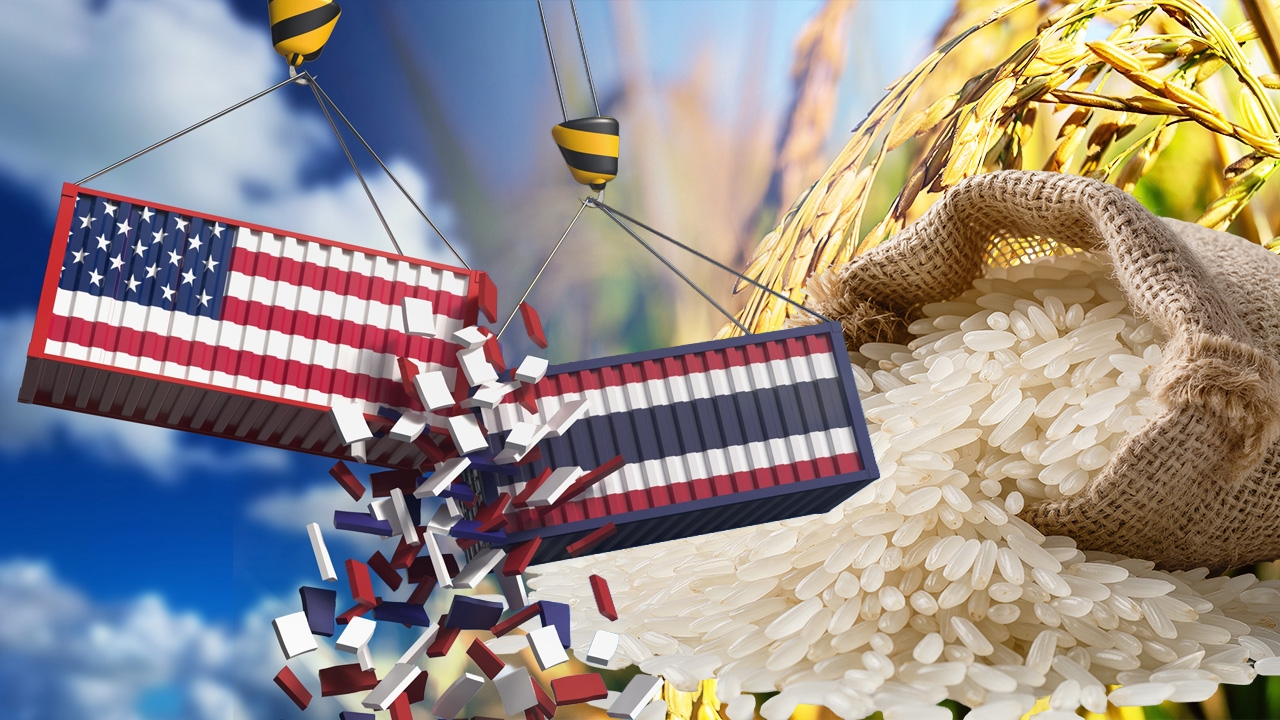
Exploring opportunities for Thai-US products after signing the ART agreement, hoping to increase exports of "jasmine rice," but facing major obstacles including tariffs, competitors, and market liberalization.
After Thailand and the United States reached a joint agreement under the Agreement on Reciprocal Trade (ART), there is hope among government and private sectors to maintain Thailand's top export market position.
This includes efforts to promote flagship products like "jasmine rice" to grow further in the US market. However, it also reveals complex challenges beyond growth figures, as behind this trade deal lies a major market opening that could inevitably impact Thailand's agricultural sector and small entrepreneurs.
Thairath Online's special team consulted Associate Professor Dr. At Phisanwanich, an economics professor at Rangsit University and expert in international economics, who analyzed that among Thai agricultural exports to the US, "jasmine rice" is the clearest and most closely watched product. The market is highly competitive and difficult to penetrate because the US can cultivate fragrant rice domestically to compete directly. At the same time, Thailand faces significant competition from Vietnam, which continuously vies for market share.
Although the ART framework is seen as a mechanism to help maintain Thailand's competitiveness and prevent disadvantage against regional rivals, if tariff conditions remain unfavorable or import taxes stay high—such as the 19% tariff rate or other tax measures—promoting Thai jasmine rice to achieve rapid growth in the US will remain a tough challenge requiring considerable effort.

Associate Professor Dr. At analyzed the product structure under the negotiation framework and found that outcomes are not solely positive but split between groups benefiting and those needing to brace for heavy impacts as follows.
Beneficiary group on the import side includes temperate agricultural products that Thailand does not produce domestically, such as cherries, apples, and grapes. Thai consumers will benefit from lower prices without affecting domestic farmers' production base. Meanwhile, soybeans and corn are already regularly imported by Thailand, so these imports do not create significant new disturbances.
Export products that will face continued challenges include:
Tropical fruits like durian, mangosteen, rambutan, and longan have a limited main market in the US, mostly among Asian consumers, and face direct competition from Vietnamese durian and Indonesian mangosteen.
Raw rubber and rubber gloves: Thai raw rubber competes with Indonesia and Vietnam, while Malaysia dominates the US rubber glove market. Even with equal tariffs, Thailand will still find competition difficult.
Beef: Thailand's domestic market has been sluggish due to imports of Australian and New Zealand beef. The arrival of US beef intensifies competition mainly among importers themselves.

Pork and poultry: Allowing US pork imports could flood the market and depress Thai pork prices. Consumers also have concerns over growth-promoting substances. Poultry such as chicken and duck, though produced in large volumes in Thailand, may face price pressure to reduce.
Sugarcane and cassava are sensitive issues often overlooked because the US imports include ethanol made from corn and ethanol byproducts valued over $5.4 billion. If Thailand imports ethanol from the US, it could compete directly with Thai farmers who produce ethanol domestically from sugarcane and cassava, potentially linked to government promotion of E20 fuel.

Experts point out that societal debate over tariffs of 19% or 12.5% is just the tip of the iceberg. The core of ART is the opening of Thailand to allow the US to reorganize nearly every domestic rule and regulation, resembling a deeper liberalization than typical FTAs. Thailand offers the US almost 100% market access, while the US continues to impose tariffs on Thai goods.
Under these conditions, Thailand may face pressure to amend laws and regulations across many sectors, including telecommunications, digital economy, customs systems, environmental standards, verification of product origin and AI chips to prevent export fraud to China, and labor rights issues that could allow migrant workers to form unions.
In this trade equation, Thailand is caught between two economic giants: China, advancing through various business channels without regard for regulations, and the US, advancing with conditions forcing Thailand to overhaul its legal system to favor competition.
Although large Thai enterprises have the capacity and capital to adapt and continue growing GDP, the most concerning groups are small entrepreneurs, who make up about 30% of GDP, and nearly 10 million Thai farmers, who have low bargaining power and find adaptation difficult.
Therefore, before legal processes and final agreement signing are completed, government agencies must seriously and transparently open forums allowing farmers and small entrepreneurs to express the impacts themselves. If new rules proceed without clear protective and remedial measures, the production structure of small-scale producers in the country may be permanently altered.