

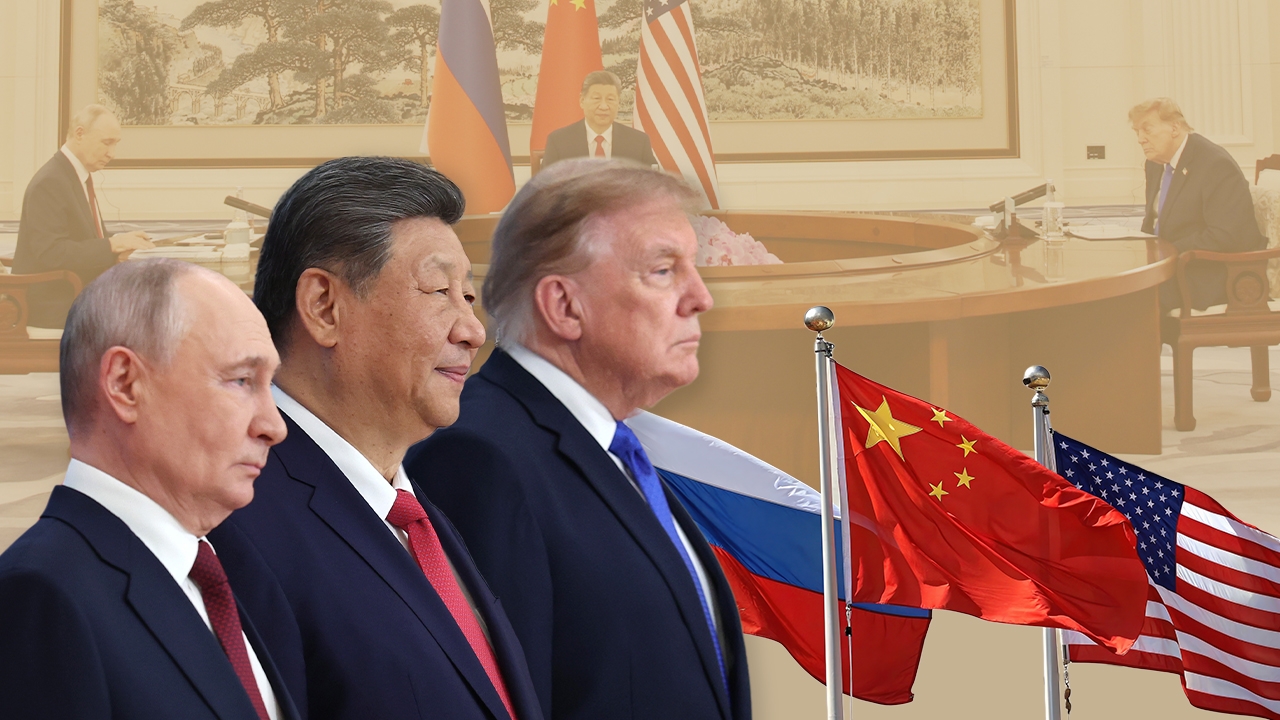
Key highlights of the historic trilateral summit "Trump-Xi-Putin," announcing a "Declaration toward Peace" to oppose nuclear war. Who benefits the most?
On 19 Nov 2026, the three world power leaders U.S. President Donald Trump, Chinese President Xi Jinping, , and Russian President Vladimir Putin held their first trilateral summit in Shenzhen, China, as a side meeting during the APEC leaders' summit at Kylin Villa, with discussions lasting approximately 60-90 minutes.
After the meeting, the three leaders issued a joint statement called the "Declaration toward Peace." Details published on the Chinese Foreign Ministry's website stated that the three heads of state exchanged in-depth views on the current international situation and pledged to maintain strategic stability and international security.
1. As permanent members of the United Nations Security Council, China, Russia, and the United States committed to reforming the UN to more effectively address global challenges, in line with its core mission of peace and international security.
2. The three countries plan to increase production and supply of refined petroleum products for the benefit of all nations, emphasizing the importance of stable energy flows.
3. The leaders acknowledged the utmost importance of state consent and respect for immunity of state officials, agreeing that the International Criminal Court (ICC) and similar organizations must not misuse their judicial power.
4. They jointly reaffirmed that nuclear war has no winners and must never occur, committing to negotiations to reduce nuclear risks and prevent nuclear proliferation.
However, analysts view the discussions as ending without binding agreements or concrete breakthroughs. Thairath Online special news team compiled the key points from this meeting, outlining the topics discussed by the three leaders and their implications.

President Trump opened the talks by telling President Xi Jinping and President Vladimir Putin, "We are making history." This meeting symbolized a rare high-level cooperation among the three countries, despite prior tensions especially over the Russia-Ukraine war, trade disputes, and recently, competition in advanced industries highlighted by the Nvidia controversy.
However, despite the cooperative image, the discussions produced no major policy agreements or new binding commitments.
Nuclear arms control was a key topic following the expiration of the New START treaty, which limited nuclear warheads to 1,550 per side between the U.S. and Russia in February. Although President Putin proposed voluntarily maintaining this cap for another year in September 2025, President Trump rejected that and called for a new agreement including China.
During the talks, President Xi urged all parties to do their utmost to prevent nuclear war and to pursue measures banning and eliminating nuclear weapons. Nonetheless, no new nuclear arms control agreement or binding reduction targets were reached.
Radio Free Europe analyzed that Beijing considers it too early to join disarmament talks, fearing strategic disadvantage since China has about 620 warheads compared to over 5,000 each for the U.S. and Russia.

The Ukraine and Iran conflicts are highly relevant to the three leaders, especially the U.S. and Russia. President Trump attended amid the costly and unresolved Iran war, while Russia’s war in Ukraine enters its fifth year with ongoing losses.
Although Trump previously indicated that Iran and the Russia-Ukraine war were on the agenda, neither Ukraine nor Iran was mentioned in the Declaration toward Peace, nor was there any indication that Trump secured agreements from Xi or Putin to assist in resolving the Iran conflict.
Russian Presidential spokesman Dmitry Peskov disclosed that the Ukraine war was discussed but was not a main topic of the trilateral talks.
When President Putin first proposed the summit last month, Ukraine and Europe expressed concern that Russia might negotiate peace without their involvement.
Experts believe this is unlikely. Zari Arho Havren, associate researcher at the UK's Royal United Services Institute (RUSI), said Beijing does not want to harm relations with Europe due to ongoing economic interdependence and wishes to maintain an image as a neutral global power.
The Declaration stated that all three countries agreed that the International Criminal Court (ICC) and similar bodies must not misuse their judicial authority. President Trump accused the ICC of "being out of control" and criticized what he viewed as overreach by the court.
Trump’s statement is significant because President Putin faces an ICC arrest warrant for war crimes issued in March 2023. However, both the U.S. and China are not parties to the Rome Statute, the treaty establishing the ICC, and thus are not obligated to comply with its rulings.

From this trilateral meeting, analysts believe President Putin gained the most. Isolated by the world community since Russia’s invasion of Ukraine, Putin attended the APEC summit with the lowest expectations among the three leaders. This was his first attendance since 2017, and simply appearing helped reduce the image of global exclusion.
Zari Arho Havren noted that Russia’s leader’s isolation diminished greatly in terms of image and possibly reality, due to the joint Declaration toward Peace after the meeting.
Havren observed that the three countries challenged the ICC’s legitimacy, which had issued an arrest warrant for Putin, and that the statement also mentioned plans by the U.S., China, and Russia to increase production and supply of refined petroleum products for mutual benefit, indirectly supporting Russia’s struggling oil industry.
As for President Xi Jinping, he likely expected less from the trilateral summit compared to Russia, since China faces no severe diplomatic or economic crises. Despite some tensions with the U.S., Xi succeeded in shaping the current U.S.-China relationship under a bilateral framework called "constructive strategic stability."
Yun Sun, Director of the China Program at the Stimson Center in Washington, said the summit was highly watched and skillfully arranged, calling it a successful meeting. It was not easy to negotiate a joint statement acceptable to all, but this came at the cost of avoiding detailed discussions on many issues.
The joint statement reaffirmed that nuclear war has no winners and must never happen—a phrase China has used for years. Meanwhile, language on reducing nuclear risks and preventing proliferation remained vague and non-binding.
"I think Xi Jinping got what he wanted: to show he is holding the reins of global affairs," Havren said.

Meanwhile, President Trump met his own expectations. Analysts say the U.S. leader had low expectations before the summit and achieved his set goals.
Ross Darrell Finegold, a lawyer and political risk analyst in Taipei, noted that with the world’s eyes on him, the U.S. leader wanted proof that he was advancing nuclear arms control with the other two nuclear powers, and he succeeded.
Regarding the Iran war, which Trump had said he wanted to discuss, it did not appear in the joint statement, and neither Putin nor Xi publicly mentioned the Iran conflict during the APEC summit.
Finegold believes both countries cannot and will not assist Trump in ending the Iran conflict, but also will not support Iran fighting the U.S. The safest approach for China and Russia is to call for peace.
A former senior U.S. Commerce Department official overseeing China issues revealed that Xi Jinping successfully charmed the U.S. leader, welcoming him with a hug at the airport, which Trump described as "a great victory for us." and a symbol of "high respect."
The friendly relationship with Trump marked a positive change for Xi after U.S.-China ties faced turmoil during both the Biden and Trump administrations. Reduced pressure from Washington gave Beijing more space to pursue strategic foreign policy goals.
"Xi is probably quite pleased with the outcome, even though he knows it cannot last forever," the official said.
Sources:rferl,abc,theguardian,pbs