

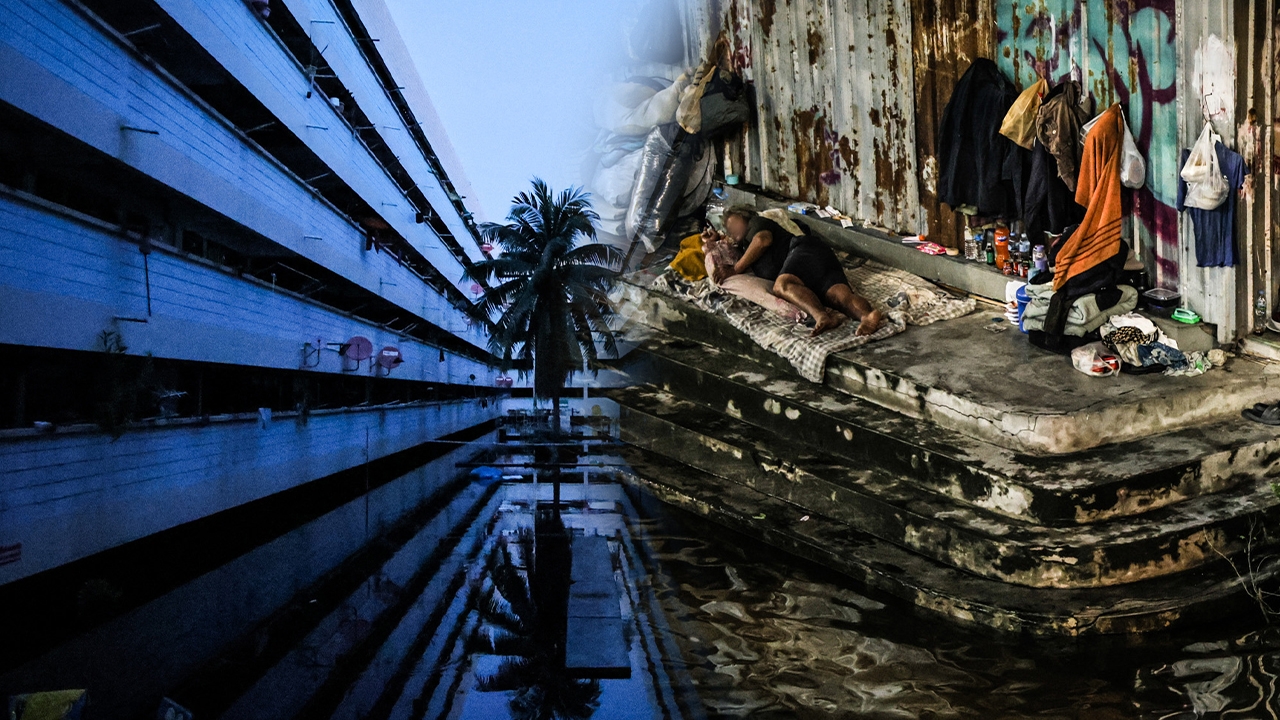
"The water came at night. I woke up and everything was already flooded. We couldn't get our vehicles out in time. I went knocking on doors to wake everyone, but it was too late," said a resident of Khlong Chan Flats, who still vividly remembers the unexpected moment. Bangkok, a metropolis of hope, should be more than just a “resilient city” — it should be a “just city.” The flood lesson at Khlong Chan Flats raises the question: who pays the highest price?
The water’s color blended into the complete darkness of a restless night. People stood on their apartment balconies, looking around the rectangular buildings, lit only by faint candlelight and flashlights. Conversations mingled softly with string music playing from the flats, the sole entertainment easing their stress.
“The water came at night. I woke up to find everything flooded. We couldn't get our vehicles out in time. I tried waking everyone by knocking on doors, but it was already too late...” residents of Khlong Chan Flats told Thairath Online.

“I have lived here for over 30 years,” said Suthep Kochintorn, 60, a Khlong Chan Flats resident, sharing with Thairath Online. He recounted that 30 years ago, after 6 p.m., shops closed because no one dared to walk outside. It was very dark—no streetlights, no CCTV—and few people dared to live in the area then.
Most residents then were from the south. The area was rife with dangers: thieves, fights, shootings, monks selling bags, rampant drug use leading to deaths—it was a gathering place of all sorts. Suthep speculated that without tacit approval from authorities, ordinary people couldn’t have sold drugs here. When the bosses gave orders, the game had to go on. He has seen and experienced it all and said it was not good.
Fifty years ago, the government began preparing housing projects in 1953, launching one in 1973. The National Housing Authority started the flat projects in 1976, completing construction by 1980. The project comprised thirty 5-story buildings with over 5,000 units, designed to house low- and middle-income people through long-term lease-purchase systems.

Wearing shorts, a sleeveless shirt, a traditional Thai cloth sash, and mismatched sandals, Suthep, originally from Nakhon Si Thammarat, moved to Bangkok and rented in Khlong Chan Flats for 600 baht. Today, he is known as the ‘Khlong Chan Flats mafia’ because of his long tenure there.
He described the flats as a community mainly of people from the south who came from different provinces, forming a neighborhood where residents helped each other and developed strong bonds with both people and place.
“This is not just a home or a room; it has become our very blood and flesh,” Suthep said.
Why is Khlong Chan housing for low- and middle-income people and why does it flood longer than other places? In 1973, Bangkok was rapidly growing, with more people coming from provinces to study and work. Affordable housing was scarce, so large-scale public housing became a government tool to manage urban growth.
But as the city grew, condos and houses were built around Khlong Chan Flats, with surrounding land being raised higher, enclosing the flats in a “basin.” When floods came, this basin collected water from all directions.

Associate Professor Dr. Boonlert Wisetpreecha of Thammasat University explained that besides the basin effect making drainage difficult, the flats are old buildings from 50 years ago, contributing to prolonged flooding at Khlong Chan and Romklao housing projects.
He invited deeper reflection: flooding itself does not discriminate as water flows from high to low ground. However, people have varying capacities to cope with floods.
The question is who is at flood risk and who lives in flood-prone areas? In the Philippines, the term "Flood Zone Area" is used. People with enough resources generally avoid such areas or have the means to protect their homes from flooding.
Residents of public housing are low- or middle-income, whether tenants or owners. To provide affordable homes, the government had to build on cheap land, which is usually in suburban low-lying areas.
Thus, the Khlong Chan housing project was established on cheap, low-lying suburban land. The land was filled and developed with the assumption that it met standards, but as the city evolved and roads around rose higher, the housing area became unable to cope with modern realities.

For comparison, Singapore has similar projects but invests in quality flats with maintenance budgets to prevent depreciation and slum conditions. This continuous upkeep keeps flats desirable. Therefore, maintenance is essential, though in Thailand, maintenance fees collected are often insufficient, requiring solutions to avoid repeated problems.

Secondly, global climate change increases the need for flood preparedness. Some residents on higher floors believe they are safe, but flooding affects the entire building because pumps and electrical panels are on the ground floor, damaging the whole structure.
When pumps and generators shut down, upper-floor residents face equal hardship. Residents’ capacities to cope vary; low-income public housing tenants cannot improve environmental conditions to better handle floods.
Additionally, responsibilities are fragmented. The Housing Authority manages the buildings, Bangkok Metropolitan Administration manages roads, and the Royal Irrigation Department manages surrounding canals. These separate jurisdictions prevent community involvement, explained Associate Professor Dr. Boonlert.
We may see the difficult evacuation of elderly and bedridden patients, but those severely affected are not limited to these extreme cases.
Many ordinary people with low or middle incomes also suffer greatly. Several had vehicles flooded, which they relied on for work, such as motorcycle taxis or street vendors. They lost vital livelihood assets, some incurring debts to repair vehicles or pay rent, sinking further into hardship.

This was the first time Khlong Chan Flats experienced such severe flooding. Compared to 2011, this area was less affected then. This time, there was no water supply or electricity, leaving thousands trapped in their units, surviving amid uncertainty. In the first one or two days, almost no aid arrived.
“We shouldn’t blame anyone because management authority lies with the government. Urban planning and roads now are higher than the communities. When such events happen, we must find solutions. Politicians and officials should value the people. From the perspective of ordinary citizens, the government should fully assist, but as seen... why was there no warning before the flood? This is a big mistake — there was not even an announcement to prepare,” Suthep said.
Associate Professor Dr. Boonlert described this as “precarity,” a vulnerability created by structural conditions and social factors such as insecure housing, poor jobs, or building conditions, all products of systems and policies.
“Rich people buy land around here to fill and build condos to sell to... who? Ordinary people like us cannot afford them. Speaking frankly, that is painful,” Suthep said.

The direct responsibility lies with the state. The fact that poor people cluster together partly means they cannot rely on the government. Most importantly, the state must fulfill its role, said Associate Professor Dr. Boonlert, who further explained what the government should do.
First, we need a non-discriminatory mindset based on minimum standards everyone should receive. We should not protect some areas from flooding while letting others flood excessively. Fairness and scientific management respecting natural principles are essential.
Concretely, urgent relief must be provided to those affected, and in the future, recovery systems should enable victims to rebuild their lives.
Second, improve early warning systems. Nobody warned residents that water would arrive within 24 hours. Could they move vehicles or valuables in time? Warning systems need upgrading.
Third, improve infrastructure to move electrical systems above flood levels so infrastructure can continue functioning despite floods.
In research in Yala, during floods, power shuts down completely, so they emphasize solar cells with batteries, ensuring at least some electricity during floods for charging phones. Such ideas need consideration alongside floodway management.

We often hear of “Resilient Cities” that recover after disasters and live with water rather than fighting it. I believe future cities should also be just. Beyond resilience, we must consider whether urban management is fair.
We want a just and sustainable city. Resilience is part of sustainability, but if resilience benefits only some people, excluding others, that is unfair. Comprehensive inclusiveness is necessary for true sustainability.
“I think we don’t just want a city that sustainably handles flooding; we want a sustainable city that is just for everyone.”
It’s unacceptable for one area to survive while others don’t. Focusing only on flooding without justice means some people survive at others’ expense. Those most harmed tend to be the disadvantaged, and this must be considered. Justice must be integrated into urban management.

“Early warning systems and inter-agency coordination have completely failed. From research in Yala, I learned that many agencies manage water, but they don’t share data,” Associate Professor Dr. Boonlert painted a picture of failure in flood management.
“We have the National Water Resources Office (NWRO) coordinating data, but it lacks decision-making power. Decisions about water flow involve negotiations among localities.
Therefore, there is no principle guiding where water should best be directed...
We must integrate urban management with an emphasis on justice. We should not manage cities in ways that worsen conditions for already disadvantaged people.
Housing must not be priced out of reach, and the many slum residents suffering invisibly must be considered. Urban management—in disaster response, planning, displacement, traffic—must address justice and inequality,” Associate Professor Dr. Boonlert concluded.

According to the Department of Disaster Prevention and Mitigation (DDPM) report dated 20 Nov 2026 GMT+7, flooding currently affects 57 provinces and Bangkok, impacting 2,272,665 households or 7,010,111 people, with 98 deaths.
The government has disbursed 13,418,384,000 baht in aid. A total of 2,547,337 households have applied for assistance, with 1,840,296 households receiving payments as of 20 Nov 2026 GMT+7. The Cabinet approved a total assistance budget of 16,100.532 million baht.
Although the major flooding in Bangkok has passed, damage remains visible. The large flood occurred without any government warning, leaving many residents unprepared for the disaster.
After the water receded, greenish-black mud covered streets. People stood outside, inspecting their homes, many cleaning belongings submerged for over seven days.
“I will live here until I die because I am deeply attached,”
Suthep said he came from the countryside to Bangkok seeking a better life and does not plan to move away.
“It can flood, but not for long. If it happens again like this — no electricity, no water, cars submerged — I won’t tolerate it,” Suthep concluded.
Today, Suthep’s wife’s shop is about to reopen after being underwater for over a week. Both wear brighter smiles than earlier this month. Asked if the 9,000 baht aid was sufficient, he declined to comment further. He and neighbors must continue living in the building known as ‘Khlong Chan Flats.’
Story and photos by Supaporn Thamprakhon