

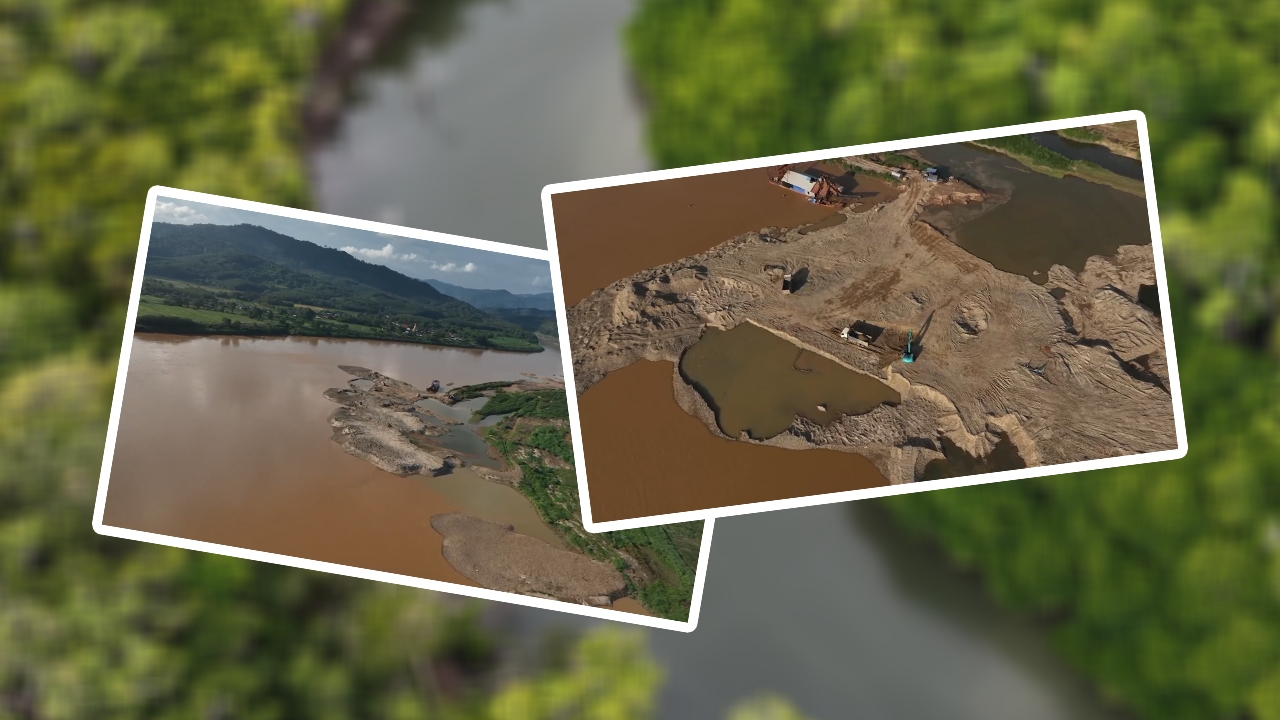
"No fish to catch—people dare not eat" Food insecurity worsens as the Kok River ecosystem collapses, with turbid water year-round severely affecting fish spawning and refuge areas contaminated by toxic substances.
Regarding reports that the Department of Fisheries detected toxic contamination exceeding standards in 10 aquatic species from the Kok River—mostly bottom-dwelling species such as shrimp, four types of shellfish, and five bottom fish—Naresuan University, together with the Science and Technology Research Promotion Agency, clarified that this data is inaccurate because it mixed test results from the Salawin River and the Mekong River in Loei Province with Kok River data.

For water animal samples from Chiang Rai and Chiang Mai provinces, totaling 598 samples collected between April 2025 and October 2026, it was confirmed that 99% of fish meat meets safety standards and is safe for consumption. Samples previously exceeding limits have normalized upon retesting. However, the public should still exercise caution and avoid eating fish entrails and four types of shellfish—cherry mussels, freshwater snails, freshwater clams, and freshwater oysters—as these accumulate arsenic and lead. Government agencies plan to use green, yellow, and red flag symbols to warn of risky areas and monitor conditions.
From the local perspective, the situation is more complex and critical. Thairath Online’s special report interviewed Assistant Professor Dr. Suebsakul Kittanukorn, a faculty member at the Social Innovation Institute, Mae Fah Luang University, who has been monitoring environmental issues in Chiang Rai Province. He said locals in Chiang Rai are not surprised by the warning about 10 contaminated aquatic species because the Department of Health and provincial authorities have long advised against consuming fish entrails and bottom-dwelling aquatic animals from the Kok and Mekong Rivers, including areas in Mae Sai district.

What is more alarming than finding toxins in fish is that the fish ecosystem itself is collapsing. Normally, natural rivers are turbid only in the rainy season and clear in the dry season, but since late 2024 until now, the water in the river has remained turbid and thick throughout the year.
The abnormal year-round turbidity signals a death sentence for aquatic life because massive sediment flowing into the river has buried fish spawning grounds, refuges, and feeding areas, causing severe habitat destruction. This has drastically reduced fish populations, leading to two major impacts locally: 1. villagers have no fish to catch, and 2. people are afraid to eat fish.

When asked about health impacts on locals who have consumed aquatic animals in the area, Dr. Suebsakul said that no acute symptoms have been observed in the short term because heavy metals accumulate slowly in the human body, usually taking at least five years or more before symptoms of illness appear.
The government's warnings to avoid consuming all fish entrails and bottom-dwelling aquatic animals clearly prove that the community’s natural food sources are contaminated and no longer safe.

This crisis is not just environmental; it has escalated into a "food security crisis" for local communities because river fish are a major natural protein source freely available to villagers. With fish disappearing and unsafe to eat, locals lose their daily food security.
"These test results clearly indicate that the contaminated aquatic ecosystem in the river is collapsing and the river is dying. Government agencies cannot continue to just address symptoms or issue warnings; they must urgently tackle the root cause, namely the mining operations that release sediment causing turbidity and heavy metal contamination."