

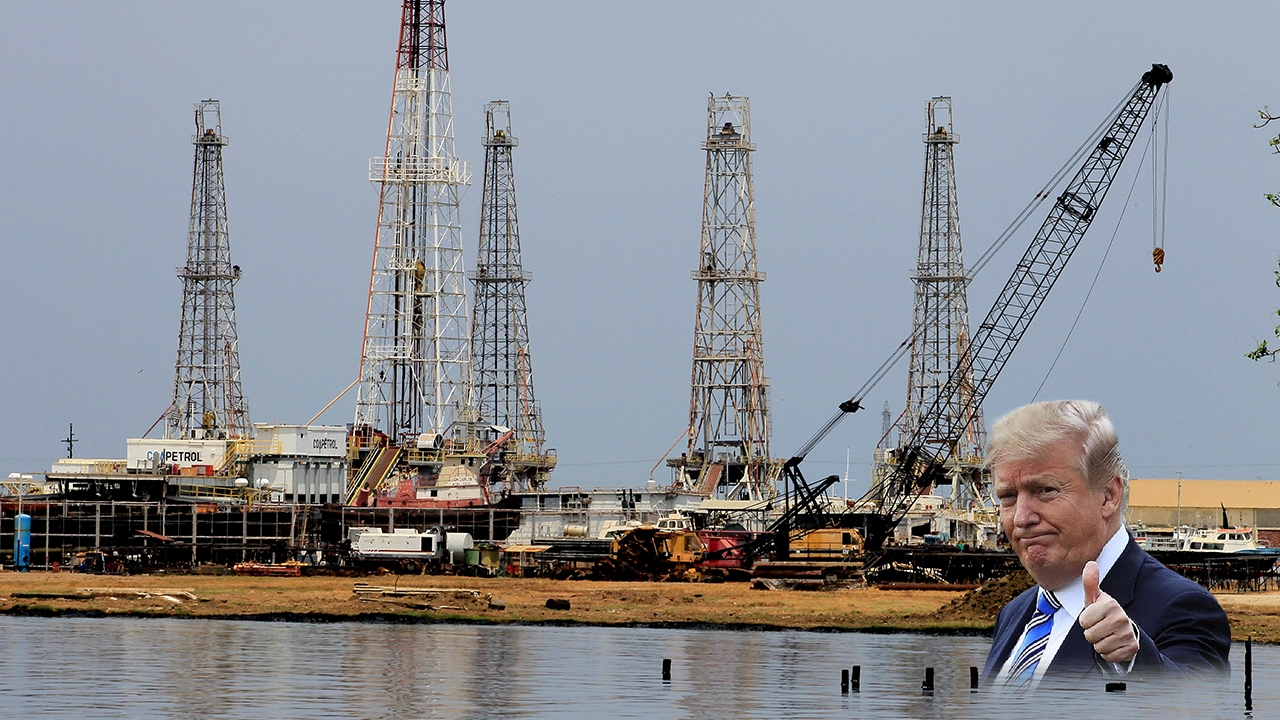
Unveiling Venezuela's oil and resource wealth that Trump might be targeting after the US launched an operation to arrest the president and plans to allow US oil companies to oversee the energy sector.
It has become a major global issue when the United States led by President Donald Trump, launched an attack on Venezuela, arresting President Nicolás Maduro along with his wife, Cilia Flores, in central Caracas, the capital of Venezuela, before extraditing them to face charges in the US for drug-related terrorism, cocaine trafficking, possession of machine guns and destructive devices, and conspiracy in possession of such weapons.
However, "drug trafficking" may not be the sole target or the "true objective" of the US but also involves geopolitics and natural resources, especially "oil," as Venezuela holds the largest reserves in the world. After arresting Maduro and his wife, President Trump stated that the US would "run" (manage) Venezuela until a safe transition occurs and plans to allow US oil companies to manage Venezuela's energy infrastructure.

1. Oil
Venezuela is a country that has the world's largest oil reserves, estimated at about 303 billion barrels, or approximately 17-18% of global oil reserves, surpassing second-ranked Saudi Arabia with 267 billion barrels and third-ranked Iran with 209 billion barrels.
Most oil is found in the Orinoco region in central Venezuela. The oil here is mostly "heavy crude," which is difficult to refine, requiring higher costs and advanced technology to produce diesel, fuel oil, and asphalt. This contrasts with the US, which produces mostly light crude and still relies on imports of heavy crude, currently mainly from Canada.
Despite high reserves, Venezuela's production rate is very low, less than 1% of global oil consumption. As of November 2025, Venezuela produced about 950,000 barrels per day, with over 80% exported to China.
The US has continuously sanctioned Venezuelan oil but has granted special licenses to Chevron, an American company still operating there. Since 2022, the US government relaxed rules allowing increased production and oil sales into the US. Chevron currently refines about one-fifth of Venezuelan oil and is expected to play a key role in the country's oil industry going forward.
2. Natural Gas
Estimated reserves are around 200 trillion cubic feet, the largest in Latin America.
3. Gold and Important Rare Minerals
In 2018, the Venezuelan government released a mineral catalog estimating the country's natural resources.
- Gold estimated at about 644 metric tons, making it the largest reserve in Latin America.
- Coal estimated reserves of 3 billion metric tons.
- Nickel estimated reserves of 340 million tons.
- Iron ore estimated reserves of 14.68 billion metric tons.
- Bauxite, 321.5 million metric tons.
In 2021, the government revealed a map compiling 2009 data showing minerals found in various regions, including lead, copper, nickel, coltan, molybdenum, magnesium, silver, zinc, titanium, tungsten, and uranium, though exact reserve quantities were not specified.
Venezuela is one of the five founding members of OPEC (Organization of the Petroleum Exporting Countries), alongside Iran, Iraq, Kuwait, and Saudi Arabia in 1960. It later established a state oil company called Petróleos de Venezuela, S.A. or PDVSA, to manage the sector and allowed foreign investment to introduce heavy crude extraction technology. American companies such as Chevron, Exxon, and Mobil were pioneers in Venezuela’s oil industry. In the 1970s, Venezuela produced up to 3.5 million barrels per day, accounting for over 7% of global oil production at the time.
However, after Hugo Chávez became president in 1999 with anti-US capitalist views, he mandated PDVSA hold majority shares in all oil projects. This led Exxon and Conoco to withdraw in the 2000s, with their assets seized. Chevron remained but with a reduced role.
Meanwhile, Chávez dismissed many PDVSA experts, replacing them with government appointees, and used profits for populist policies. Mismanagement continued into Maduro’s era, with no new technology or infrastructure development, plus US sanctions, resulting in severely reduced oil production down to the hundreds of thousands of barrels per day.
On 17 December 2025, President Trump designated the Venezuelan government as a foreign terrorist organization, ordered a blockade of oil shipments in and out, and posted on TRUTH SOCIAL that the US built Venezuela’s oil infrastructure but the illegitimate Maduro government "stole" these resources and funneled funds to drug-related terrorism, human trafficking, murder, and kidnapping. This preceded the operation to arrest Maduro and the plan to oversee a transitional government with US involvement in the energy sector.
However, experts believe US control of Venezuela’s oil resources will not be easy. Many say it will require tens of billions of dollars and decades to restore Venezuela’s oil industry to previous production levels.
Homayoun Falakshahi, senior commodity analyst at data platform Kpler, told the BBC that major obstacles include legal and political issues. Any oil concession must be negotiated with the government, and the future government and political direction remain uncertain. Even with political stability, infrastructure is not yet ready.
Falakshahi added that oil executives are debating whether to seize this opportunity, and despite political uncertainties, the potential returns are too significant to ignore.
Source:Reuters,BBC,Americas Quarterly