

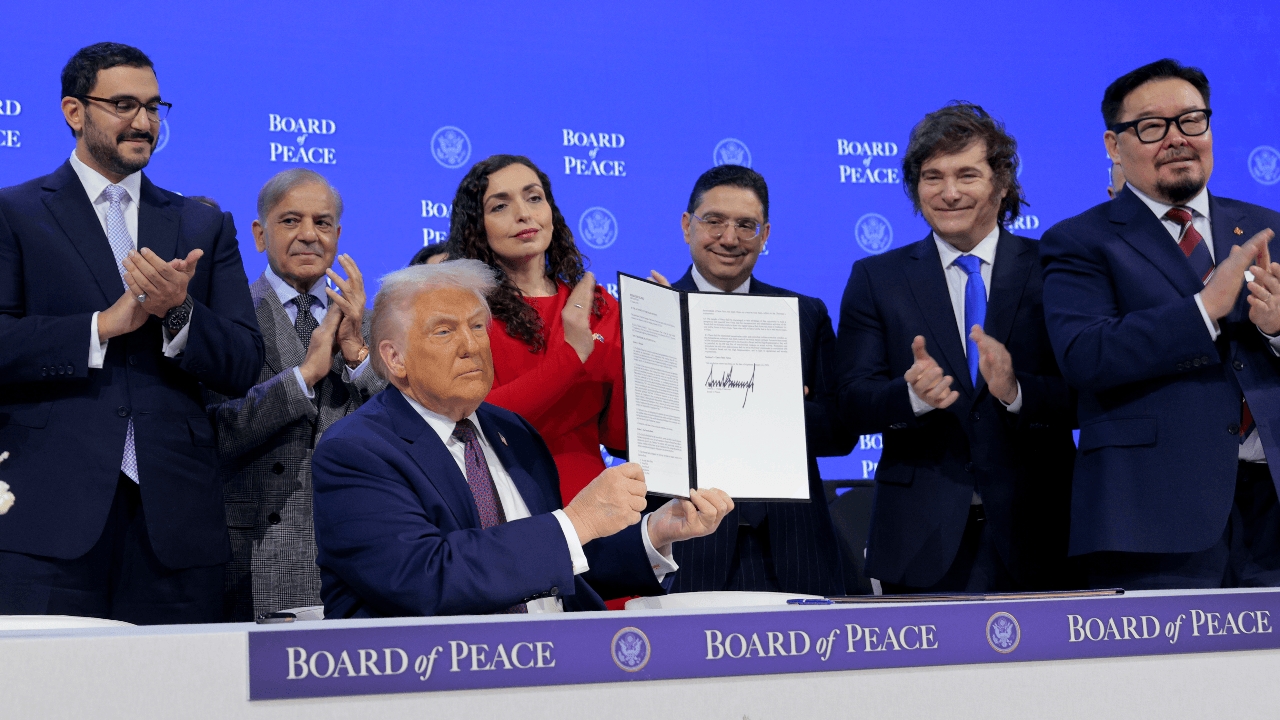
Introducing the 'Board of Peace,' Trump’s peace committee inviting 50 countries including Thailand. On 22 Jan 2026, it was officially launched at the World Economic Forum with representatives from 19 countries attending.
On 15 Jan 2026, U.S. President Donald Trump, announced the establishment of the 'Board of Peace' or 'Board of Peace' committee, to oversee reconstruction and resolve conflicts in the Gaza Strip, with himself as lifelong chairman. He invited leaders from about 50 countries, including Thailand.
On 22 Jan 2026, at the World Economic Forum Annual Meeting in Davos, Switzerland, President Trump officially launched the 'Board of Peace,' with representatives from 19 countries participating amid concerns it might impact the role of the United Nations (UN).

The Board of Peace, or Board of Peace, is a new mechanism proposed by Trump, authorized by the UN Security Council (UNSC) to disarm and rebuild the Gaza Strip after severe damage from a prolonged two-year war between Israel and Hamas militants.
Trump first proposed the idea in September 2025 when announcing plans to end the Gaza conflict, before officially establishing it on 15 Jan 2026. Reports indicate Trump sent invitations to over 50 countries, including Thailand.
The charter states member countries serve three-year terms unless they pay a fee of 1 billion U.S. dollars (approximately 32 billion baht) to support operations, granting them permanent membership status.

On 21 Jan 2026, the White House revealed that around 35 of the approximately 50 invited leaders agreed to join. Accepting countries include Middle Eastern allies such as Israel, Saudi Arabia, the United Arab Emirates, Bahrain, Jordan, Qatar, and Egypt, as well as NATO members Turkey and Hungary, whose leaders have close personal ties with Trump.
Other participants include Morocco, Pakistan, Indonesia, Kosovo, Uzbekistan, Kazakhstan, Paraguay, Vietnam, Armenia, and Azerbaijan, the latter two having reached a U.S.-brokered peace agreement in August last year.
Belarusian President Alexander Lukashenko, long shunned by Western nations over human rights issues and support for Russia in the Ukraine war, also accepted amid efforts to restore U.S.-Belarus relations.
At the signing event on 22 Jan, representatives from 19 countries attended, including Argentina, Armenia, Azerbaijan, Bahrain, Bulgaria, Hungary, Indonesia, Jordan, Kazakhstan, Kosovo, Mongolia, Morocco, Pakistan, Paraguay, Qatar, Saudi Arabia, Turkey, United Arab Emirates, and Uzbekistan.
This initiative arises amid tensions among NATO allies over issues like Greenland, tariffs, and policy disputes, causing many close U.S. partners to approach cautiously. Reports indicate France, Norway, Sweden, Denmark, and Slovenia have declined the invitation.
Meanwhile, Russia has yet to announce its position, while another major power, China has also not expressed a clear stance.
Regarding Thailand, on 19 Jan, the Ministry of Foreign Affairs issued a statement saying
"Thailand has received an invitation from President Donald J. Trump concerning the Comprehensive Plan to End the Gaza Conflict and the U.S. initiative to establish the Board of Peace and is currently reviewing the details.
In principle, Thailand welcomes any initiative that supports sustainable peace in the Middle East and humanitarian efforts to alleviate the suffering of Palestinians. We hope the initiative aligns with Palestinian aspirations and gains support from regional countries.
Thailand affirms its support for ongoing efforts by all parties to achieve a two-state solution with Israel and Palestine coexisting peacefully and securely, based on international law and relevant UN resolutions."

The attached draft charter with the invitation has raised concerns among some European governments that the Board of Peace might undermine the UN's role. Trump has previously criticized the UN for not supporting his efforts to end conflicts worldwide.
One diplomat commented that this might represent a 'Trump-style United Nations' that disregards core UN charter principles. Several Western diplomats agree that if the project proceeds, it could weaken the UN's role.
However, at today’s signing, President Trump declared his desire for the Board of Peace to work alongside the United Nations, noting he often says the UN has tremendous potential but remains underutilized.