

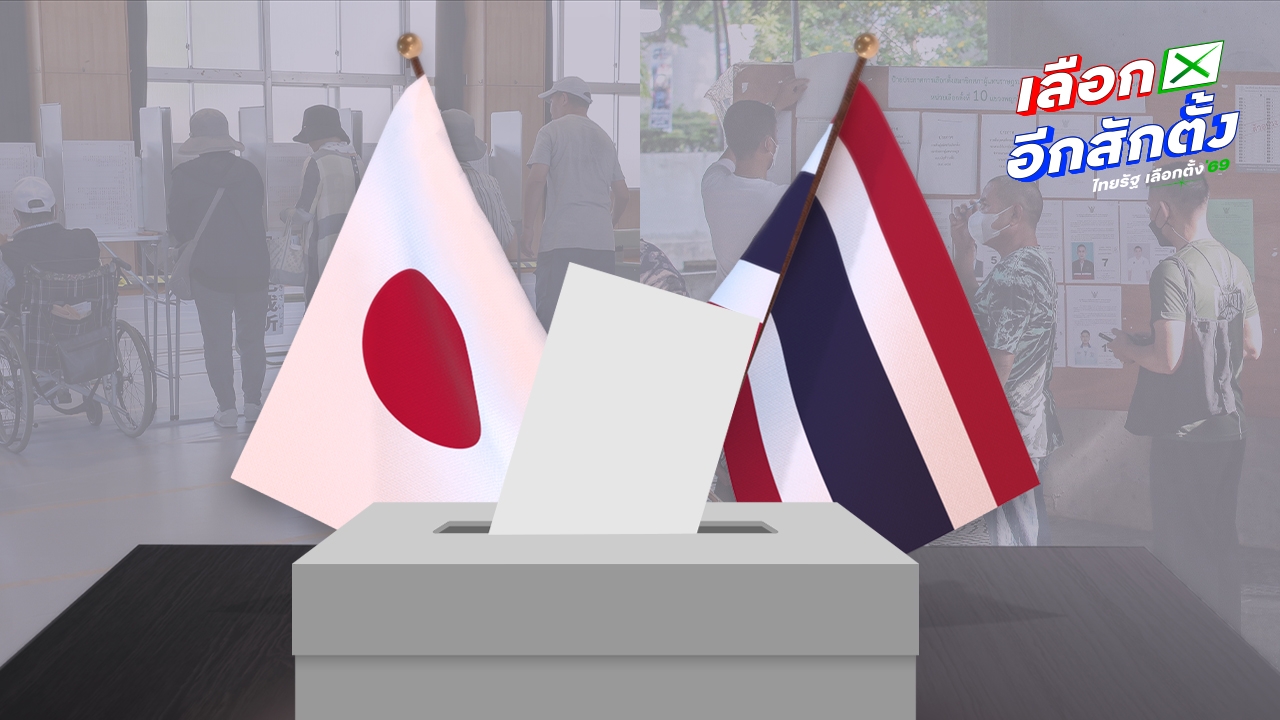
A comparison of the 2026 elections between Thailand and Japan before the decisive voting on 8 February 2026, exploring the government journey before parliament dissolution and the election processes, and how they are alike and different.
8 February 2026 marks a significant political milestone in Asia, when Thailand and Japan will both hold general elections on the same day to determine each country's political future, amidst public expectations and prior accumulated political pressures.
Although voting occurs simultaneously, the political contexts, election rules, and post-election challenges differ between the two countries. Nevertheless, Thailand and Japan share a crucial post-election challenge: "forming a government," which may prove difficult for both.

The path of Thailand toward this election has been marked by prolonged political turbulence. After Anutin Charnvirakul assumed the premiership, he decided to dissolve parliament on 12 December 2025 to allow the people to decide the country's direction once more amid ongoing political uncertainty and intensifying competition among parties.
Looking back to the 2023 election, Thailand's politics have undergone rapid transitions, with three prime ministers within a few years, beginning with Srettha Thavisin, who stepped down after the Constitutional Court ruled he committed a serious ethical violation related to appointing Pichit Chuenban as Minister attached to the Prime Minister's Office.
Next was Pattama Chinawatra, the former female prime minister, who also resigned due to ethical breaches regarding an audio clip involving Cambodia’s Senate President Hun Sen, passing the role to Poomit Vejjajiva, Deputy Prime Minister and Defense Minister, as acting prime minister,

before executive power was transferred to Anutin Charnvirakul, the latest prime minister. After some time in office, he chose to dissolve parliament due to conflicts over constitutional amendments with the People's Party. Anutin explained that the country faces many challenges while governing with a minority government lacking stability to push policies effectively, thus returning the decision to the people through elections alongside a referendum on drafting a new constitution. This raises crucial questions about how stable the political environment will be after the new election.
Meanwhile, on the side of Japan, the lead-up to the general election has been equally turbulent. The 8 February 2026 election is closely watched after Sanae Takaichi, Japan's latest prime minister, announced the parliament dissolution on 23 January 2026 to pave the way for new elections. Her key goal is to seek a public mandate to drive economic and security policies alongside a new coalition government amid domestic economic pressures and escalating regional security tensions.
Previously, Japan’s political scene began to shake during the era of Fumio Kishida, who took office as prime minister in November 2021 but decided not to run again as head of the Liberal Democratic Party (LDP) in October 2024. This decision was seen as the end of his premiership amid declining government popularity due to political donation scandals and various controversies.
Subsequently, Shigeru Ishiba was elected LDP leader and prime minister, tasked with restoring trust in the government and party. However, political challenges persisted when the LDP lost its majority in parliament, prompting Ishiba to resign in September 2025 to take political responsibility.
This event marked a pivotal turning point in Japanese politics, leading to a power realignment within the LDP and opening the path for Sanae Takaichi to become Japan’s first female prime minister.

However, Takaichi’s early dissolution of parliament during the ordinary session caused significant political shock, as it was the first such dissolution in over 60 years at this time, amid criticism over the draft 2026 budget scheduled to take effect in April.
For this election, the LDP aims clearly to secure a parliamentary majority to gain a public mandate supporting long-term strategic, security, and economic policies amid Japan’s structural problems, including rising living costs, a weakening yen, regional security tensions, and noticeably declining government popularity.
At the same time, the LDP faces a major political test due to a political realignment involving a coalition with the Japan Innovation Party (Ishin), while the opposition unites under the Constitutional Democratic Party (CDP) and Komeito, a longtime former LDP ally for 26 years.
All this makes the election more than a routine event; it is a decisive moment for Japan’s political future, determining whether the LDP can maintain its dominant party status and parliamentary majority amid steadily decreasing popularity.
Although Thailand and Japan both have constitutional monarchies with democratic systems and grant voting rights to citizens aged 18 and over, voting on the same day, their election rules differ significantly in structure, number of representatives, voting methods, election day procedures, and early voting, reflecting distinct political contexts.
Number of representatives
Both countries use mixed electoral systems for their House of Representatives. Japan has 465 members: 289 elected by districts and 176 by party lists, whereas Thailand has 500 members: 350 district representatives and 150 party-list members. Both set terms at four years.
Practical differences in election procedures appear as Japan opens polling stations mostly from 07:00 to 20:00, while Thailand allows voting nationwide from 08:00 to 17:00.

Voting method
Additionally, the voting methods reflect different political cultures: Japanese voters write the name and surname of their chosen candidate and party on the ballot, whereas Thai voters mark an X beside the candidate's number, a familiar long-standing practice. Early voting Regarding early voting, Japan permits citizens to vote from the day after official candidate announcement up to the day before the election, at early voting stations in their district without prior registration. For this election, early voting runs from 28 January to 7 February 2026, offering flexibility. In contrast, Thailand designates a specific day for early voting, usually the Sunday before the main election day, which this time is 1 February 2026, ahead of the general election on 8 February. An additional notable difference is the campaign period length: Thailand allows 57 days from parliament dissolution to election day, while Japan has only 16 days, reflecting differences in election preparation and candidate readiness.
Although both countries ultimately give their citizens the opportunity to shape political direction through voting, their election rules and procedures clearly reflect differing political and democratic cultures, potentially influencing voter behavior and overall political outcomes.
The major challenge after the election
However, the real challenge for both countries extends beyond election day to the post-election government formation process.

In Japan, although the LDP has long been the main party, the shift of former coalition partners has intensified the competition for a parliamentary majority. Securing a majority is crucial for the party’s future and the prime ministership.
In Thailand, multiple parties are competing for parliamentary seats to gain an advantage in forming a government. The key question is what form the post-election government will take and how stable it will be politically.
