

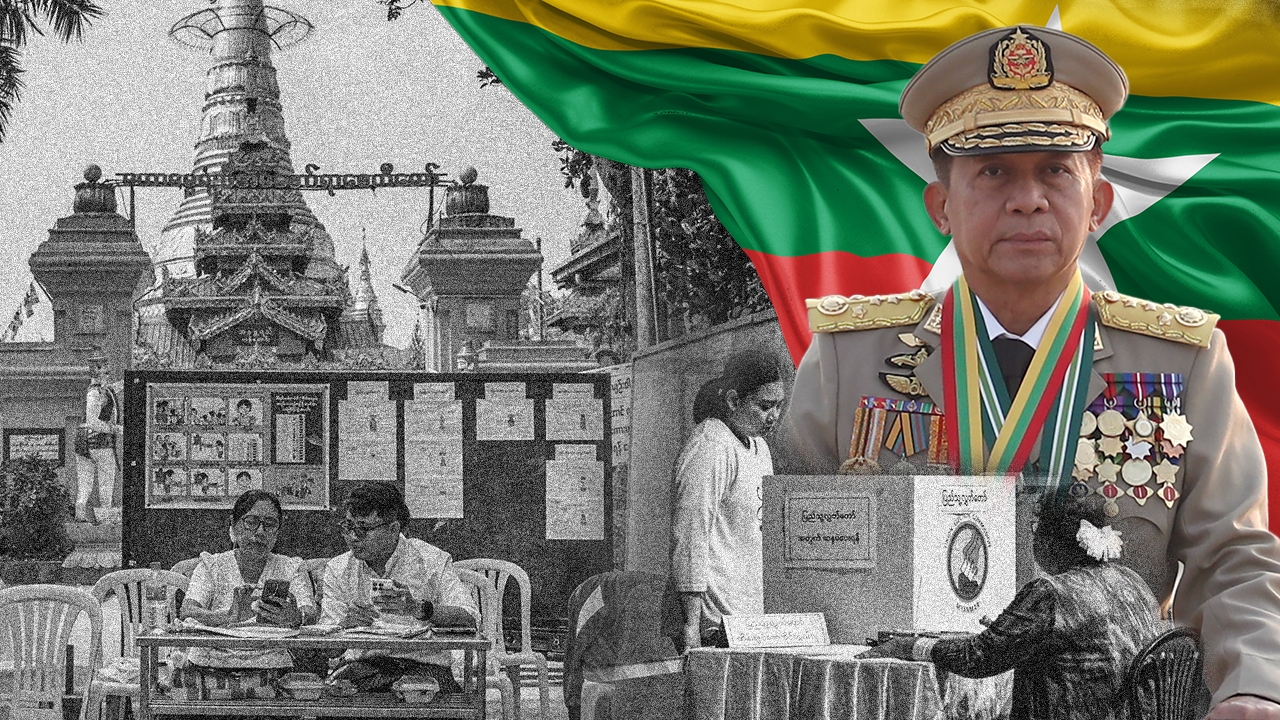
Myanmar's future under military dominance remains uncertain after an election widely perceived as a whitewashing exercise rather than a genuine restoration of power to the people. Attention is on Min Aung Hlaing, who is consolidating complete control through the newly formed "Union Consultative Council," representing a new power structure.
When mentioning "elections" the general understanding is that they allow citizens to exercise their rights to determine the political future, choosing leaders and representatives to govern the country. However, for "Myanmar" the latest election has been widely questioned as merely a "whitewashing tool" a ritual to legitimize the military regime more than a true democratic mechanism.
The victory of the Union Solidarity and Development Party (USDP) which is backed by the military, was hardly surprising. Under rules that exclude opposition parties and severely restrict political freedoms, power structures remain firmly in the hands of the military and its allies.
This election also took place amid scrutiny over whether "Min Aung Hlaing" the military leader, would officially become the country's leader or choose to wield power behind the scenes through a newly designed political framework to maintain military influence without holding the top official position.
Myanmar has long been under military influence. Although the military briefly stepped back from leading roles during reforms under civilian governments for over a decade, everything changed when the Tatmadaw (Myanmar military) staged a coup in 2021, detaining civilian leaders including Aung San Suu Kyi from the National League for Democracy (NLD) citing allegations of election fraud.
This triggered massive protests that escalated into civil war and a prolonged humanitarian crisis, leaving the latest election viewed not as a solution but as part of a military-backed power succession mechanism.

Myanmar's first election in five years was held in three phases from December 2025 to January 2026 but covered only 263 of 330 constituencies, as many areas remained under control of resistance forces. Major opposition parties were barred from contesting, and freedom of expression was tightly restricted, resulting in many opposition candidates unable to run. Under these conditions, the USDP, led by former military officers, won a landslide victory as expected.
Unofficial results indicate the USDP secured 339 of 586 seats. Combined with the 166 seats automatically allocated to the military by the constitution, the military and its allies control around 505 seats, about 86% of the parliament. The constitution reserves 25% of parliamentary seats for the military, reinforcing its political dominance through both electoral mechanisms and legal provisions.
Voting in the final phase took place in several areas including major cities like Mandalay and the Hlaing Tharyar township in Yangon, which was a center of brutal protest suppression after the coup. State reports claimed over 13 million voters participated, about 54% of eligible voters. However, compared to the 2020 election with freer competition and over 70% turnout, the decline reflects significant changes in participation levels and the altered political climate.

Although Min Aung Hlaing's military government has sought legitimacy through elections, it remains internationally isolated. Meetings with key leaders such as Chinese President Xi Jinping and Indian Prime Minister Narendra Modi are seen as attempts to ease diplomatic pressure and gain acceptance, while the U.S. and Western countries continue sanctions.
Domestically, the Myanmar military has regained some territory in recent months. In July last year, it recaptured Mong Ko town in Shan State from the Ta'ang National Liberation Army, a key strategic point on the China-Myanmar trade route.
In September, the military reclaimed a strategic base protecting an ammunition factory in Magway district and regained control of the Asian Highway 1 leading to Myawaddy near the Thai border. This town is influenced by the Karen National Army (KNA), an ally of the military government, known as a center for trade, gambling, and scam networks.
However, these gains do not represent a strategic turning point. The military continues to lose ground and faces heavy pressure in many regions. Although conscription has alleviated manpower shortages, and support from China and Russia has enabled ongoing air and artillery operations, the military's chances of regaining or stabilizing enough territory soon to legitimize the electoral process remain slim.

Earlier, U Kyin Ye, USDP chairman, presented the party’s policies, positions, and plans in October 2025, emphasizing that the party has continuously studied public needs and developed systematic plans for security, economy, and social welfare. The party firmly commits to cooperating with the Myanmar military to strengthen state security and stability.
Politically, the party supports constitutional amendments within defined frameworks and emphasizes resolving conflicts through political processes and negotiations. Regarding ethnic issues, the party focuses on unity, stressing its governance experience and calling for public support.
Moreover, the first key goal after forming the new government is to swiftly build "stability" and restore confidence domestically and internationally, potentially including establishing a civilian government led by the USDP.
However, many analysts view these moves as part of creating a legitimacy facade for the new power structure in which the military continues to hold decisive influence behind the scenes, especially if Min Aung Hlaing chooses to exercise power through political mechanisms rather than direct military office. This may amount to whitewashing the new government rather than a genuine democratic transition in Myanmar.

Senior General Min Aung Hlaing, leader of Myanmar's military government, is expected to assume the position of president when the new parliament convenes in March. However, Myanmar's constitution clearly states that the president cannot simultaneously hold the position of commander-in-chief, which is seen as the real seat of power, raising the key question whether he will relinquish military authority in exchange for civilian leadership.
It is possible he may not need to openly hold either position, as on 3 February he signed a law establishing the "Union Consultative Council" which allows its chairman to direct political affairs without direct public leadership. The law, published through state media, states the president can establish this council with at least five members including the chairman, tasked with advising and coordinating on critical issues ranging from
national security, foreign relations, peace processes, to legislation. Analysts note the council could enable Min Aung Hlaing to oversee both the government and military leadership simultaneously. In practice,
this council may become a parallel power mechanism guiding the country's direction. Establishing such a body reflects the military's approach to retaining power since the 2021 coup that ousted the civilian government. However, it remains unclear whether Min Aung Hlaing will assume the chairmanship of the Union Consultative Council, opt for the presidency or council chairmanship alone, or hold both posts.
.

The Myanmar coup occurred on 1 February 2021, when the Tatmadaw declared a nationwide state of emergency for one year and transferred power from the civilian government to Senior General Min Aung Hlaing, the commander-in-chief, while declaring the November 2020 general election "unconstitutional." They pledged to hold new elections after the emergency period ended.
This happened just one day before the new parliament was to be sworn in. Aung San Suu Kyi, state counselor and NLD leader, President Win Myint, and other key NLD figures were detained. The coup was triggered by the 2020 general election results, where the NLD won a landslide with 396 of 498 seats, nearly 80% of the parliament, with about 70% voter turnout out of over 37 million registered voters. Meanwhile, the military-backed USDP won only about 6% of seats. The military alleged widespread election fraud, though these claims were never substantiated.
After the coup, tens of thousands of Myanmar citizens protested nationwide against the takeover and launched the
"Civil Disobedience Movement (CDM)," involving professionals like doctors, teachers, and civil servants who used strikes to pressure the military government. This movement rapidly expanded and was dubbed the "Spring Revolution." However, the military responded with brutal crackdowns, killing over 1,000 people and arresting many others. The conflict escalated as armed ethnic groups sided with the people's movement, forming alliances against the military, leading to a protracted civil war and ongoing political and humanitarian crisis. Sources: gnlm, irrawaddy, washingtonpost, asahi