

An in-depth look at the weaponry in Operation Epic Fury, where the U.S. and Israel have joined forces to launch an attack on Iran, deploying a variety of advanced weapons and sparking significant tensions across the Middle East region.
After the United States and Israel jointly initiated an attack on Iran on 1 Mar 2026 GMT+7, resulting in the deaths of Iran's Supreme Leader Ayatollah Ali Khamenei and several senior officials, Iran responded immediately, igniting major regional tensions.
The U.S. Central Command (CENTCOM) released images and details of the U.S. operation under the name "Operation Epic Fury." More than 20 types of weapons and military equipment were deployed to attack Iran, including missiles, stealth bombers, electronic warfare aircraft, rocket launch systems, and low-cost, single-use attack drones employed in combat for the first time.
One of the most notable U.S. weapons is "LUCAS." LUCAS is a one-way attack drone designed to crash into its target, modeled after Iran’s "Shahed-136" drone. Its key features are a simple structure, low cost, and mass producibility to achieve quantitative advantage on the battlefield.
CENTCOM stated this operation marked the first combat use of LUCAS. Each drone costs about $35,000 USD, roughly 1 million baht, reflecting a strategy of deploying many low-cost weapons to overwhelm the opponent’s defense systems.
Meanwhile, Iran’s Shahed-136 uses GPS navigation to fly to designated coordinates and explode on impact. It has been used in Iraq and extensively by Russia in attacks on various Ukrainian cities. Recently, it has been deployed in the Persian Gulf region.
The production cost of Shahed-136 in Iran is about $20,000 USD, or approximately 600,000 baht per unit. Despite its low price, it can carry explosives to strike targets up to 2,000 kilometers away without needing a runway. Mass production puts heavy pressure on high-cost air defense systems.

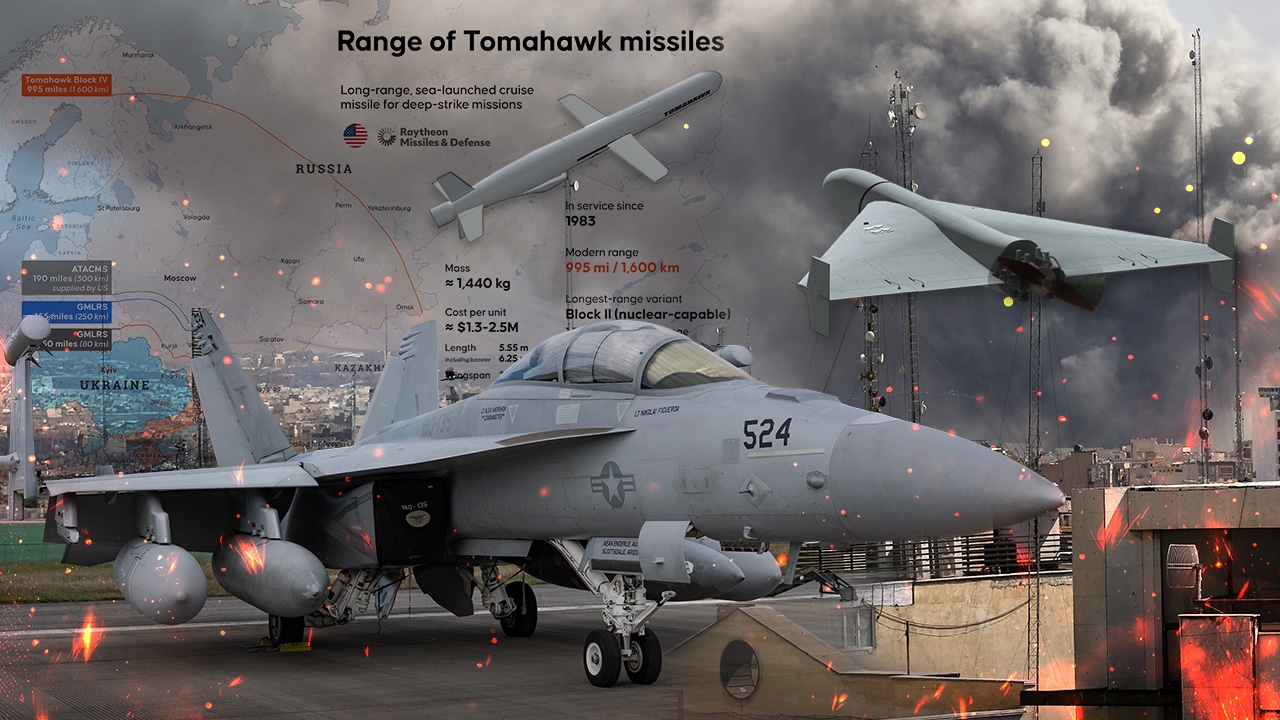
The Tomahawk is a long-range cruise missile launched from U.S. Navy warships and submarines. It flies at speeds close to commercial aircraft and can carry a warhead weighing about 1,000 pounds to precisely strike ground targets.
Fired from destroyers or submarines positioned hundreds of kilometers from targets, it allows the U.S. to respond quickly without sending pilots into heavily defended airspace or risking ground forces. Thus, Tomahawk is a key choice for limited military operations, offering accuracy, flexibility, and reduced troop exposure.
Produced by Raytheon (now under RTX), Tomahawk has been a core asset of the U.S. Navy arsenal since the 1980s. It was first used in combat during the 1991 Gulf War and has since become the preferred long-range strike tool for U.S. leaders seeking to limit personnel risk.
Before the latest operation, this missile was also used in June 2025 to target nuclear sites in Iran. Overall, Tomahawk missiles have been launched over 2,350 times.
Each Tomahawk costs about 400 million baht, with a range of approximately 1,200 to 2,400 kilometers. They can be fired from more than 140 U.S. Navy ships and submarines worldwide.

The B-2 Spirit stealth bomber of the U.S. flew round-trip missions from the U.S. mainland to strike fortified underground missile bases using 2,000-pound guided bombs, with an estimated four aircraft deployed in the initial wave.
Manufactured by Northrop Grumman, the B-2 is among the most advanced U.S. bombers, capable of carrying both conventional and nuclear weapons. It is central to the U.S. Air Force’s long-range bomber modernization program.
The B-2’s standout feature is its stealth technology, allowing it to penetrate sophisticated air defense systems and threaten heavily guarded critical targets. Its flying wing design, composite materials, and special coatings reduce radar, infrared, and electromagnetic signatures, making it difficult to detect.
The aircraft has a range of about 9,600 kilometers without aerial refueling, though many long missions still require mid-air refueling to increase operational flexibility.

The EA-18G Growler is a U.S. Navy electronic warfare aircraft tasked with jamming and disabling enemy radar and air defense systems. It is deployed on the aircraft carriers USS Gerald R. Ford and USS Abraham Lincoln.
The Growler’s mission is to "blind and deafen" the enemy by detecting, analyzing, and disrupting electromagnetic signals from radar to radio communications. Equipped with high-sensitivity receivers, it can locate enemy radar or communication sources in real time and then use electronic warfare pods to jam or deceive them.
The Growler can conduct jamming operations up close to protect attacking flight formations or operate from a distance depending on the situation, making it vital for clearing the way for strike aircraft to enter target areas more safely.

Another key asset in this operation is the M142 HIMARS, used to launch new short-range missiles known as Precision Strike Missiles (PrSM) to attack targets. The U.S. has continuously deployed HIMARS in the Middle East.
The M142 HIMARS (High Mobility Artillery Rocket System), developed by Lockheed Martin, is a lightweight, highly mobile multiple rocket launcher mounted on a 5-ton tactical FMTV truck chassis.
HIMARS can be airlifted by cargo aircraft such as the C-17, C-5, and C-130, enabling rapid deployment to operational areas. It is widely regarded as one of the most effective rocket systems, proven in combat globally.

Sources:airandspaceforces,reuters,foxnews