

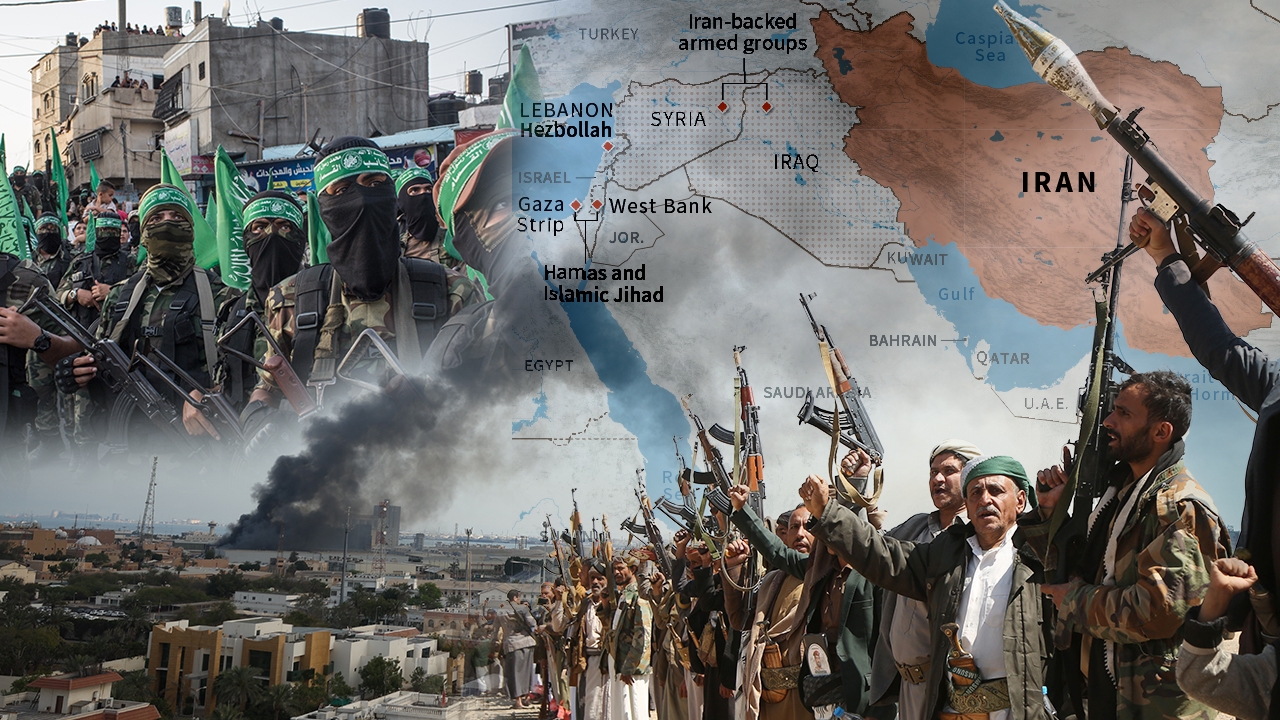
Examining Iran's allied "armed forces," closely monitored for coordinated responses to the US and Israel, escalating violence. Experts anticipate they may be used as a "trump card" for terrorism and attacks on civilians.
Regarding the events of 28 Feb 2024 GMT+7, the United States and Israel launched an operation Epic Fury in an airstrike against Iran after the third round of indirect nuclear talks between Washington and Tehran in Geneva, Switzerland, failed to meet the Trump administration's objectives. The strikes were justified as attempts to destroy weapon stockpiles and military infrastructure to prevent Iran from developing nuclear arms. Several key figures, including Ayatollah Ali Khamenei, Iran's Supreme Leader, along with senior military and political leaders, were reportedly targeted or killed.
Iran did not surrender easily, promptly appointing new leadership and retaliating under an operation named True Promise IV, launching missile and drone attacks against Israel and US allies in the Middle East, including the UAE, Qatar, Saudi Arabia, Bahrain, Kuwait, Jordan, and Iraq. These assaults hit Dubai International Airport, oil rigs, US bases, and threatened to close the Strait of Hormuz, a critical oil and trade shipping route, disrupting the global oil supply chain.
Beyond the military responses of both sides, it is widely known that Iran supports various armed groups across the Middle East. Experts believe these proxy groups could be deployed to target US-related interests, including civilians, further intensifying regional tensions.

Iran has established and backed multiple armed proxy forces throughout the Middle East, coordinated mainly by the Quds Force, a branch ofthe Islamic Revolutionary Guard Corps (IRGC),which primarily oversees training, arms supply, and funding to ensure these groups protect Iran's strategic interests regionally. This network is known as the "Axis of Resistance," united in opposing Western powers' influence and seeking to eliminate Israel.
Iran's main proxy groups come from countries with majority Shia Muslim populations, such as Iraq and Lebanon. However, Iran also supports armed groups among Sunni Muslims in Palestine, Syria, and Yemen.
founded in the 1980s and based in Lebanon, is one of the most powerful armed groups in the Middle East, often described as a "state within a state." It maintains sleeper cells globally, ready to act on command. Estimated strength ranges from 40,000 to 50,000 fighters, with some sources suggesting up to 100,000, armed with tens of thousands of rockets and missiles spanning various ranges, totaling approximately 150,000 to 200,000.
Hezbollah's tactics include cross-border missile strikes, suicide drones, tunnel infiltration, and international terrorism operations.
Iran is recognized as Hezbollah's primary sponsor, providing training, weapons, and hundreds of millions of dollars annually. The group also benefits from support by Bashar al-Assad's Syrian government, legitimate business networks, international crime syndicates, and Lebanese diaspora communities.
Colin Clarke, Executive Director of the Soufan Center in New York, a security and counterterrorism research institute, considers Hezbollah one of the West's most significant threats with the capability to greatly complicate and escalate the situation.

based in Yemen, formed in the 1990s and rose to prominence in 2014 after opposing the Yemeni government, leading to civil war.
Currently, the Houthis control the capital Sana'a and northwest territories, including strategic Red Sea coastal areas. The Red Sea and key port cities like Hodeidah fall under their control, including the Bab al-Mandeb Strait, the southernmost point of the Red Sea and a vital maritime route linking Asia and Europe.
Since November 2023, the Houthis have attacked civilian and military vessels in the Red Sea suspected of Israeli affiliation, retaliating for Israeli military actions in Gaza, severely disrupting Red Sea shipping.
A 2010 UN Security Council report estimated Houthi membership between 100,000 and 120,000, including fighters and unarmed civilian supporters. A 2024 Associated Press report suggested their numbers could reach 350,000.
A former senior US intelligence official, speaking anonymously to The Hill, said the US government should be more concerned about the Houthis. They were targeted in the Rough Rider operation from March to May to destroy arms stockpiles and secure Red Sea shipping lanes, but the campaign faced difficulties, and the Houthis rapidly resumed attacks on commercial ships.
"I am more worried that the Houthis will target oil infrastructure and directly attack Israeli civilians," the official said.
are based in Palestine. Hamas was founded in 1987, and PIJ in 1970, both aiming to oppose Israel and establish an Islamic state in Palestine. Before the October 2023 Gaza conflict, Hamas produced its own rockets and held an arsenal of over 20,000 rockets and mortars, primarily employing rocket attacks, suicide bombings, and rapid raids.
PIJ is a smaller, secretive group with an estimated few thousand members, specializing in underground operations, suicide bombings, and attacks on military and civilian targets. Both groups have weakened considerably due to the Gaza war.

The Popular Mobilization Forces (PMF) or Hashd al-Shaabi, are coalitions of Shia militias formed in 2014 to expel Sunni ISIS militants from Iraq. They gained legal status separate from the Iraqi army and are estimated to number between 100,000 and 200,000 fighters.
Notable PMF armed groups include Kata'ib Hezbollah, operating mainly in Iraq and parts of Syria, with about 10,000 fighters, and the Badr Organization, established in the 1980s, functioning as both a political party and militia, with 10,000 to 20,000 fighters.
Iran reportedly supports several smaller armed groups in Bahrain, such as Al-Ashtar Brigades and Saraya al-Mukhtar, Shia militias opposing the Sunni monarchy and Bahraini government. These are designated terrorist organizations by multiple countries, including the US. Their exact numbers are unclear, but they have conducted sabotage and security target attacks in Bahrain.
On 2 March 2024 GMT+7, reports indicated Iran's allied armed groups joined counter-operations against the US, withHezbollahfiring over 200 rockets into northern Israel, declaring readiness to confront the US and Israel. Concurrently, the Houthis in Yemen announced renewed operations in the Red Sea, targeting vessels linked to the US and Israel. Experts worry Iran might deploy these proxies for terrorist attacks as retaliation.
Brett Velicovich, a former special operations intelligence officer, who served in Iraq and Afghanistan, stated that if the US opts for prolonged operations rather than swift strikes, Iran "would likely unleash proxy groups to attack various regional targets."
Velicovich added that extended US campaigns, similar to those in Iraq and Afghanistan, would be a major mistake, giving proxies more time to recruit under religious pretexts and undertake increasingly dangerous missions. These groups would likely target US drones and naval assets, as the Houthis have, potentially escalating to assassinations, kidnappings, or "creating chaos" in areas with large Iranian communities, such as the UAE.

Meanwhile, Colin Clarke, Executive Director of the Soufan Center, expressed concern that US embassies in Europe and various hotels might become targets.
"These groups often target civilians, so potential targets are virtually unlimited. Hezbollahhas sleeper cells worldwide; this may be the time Iran calls them into action since their survival is at stake,"Clarke warned.
Javed Ali, former senior counterterrorism director at the National Security Council, believes there is a serious terror threat in the region, with the most dangerous organization under Iran's umbrella being theQuds Force,the IRGC's clandestine unit,which is armed, trained, and allied with the Axis of Resistance for decades.Ali said,
"To me, this is Iran's trump card in unconventional warfare, and they have not yet used it against the US, at least not outside Iraq."
However, some experts argue these proxy groups may be limited in capability due to heavy Israeli attacks over recent years.
Rear Admiral William Fallon, former commander of US Central Command (CENTCOM), told The Hill that recently,Hezbollahhas been unusually quiet and not in a strong position to attack US forces.
"I don't think any group can do much right now. Hezbollahmay have many rockets, but most are aimed at Israel. Lately, they've been mostly defensive, trying to survive," Fallon said..