

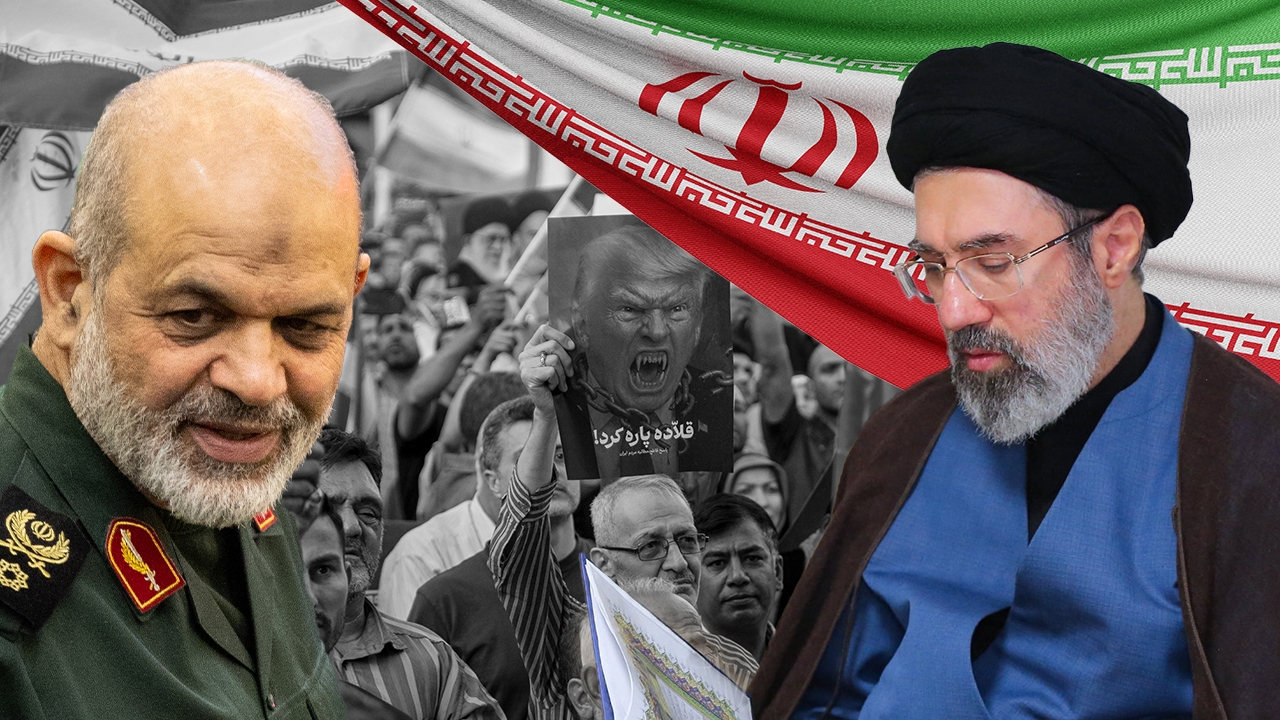
Inside the Power Base "Mojtaba," the leading candidate for Supreme Leader, and "Vahidi," the IRGC commander—hawkish partners shaping Iran's direction in the struggle against the U.S. and Israel.
Iranian politics is at a critical crossroads after the U.S. and Israel launched attacks killing Ayatollah Ali Khamenei, the Supreme Leader on 28 Feb 2026, along with over 40 military and political leaders amid geopolitical tension and internal uncertainty.
Questions about the country's leadership succession are growing, with the most closely watched figure being "Mojtaba Khamenei," the son of Khamenei, who is predicted to succeed his father, and "Ahmad Vahidi," a senior influential military officer who has risen as the new leader of the Islamic Revolutionary Guard Corps (IRGC). These two have become key figures who will determine Iran's future political direction.
The issue intensified when Donald Trump, the U.S. president, stated that the U.S. should have a role in deciding Iran's future leader and signaled opposition to the succession of "Mojtaba Khamenei."

"Mojtaba Khamenei," 56 years old, is the second son of "Ayatollah Ali Khamenei," the late Supreme Leader who was assassinated. Although he held no official government position, within Iranian political circles he is viewed as a highly influential figure and the "power behind the scenes" of the ruling system.
Born in 1969 in Mashhad, Iran, he studied religion at the Hawza seminary in Qom, the Shiite religious educational center. He currently holds the title of Ayatollah, an essential qualification for anyone who may ascend to the country's Supreme Leader position.
His power network is also connected to the political elite through family ties; he is married to the daughter of Gholam Ali Haddad-Adel, a former parliament speaker and influential conservative politician.
Though Mojtaba lacks a prominent public political record like other politicians, his true role lies within the state's security network. A key influence is hisclose relationship with the Islamic Revolutionary Guard Corps (IRGC),particularly the Basij volunteer forces, which are the main force controlling domestic order.
Additionally, Mojtaba plays an important role in the Supreme Leader's Office administration, or "Beit-e Rahbari," the center of political, security, and economic power of Iran's leader. It is said that many major state decisions hardly occur without his knowledge or approval.
Mojtaba Khamenei has been sanctioned by the U.S. since 2019. Politically, he has been criticized for supporting "Mahmoud Ahmadinejad" to win the presidency in 2005 and 2009, leading to intense conflicts with reformist political groups.
Analysts believe he played a major role in ordering the crackdown on the Green Movement protests after the 2009 election. Reformists see him as a key figure in suppressing demonstrations triggered by allegations of election fraud. His name was chanted in protest on the streets. Mostafa Tajzadeh, a senior reformist party member imprisoned after the election, claimed his and his wife's legal cases were directly orchestrated by Mojtaba.
For more than a decade, it has been predicted that he will succeed his father. In 2022, he was granted the title of "Ayatollah," a high-ranking Shiite Islamic religious title, and has become a regular presence alongside his father at political meetings. He also holds significant influence over the Islamic Republic of Iran Broadcasting, the government mouthpiece often criticized for producing political propaganda, and plays a key role in managing his father's financial empire.

This momentum intensified when "Ebrahim Raisi," the president elected and known as Khamenei's favorite, died in a helicopter crash in 2024, increasing focus on Mojtaba as the likely Supreme Leader successor, especially as another top contender disappeared. He also enjoys strong trust from both the Supreme Leader and military networks, with close political allies including Ahmad Vahidi, the newly appointed IRGC commander, Hossein Taeb, former IRGC intelligence chief, and Mohammad Bagher Ghalibaf, the current parliament speaker.
With a deeply embedded power network in the state structure, many view Mojtaba as the de facto successor of the Khamenei regime and a "hardliner" or staunch conservative leader. If chosen by the Assembly of Experts, which has 88 members, it would strongly signal that Iran has no intention of changing its policy direction.
However, the idea of father-to-son succession remains sensitive in Iran as it could resemble a monarchy system, which the 1979 Islamic Revolution sought to overthrow.
Another highly watched figure at present is "Ahmad Vahidi," a senior military officer appointed as commander of the Islamic Revolutionary Guard Corps (IRGC), a central power hub in Iran, especially during times of military confrontation and tension with the U.S. and Israel.
Vahidi took over after several IRGC commanders were killed amid escalating conflicts, leading to multiple leadership changes in a short period. He is among the IRGC's founding members post-1979 Islamic Revolution and rapidly rose through the ranks during the 1980s.

In the mid-1980s, reports indicate Ahmad Vahidi was involved in secret contacts between Iranian representatives and intermediaries close to President Ronald Reagan's administration, linked to the infamous "Iran-Contra" scandal. The U.S. allegedly facilitated secret arms sales to Iran for use in the war against Iraq, with proceeds supporting Contra rebels in Nicaragua, in exchange for Iran helping negotiate with Hezbollah to release American hostages.
Ali Alfoneh, an Iran expert at the Arab Gulf States Institute in Washington, told Al Jazeera that Vahidi has "deep familiarity" with Israel and the U.S. from his involvement in these secret talks.
This background means his image is not just that of a hardliner but also a pragmatic operator who once cooperated secretly with America's top adversary.
Iranian state media report he commanded the Quds Force from 1988 to 1997 before handing over command to Qasem Soleimani in 1998. Soleimani was killed in a U.S. drone strike in 2020 under President Donald Trump's orders.
Vahidi's role extends beyond the military; he also served as defense minister under Mahmoud Ahmadinejad's government and later as interior minister in Ebrahim Raisi's administration before leaving office in 2024.
His combined military, bureaucratic, and political experience makes him a highly influential figure in Iran's power structure. However, Vahidi is internationally linked to serious allegations.
Interpol issued a "red notice" at Argentina's request, accusing him of possible involvement in the 1994 AMIA bombing of a Jewish community center in Buenos Aires that killed 85 people. Iran denies these allegations, and both the U.S. and European Union have sanctioned him for roles in suppressing nationwide protests following the death of "Mahsa Amini," who was detained in 2022 for improper hijab wearing.

Analysts see the comparison between "Mojtaba Khamenei" and "Ahmad Vahidi" as reflecting two main pillars of Iranian state power: on one side, the religious and familial network of the ruling leader dominating politics for decades; on the other, the IRGC's power, which has become a key state mechanism in security, economy, and geopolitics.
As Iran faces war pressures and international sanctions, maintaining state stability is critical. Whoever ascends to Supreme Leader, this transition is likely to shape Iran's political, security, and global role for decades to come.
Source:BBC,The Guardian