

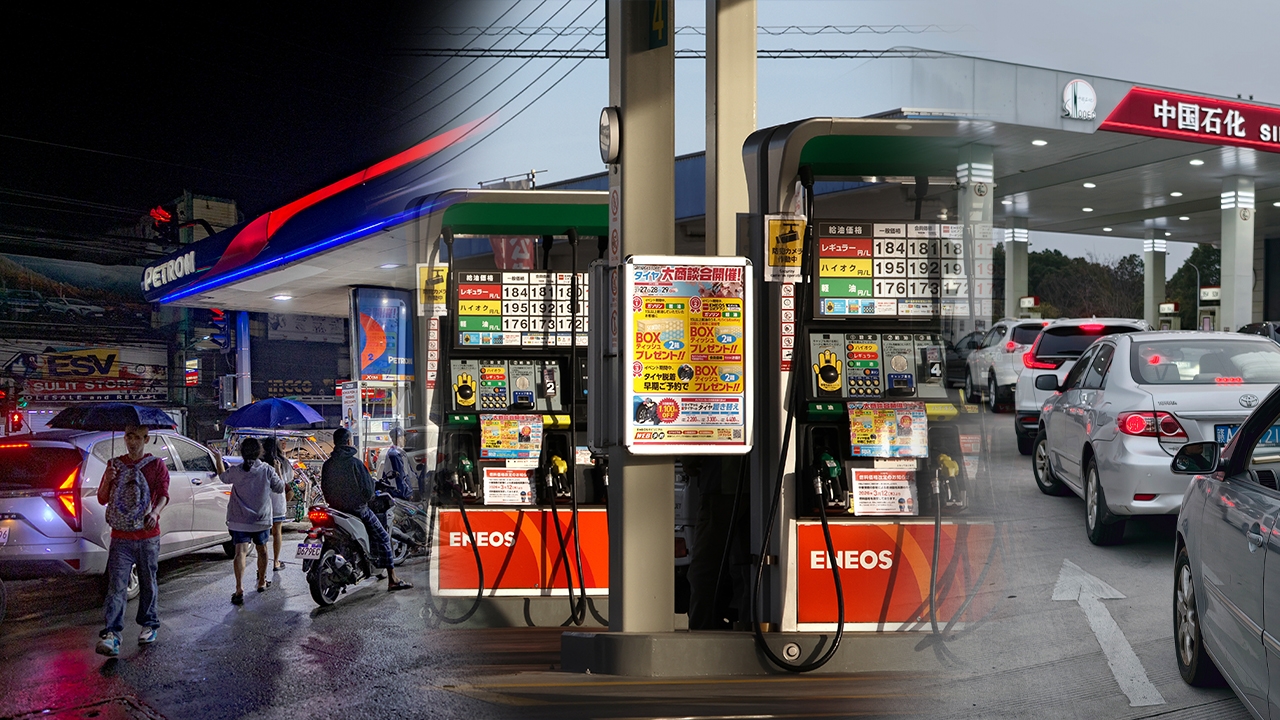
Examining the measures of 10 Asian countries to cope with the crisis of high oil prices and shortages caused by the Iran war, as they are the main destinations for oil from the Strait of Hormuz.
Global oil prices have been highly volatile due to tensions from the Middle East war and the closure of the Strait of Hormuz, a key transit route for oil from the Persian Gulf countries, putting significant pressure on the world economy, especially the region. "Asia" which receives 90% of the oil and gas passing through this strait. This has forced many countries to urgently adopt emergency measures ranging from price controls and subsidies to restrictions on public energy consumption.
China is a major oil customer of Iran and is directly affected by the ongoing conflict. Reports indicate that China has issued orders to ban the export of all types of oil products, including gasoline, diesel, and jet fuel, to reserve supplies for domestic use.
Furthermore, China has accelerated oil imports from Russia, setting a record in February 2026 with approximately 2.08 million barrels per day, an increase of 21.4% from January. Meanwhile, oil imports from Iran decreased from 1.25 million barrels per day in January to 1.03 million barrels per day in February.
China also maintains a large strategic and commercial oil reserve of about 1.3 to 1.4 billion barrels, sufficient to cover roughly four months of imports. As of 16 March 2026, diesel prices in China stood at around 36 baht per liter.

Although Japan is structurally vulnerable in energy due to its reliance on imports for about 80% of its oil and fossil fuel needs, it has a significant advantage: a large oil reserve ranked among the largest globally, able to sustain domestic consumption for up to 254 days.
The Japanese government decided to release a large volume of oil reserves, starting with private sector stocks equivalent to 15 days, followed by gradual releases from government reserves totaling about 80 million barrels.
Concurrently, the government introduced gasoline price subsidies to keep prices around 35 baht per liter, compensating wholesalers if market prices exceed the ceiling. This helps mitigate short-term shocks while maintaining economic stability and consumer confidence. The subsidy aims to keep gasoline prices below 170 yen per liter, approximately 34 baht.
India is another heavily affected country since over half of its oil and gas shipments pass through the Strait of Hormuz. The Indian government is diversifying crude oil sources, increasing imports from 27 to 40 countries and raising the share of shipments through routes bypassing the Strait of Hormuz to 70%.
Additionally, India received a one-month waiver from the United States (starting 5 March 2026) allowing the import of Russian oil stranded at sea to alleviate impacts from the strait's closure.
The government also subsidizes price differences to protect the cost of living, especially for low-income groups under the PMUY program (supporting cooking gas for over 10.5 million low-income households). As of 16 March 2026, diesel prices in India were about 30 baht per liter.
The Singapore government does not directly intervene in oil prices but allows them to fluctuate with the global market, resulting in high volatility. Some gas station operators have adjusted prices multiple times a day, with octane 95 fuel reaching levels surpassing those during the 2022 energy crisis.
Nearly half of Singapore's natural gas is imported via pipelines from regional countries, supplemented by liquefied natural gas (LNG) imports from sources such as the United States and Australia to reduce reliance on a single supplier.
The government has appealed to the private sector and households to conserve electricity and choose energy-efficient appliances. It has also launched targeted assistance programs, providing eligible households with electricity rebates (U-Save) up to SGD 570 (about 14,000 baht) and Climate Vouchers worth SGD 400 (about 10,000 baht) to ease living costs and encourage energy-efficient appliance use.
The government emphasized readiness to expand aid measures for households and businesses if the global energy situation prolongs or worsens. As of 9 March 2026, diesel prices in Singapore were about 115 baht per liter.

Despite rising oil prices in Vietnam, with gasoline up 7.66% and diesel up 1.6%, the government has used its oil price stabilization fund to provide subsidies, along with reducing and exempting certain environmental protection taxes.
Beyond pricing measures, the government promotes telecommuting, encourages public transportation, and campaigns to reduce private vehicle use.
A task force on energy security has been established to prepare for long-term volatility, reflecting a shift from short-term fixes to structural risk management. As of 10 March 2026, diesel prices in Vietnam stood at about 37.79 baht per liter.
In the Philippines, where an open oil market operates under the Oil Deregulation Law, the government has limited capacity to directly control prices.
However, the government has negotiated with oil companies for phased price increases over 2-3 days to lessen impact on consumers and plans to suspend excise taxes on oil products.
Additionally, measures include ordering some civil servants to work from home at least one day per week and banning nonessential government travel. Cash aid ranging from 3,000 to 5,000 pesos (approximately 1,500 to 3,000 baht) has been provided to groups such as tricycle drivers, farmers, and fishers. As of 10 March 2026, diesel prices were about 62.26 baht per liter.
Laos has increased the frequency of oil price reviews from every seven days to every 2-3 days, enabling quicker government response to global market volatility, reducing domestic risks, and enhancing regulatory oversight.
The government continues to control prices through official pricing and strictly enforces compliance among operators. As of 10 March 2026, diesel prices in Laos were about 49.80 baht per liter.
Cambodia relies almost entirely on imported oil and lacks domestic refineries, causing rapid oil price increases—gasoline up over 30% and diesel by about 70%. Domestic reserves last less than 30 days.
The government has applied strict measures including monitoring oil hoarding, penalizing violating operators, and reducing taxes to ease public burdens.
However, structural limitations restrict government intervention scope, making Cambodia inevitably subject to global market fluctuations. As of 17 March 2026, diesel prices were about 52.78 baht per liter.

Myanmar has implemented alternating day driving restrictions based on license plate numbers (odd-even system). For example, vehicles with plates starting with 2A or 4A may only drive on even days, while those with 1A or 3A plates can drive only on odd days.
This measure applies to personal vehicles using fuel, including passenger cars, commercial vehicles, and buses, but excludes electric vehicles, public buses, taxis, oil transporters, construction material carriers, large trucks, ambulances, hearses, and garbage trucks.
The government also strictly prohibits business owners and individuals from hoarding fuel for speculative purposes. As of 9 March 2026, diesel prices in Myanmar were about 42.98 baht per liter.
The Sri Lankan government announced reducing the workweek to four days, designating Wednesdays as official holidays to conserve the country's fuel reserves. This shutdown also covers schools and universities but excludes essential services such as healthcare and immigration.
Additionally, the government employs fuel rationing through a "National Fuel Pass" system, limiting purchase quotas to 15 liters per personal vehicle and 5 liters per motorcycle per transaction. Some citizens have criticized these amounts as insufficient for daily use. As of 10 March 2026, diesel prices in Sri Lanka were about 31.47 baht per liter.