

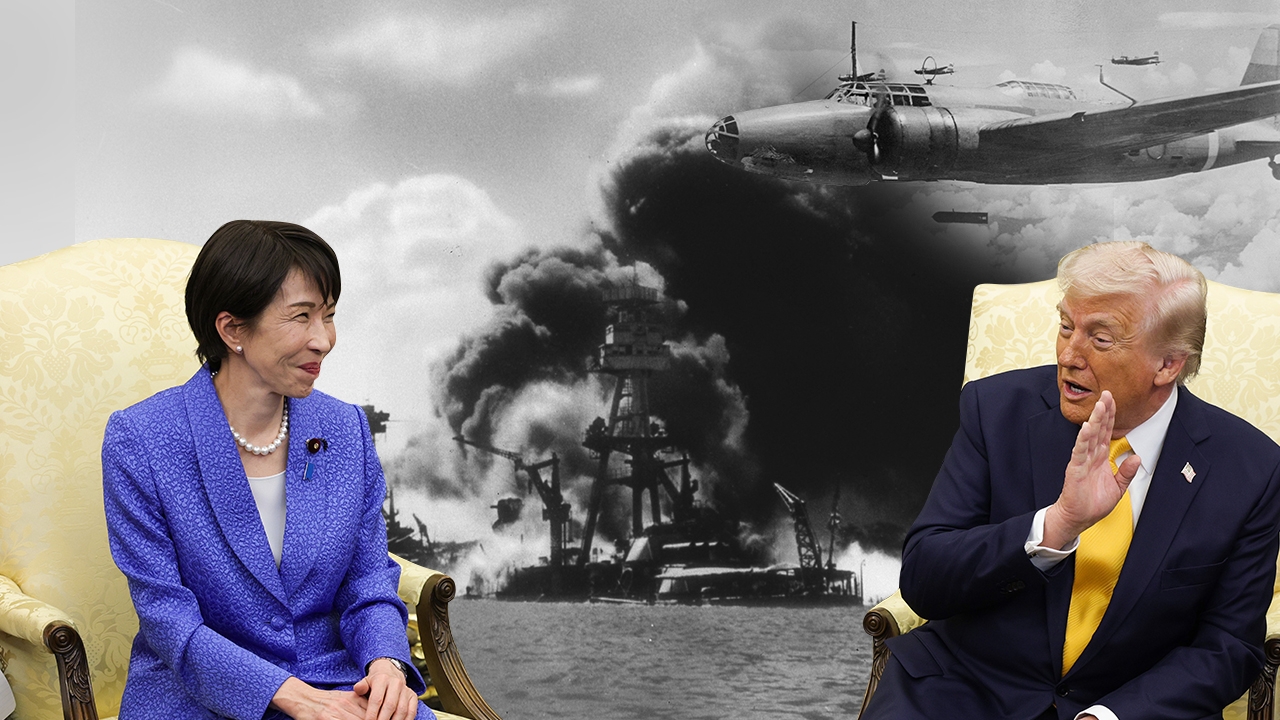
A historical look back at the Pearl Harbor attack, the war's tears. Donald Trump's joking remarks have reduced "Pearl Harbor" to just a joke, but behind that lies one of the tragedies that permanently changed world history.
"Who knows how to surprise better than the Japanese?" Donald Trump said, adding, "So why didn’t you tell me about Pearl Harbor? Is that okay?"
These seemingly playful words were spoken in the Oval Office during a meeting with Japanese Prime Minister Sanae Takaichi at the White House in Washington, D.C., to discuss the Middle East conflict and bilateral cooperation.

Donald Trump made the joke in front of Japanese Prime Minister Sanae Takaichi after a reporter asked why the U.S. did not notify its ally Japan in advance before the Iranian military operation. Trump replied, "One reason is you don’t want to give away too much. You know when we invaded, we did it heavily, and we didn’t tell anyone because we wanted to surprise them," then he referenced Pearl Harbor as a metaphor.
The problem is that "Pearl Harbor" is not just a metaphor or a joke; it is a memory of loss etched deeply in world history.
The war dates back to the morning of 7 December 1941 at 07:48 a.m., when the Imperial Japanese Navy launched 177 aircraft to attack the U.S. naval base at Pearl Harbor on Oahu Island, Hawaii. The goal was to destroy the U.S. Pacific Fleet before the U.S. could respond to Japan’s simultaneous military operations in Southeast Asia.
The attack began suddenly and systematically. Bombers struck airfields, bombed hangars, and targeted aircraft still parked on the ground. Meanwhile, other planes flew low over the water, firing torpedoes at warships lined up in the harbor with almost no chance to defend themselves.

Within the first five minutes, four battleships were heavily attacked, including the USS Oklahoma and USS Arizona. Shortly after, the Arizona exploded, tearing apart and sinking rapidly, killing 1,177 crew members—one of the greatest single-day losses in U.S. Navy history.
An hour later, a second wave of 163 Japanese planes followed up, striking targets again and crippling the U.S. military infrastructure on the island.
In just two hours, the damage was clear: 21 warships sunk or damaged, 188 aircraft destroyed, and 2,403 deaths among military personnel and civilians.
However, the three aircraft carriers of the Pacific Fleet were not at Pearl Harbor that day, sparing them from attack and later making them the core strength of the U.S. in the Pacific battles.
The next day, the United States declared war on Japan and fully entered World War II. The Pearl Harbor event was not merely a surprise attack but a turning point that propelled the country into global conflict and shifted 20th-century power balances.

Its impact extended beyond the battlefield. Many surviving sailors bore physical wounds—burns from explosions, metal fragments embedded in their bodies, and loss of limbs from collapsing shipwrecks.
The psychological scars were equally profound. Post-Traumatic Stress Disorder (PTSD) haunted many, who lived with memories of flames, explosions, and fallen comrades witnessed firsthand.
Thus, the Pearl Harbor war was not just a historical battle but a loss that claimed lives, left scars in memory, and caused enduring repercussions across decades.
This makes the attempt to turn the tragedy into laughter ironically reflect the opposite—when the history of loss is reduced to a mere “joke” in the press room.
