

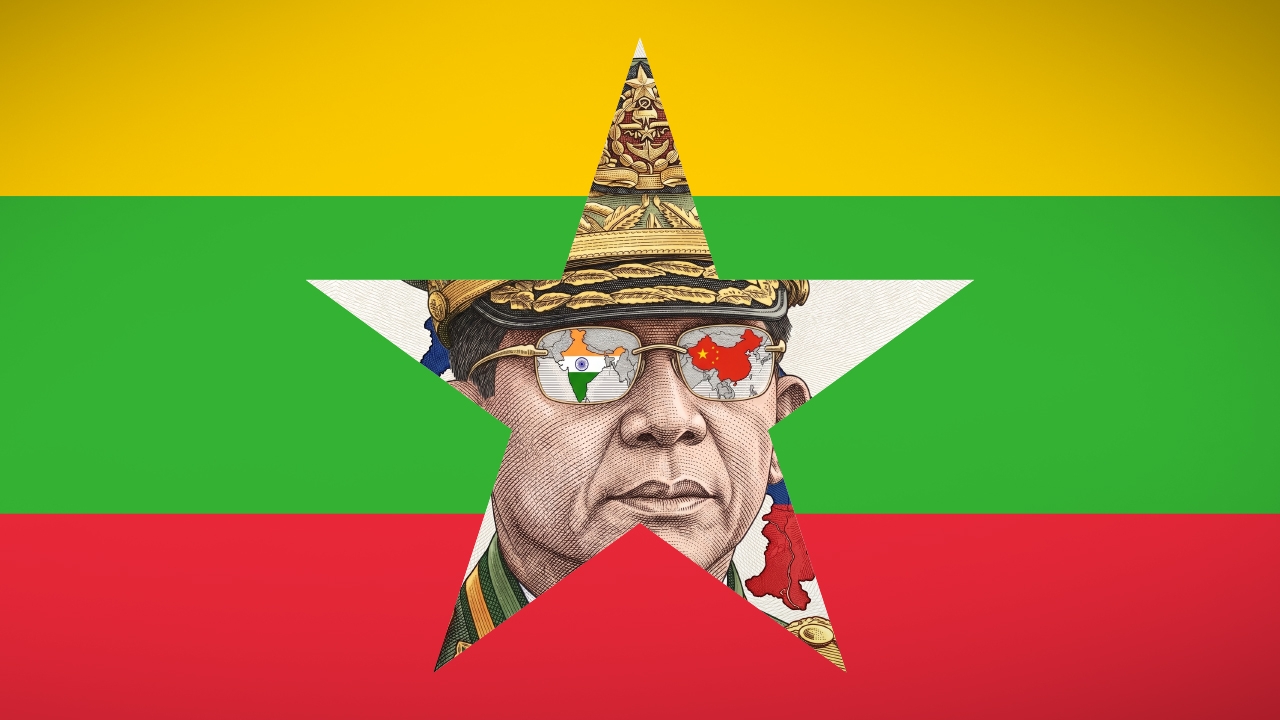
Decoding Min Aung Hlaing's foreign policy strategy: strengthening ties with the two major powers, China and India, followed by Laos, signaling bilateral friendships while ignoring ASEAN's pressure and consensus.
The visits India followed by China and Laos of Min Aung Hlaing As Myanmar’s head of state, Min Aung Hlaing’s visits carry strategic significance both for Myanmar itself and the regional level, beyond merely seeking legitimacy after elections. The countries he chose to visit after Myanmar’s transition to a civilian government are neighboring countries with contiguous borders and intense shared strategic interests in multiple areas, as follows.

Firstly, Border security issues Myanmarshares borders with India (1,643 kilometers), China (2,129 kilometers), and Laos (238 kilometers), with numerous security concerns, especially movements of opposition groups. On the Indian side, groups opposing India include the Nagas, Meitei, and various Assam Liberation Forces, such as the National Socialist Council of Nagaland, United Liberation Front of Asom, People’s Liberation Army of Manipur, and People's Revolutionary Party of Kangleipak, active in India’s northeast region.
Meanwhile, opposition groupsTatmadawsuch as the Chin National Front, Chin Brotherhood Alliance, and People’s Defense Forces, mainly operate in Myanmar’s northwest, particularly Chin State and the Sagaing region.Myanmarespecially in Chin State and Sagaing region.
These armed groups not only cross borders frequently, but there are reports of mutual aid among them for survival or specific objectives, prompting central governments in Myanmar and India to seek cooperation for border stability and security, a shared strategic interest.
On the Chinese border, security issues differ from those on the Indian side. China exerts influence over several ethnic armed groups, notably the Kachin, Kokang, and Wa forces such as the Kachin Independence Army, Myanmar National Democratic Alliance Army, and United Wa State Army. This weakens or renders ineffective Myanmar's central government control in Naypyidaw over these groups, as they operate with considerable autonomy, having independent political and economic systems separate from Myanmar's central government, while maintaining close ties and economic interests linked to China.
Thus, Myanmar must seek strong cooperation from China to maintain stability and security along its northern and northeastern borders, while China restrains Myanmar from harshly suppressing these groups to avoid harming Chinese interests within Myanmar and along the border.
Myanmar’s border with Laos is relatively short, with most issues related to drug trafficking and cross-border smuggling, especially in the Golden Triangle and along the Mekong River. Recently, human trafficking and illegal cross-border labor migration to scam centers in parts of Shan State have increased. Myanmar and Laos must cooperate bilaterally and multilaterally to address these cross-border problems.

Secondly, Geographically, Myanmar serves as a link between China and India, or conversely can physically connect both China and India. Thus, China and Myanmar have established an economic corridor connecting transport and logistics from the Indian Ocean. The Kyaukpyu Project in Rakhine State passes through central Myanmar to southwest Yunnan Province, shortening previous transport routes through the Strait of Malacca, representing a crucial strategic route for China.
India has a similar project, the recently opened Sittwe Port, part of a multimodal transport network,the Kaladan Multi-Modal Transit Transport Project,which connects India’s landlocked northeast through Chin State and Rakhine State in Myanmar without passing through Bangladesh.
India also has an older overland route connecting its northeast to Myanmar and Thailand, initiated in the early 21st century, another strategic corridor India aims to link to mainland Southeast Asia.
Thirdly, Shared economic interests India is currently Myanmar’s 11th largest investor, with 39 projects valued at about 782 million USD. During his visit, Min Aung Hlaing discussed with Prime Minister Narendra Modi plans to raise bilateral trade from over 2 billion USD annually to 3 billion USD initially, aiming to reach 5 billion USD in the future.
The Myanmar leader brought close business figures seeking opportunities and discussed accelerating payment systems, enhancing banking cooperation, and using the Indian rupee and Myanmar kyat for direct trade settlements.
Myanmar and China’s economies are deeply linked; China remains Myanmar’s largest trading partner. Chinese official data indicates bilateral trade in 2025 was about 19.4 billion USD, up 19.1% from the previous year despite global economic uncertainties. In the first two months of 2026, trade reached 3.73 billion USD, a 50.8% increase over the same period last year.
Beyond trade, China is one of Myanmar’s top foreign investors across sectors like telecommunications, textiles, energy, and infrastructure, including the China–Myanmar Economic Corridor (CMEC), a core pillar of bilateral economic cooperation. It is unsurprising that the Myit Sone dam project in Kachin State was revived following Min Aung Hlaing’s visit to China.

Fourthly, The Myanmar military, or Tatmadaw, maintains close ties with both China and India, to the extent that both nations have provided submarines as gestures of goodwill. China remains Tatmadaw’s largest arms supplier, providing fighter jets, air defense systems, armored vehicles, warships, and guided missiles. China also supports Myanmar’s defense industry and shipyards. Myanmar received a Type-35B Ming-class submarine from China in 2021, which remains operational. Many Myanmar frigates and patrol vessels use Chinese weaponry and electronics.
Notably, China’s military policy is complex: it supports Myanmar’s government at the state level while maintaining contact and support for several ethnic armed groups along the northern border to preserve its influence and interests. In other words, China does not bet on one side alone but seeks to maintain influence with all key players affecting border stability.
India’s approach differs significantly from China’s. India’s primary goal is not to be a major arms supplier but to ensure security in its northeast states, suppress insurgents, and protect economic connectivity projects.
India continues to train Tatmadaw personnel, exchanges intelligence, coordinates border operations, and holds ongoing military-level meetings. Despite internal criticism in India about its stance after Myanmar’s coup, security cooperation persists due to shared interests in controlling border armed groups.
Similarly, India provided Myanmar’s first submarine, INS Sindhuvir (Kilo class), in 2020, renamed UMS Minye Theinkhathu. India also trained submarine crews and supplied anti-submarine torpedoes to Myanmar’s navy.
However, since 2021, there have been no reported major arms deliveries. Cooperation focuses on training, border coordination, intelligence sharing, and counterinsurgency rather than arms sales.

Fifthly, diplomatically, Min Aung Hlaing’s choice to visit India and China first reflects that Myanmar’s government prioritizes strengthening relationships with neighboring countries that share clear strategic interests, particularly in border security, economic connectivity, and infrastructure development, over hastening to restore relations with ASEAN as a regional organization of whichMyanmaris a member.
Since the 2021 coup, Myanmar’s relations with ASEAN have faced constraints due to differing member views on Myanmar’s political situation. Many countries openly reject the military government,while ASEAN has repeatedly excluded Myanmar’s official representatives from ministerial and summit meetings, citing lack of progress on the Five-Point Consensus. Min Aung Hlaing has responded by disregarding ASEAN’s demands, including refusing to allow ASEAN representatives to meet Aung San Suu Kyi.In this context, it is unsurprising that Myanmar emphasizes strengthening relations with countries willing to advance cooperation based on concrete shared strategic interests, despite differing views on Myanmar’s internal politics.
Choosing Laos as the first ASEAN member country to visit signals that Myanmar does not intend to diminish ASEAN’s role entirely but is distinguishing between ASEAN as an organization and individual ASEAN member relations. While organizational ties are politically constrained, bilateral relations continue based on each country’s interests and stance, enabling Myanmar to build and expand cooperation with ASEAN members open to interacting with the Naypyidaw government.
All this shows ASEAN needs to reconsider the limitations of its approach toward Myanmar over recent years, as pressured member states increasingly expand diplomatic space through bilateral relations with neighbors.
Importantly, if Min Aung Hlaing can consistently build and deepen ties with individual ASEAN members, ASEAN as a regional organization may struggle to maintain unity and consensus on the Myanmar issue.