

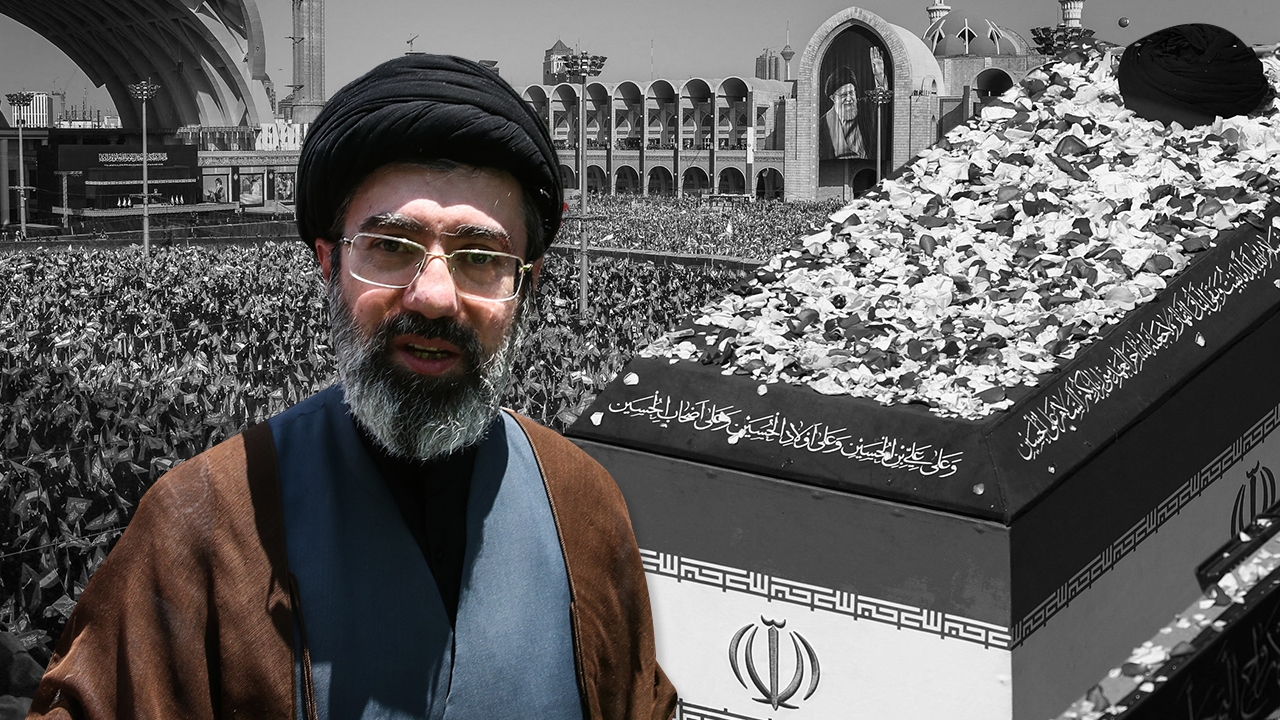
Iran held a grand funeral for former Supreme Leader Ali Khamenei, with the conspicuous absence of Mojtaba, the new leader, fueling speculation whether he is keeping a low profile to avoid assassination or confirming rumors of injury.
Iran held a funeral Ayatollah Ali Khamenei the former Supreme Leader, along with his daughter, son-in-law, daughter-in-law, and granddaughter, all of whom died in an airstrike on 28 February, marking the outbreak of war between the U.S.-Israel alliance and Iran.
The funeral was held on Friday, 3 July, at the Grand Mosalla Mosque in Tehran, Iran’s capital, a key religious venue.

Iranian authorities called this event "the funeral of the century." The ceremony was planned to continue throughout the week across Iran and Iraq, with an expected attendance of 12 to 20 million people. The schedule was as follows:
3-5 July: Funeral services began at the Grand Mosalla Mosque in Tehran, open to the public for mourning.
6 July: The funeral procession moved through central Tehran.
7 July: The procession traveled through Qom, the center of Shia Islamic education.
8 July: The procession passed through Najaf and Karbala in Iraq.
9 July: Burial took place at the Imam Reza Shrine in Mashhad, Iran, Khamenei’s hometown.
Ayatollah Ali Khamenei ruled Iran since 1989 CE until his assassination. Mojtaba Khamenei, his second son, succeeded him as Supreme Leader.
At the funeral, Khamenei’s three sons — Mostafa (eldest), Masoud (third), and Meysam (fourth) — appeared publicly, a rare occurrence. They attended alongside high-ranking officials including President Masoud Pezeshkian, Parliament Speaker Mohammad Bagher Ghalibaf, IRGC Commander Ahmad Vahidi, and Quds Force Commander Esmail Ghaani. However, Mojtaba, the new Supreme Leader, was notably absent.

The global mystery centers on the disappearance of Mojtaba Khamenei, who assumed the Supreme Leader role after his father. He has not been seen publicly since his appointment in early March, and his absence from his father’s funeral deepens the enigma.
Rumors and speculation about Mojtaba’s status persist, including unconfirmed reports that he was wounded in the same airstrike that killed Ali Khamenei. Iranian authorities have not officially confirmed these reports, leaving his condition uncertain.

Some analysts suggest Mojtaba’s absence at the funeral is primarily due to security concerns, fearing Israel might seize the occasion to attack or assassinate him. His low profile is seen as a protective strategy during a fragile ceasefire and ongoing peace negotiations between the U.S. and Iran, both parties threatening renewed military action.
The U.S. news site Axios reported President Donald Trump said on Saturday (4 July) that peace talks were temporarily paused for a week to allow the funeral to conclude.
Trump reportedly remarked that many senior Iranian officials attended the funeral and that Washington had the capability to eliminate them all in "one strike." However, he added that the U.S. would not do so, as it would leave no one to negotiate with. He also expressed surprise at seeing Iranians mourn, stating he thought they hated Khamenei, and said, "Maybe the tears are fake."

Meanwhile, the funeral atmosphere in Iran was somber, with large crowds mourning. Some shouted curses at Donald Trump, chanting “Death to America” and “Death to Israel.” Due to the heat, water sprays were used, and many attendees fainted and required medical attention.
Iran's official IRNA news agency reported on 5 July that over 4,000 people used medical services at and near the Grand Mosalla, though no deaths were reported.

Source:Al Jazeera,BBC