

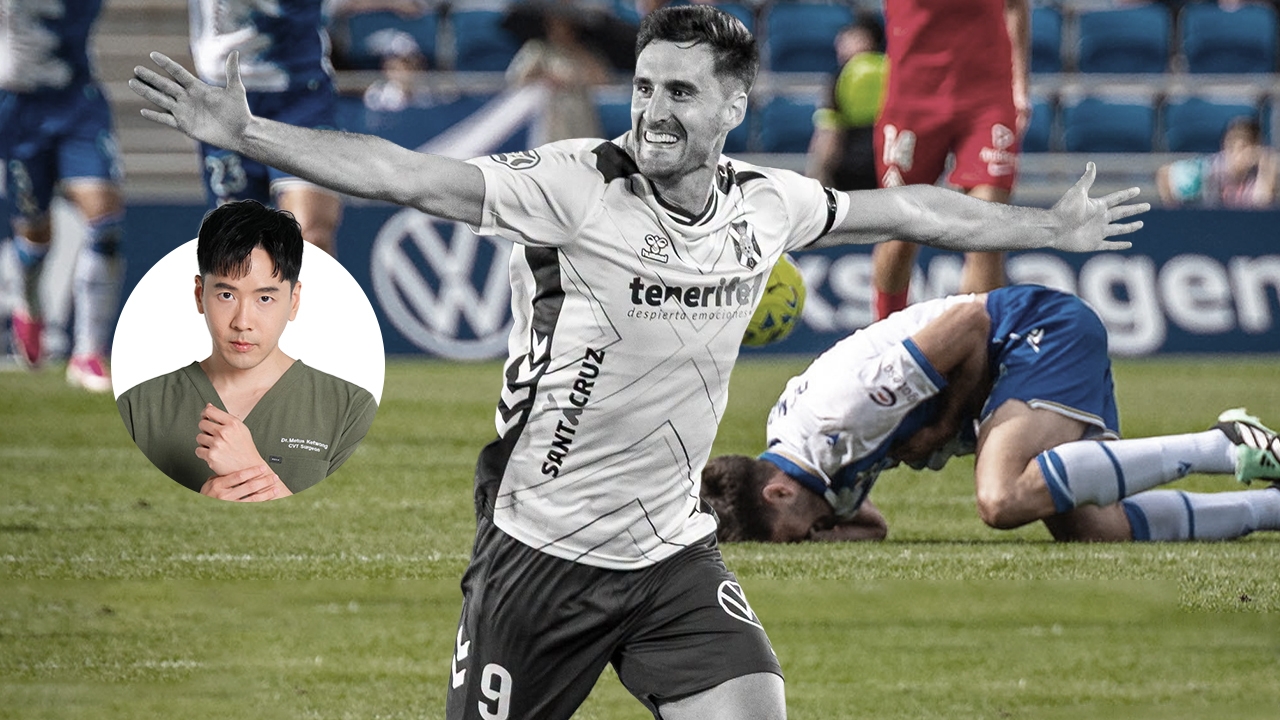
A cardiologist warns about "Commotio Cordis," a condition where a sudden chest impact causes cardiac arrest, revealing that the first three minutes are critical for survival.
Following the death of 30-year-old forward Jesús de Miguel of Tenerife after a heavy collision with Jesús Ovono, goalkeeper of FC Andorra in Spain's Segunda Division, Dr. Methas Ketwong, a cardiothoracic surgeon and owner of the Facebook page “Bad Fat with Dr. Methas,” published a commentary on this incident.
Dr. Methas provided information about a medical condition called “Commotio Cordis,” which is one possible cause of such events, but he clarified it is not a confirmed cause in the case of the player involved.
Commotio Cordis occurs when a blow to the chest directly over the heart causes severe electrical disturbance, leading to ventricular fibrillation (VF), preventing the heart from pumping blood effectively, and resulting in loss of consciousness within seconds.
The alarming aspect is that this can happen to individuals with normal heart anatomy and no underlying heart disease, and the impact need not be strong enough to fracture ribs; the crucial factor is the timing of the blow during a brief vulnerable electrical phase of the heart.
Data from U.S. patient registries show most cases occur in males, averaging around 15 years old, often during sports involving balls or hard equipment such as baseball, hockey, and lacrosse. However, football and contact sports also carry risk.
The most important factor is prompt life-saving intervention.
Dr. Methas stated that rapid CPR and use of an automated external defibrillator (AED) significantly improve survival chances. He cited data indicating about 40% survival if resuscitation occurs within 3 minutes, dropping to roughly 5% if delayed beyond that.
He cited the example of Damar Hamlin, an NFL player who lost consciousness on the field after a chest impact in 2023 but survived following immediate CPR and AED use and was able to return to play.
Six steps to take if someone loses consciousness after a chest impact:
Immediately call emergency hotline 1669.
If unresponsive and not breathing normally, suspect cardiac arrest.
Begin CPR with hard and fast chest compressions at 100-120 per minute.
Have someone quickly bring an AED.
Turn on the AED and follow its instructions.
Continue CPR as directed until medical help arrives or the patient shows signs of life.
Dr. Methas concluded that both professional and amateur sports venues should have AEDs and personnel trained in CPR, because every minute counts during cardiac arrest, and swift help can save a life.
It should be noted that Commotio Cordis is only one possible cause of the incident involving de Miguel; official autopsy results are awaited to confirm the cause of death.