

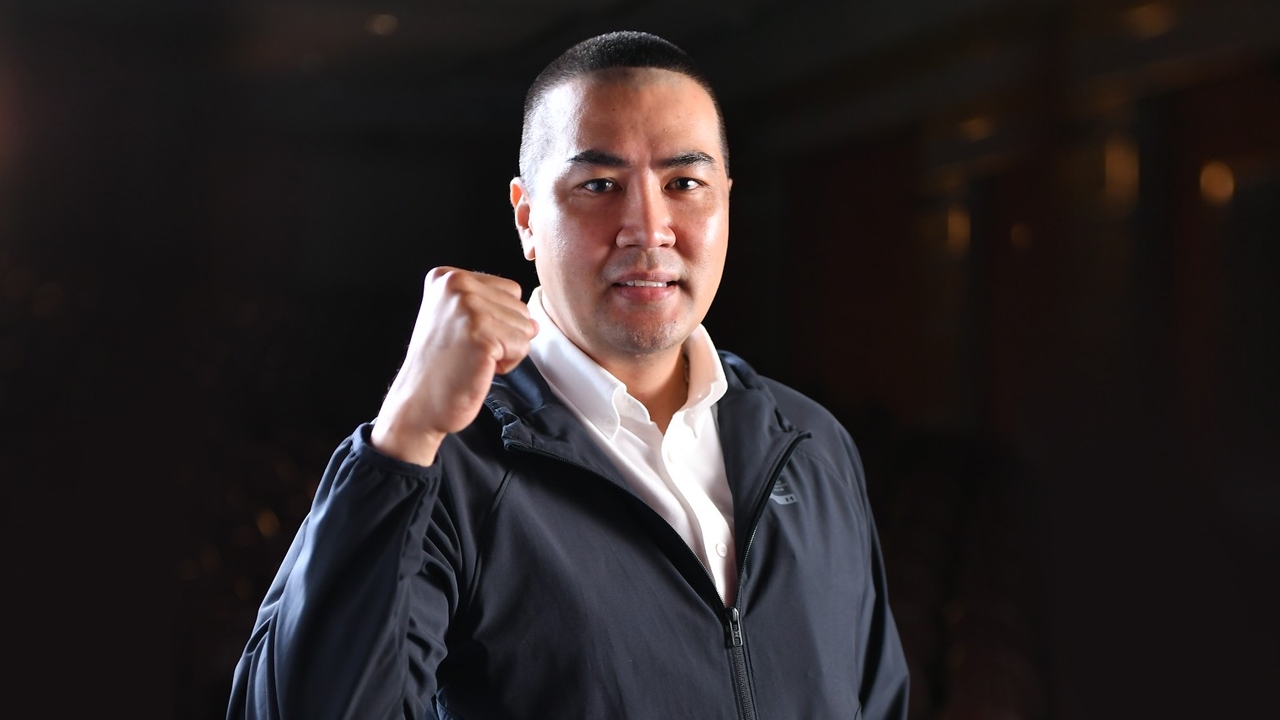
The new role of “Joe Backfoot,” Police Lieutenant Colonel Suebsak Phansueb, as manager of the Thai women's national Sepak Takraw team heading to the SEA Games.
Police Lieutenant Colonel Suebsak Phansueb, former Thai national sepak takraw player and legend who won medals at seven SEA Games and four Asian Games, known by media nicknames “Joe Backfoot” and “Joe Front Jade,” currently serves as deputy traffic superintendent at Bang Thonglang Police Station. He has returned to the sepak takraw arena in a new role as manager of Thailand's national team for the SEA Games competition this December.
After retiring from playing in 2010 and returning to police service, a change in the Thai Sepak Takraw Association's committee led to Suebsak being trusted to join the executive board representing the Police Club. He was assigned to oversee the national team, as the management saw his former athlete experience as valuable for fully supporting and managing the players.
Q: Your new role as national team manager.
Police Lieutenant Colonel Suebsak sees returning to this role as a source of happiness and a great opportunity to apply his experience as a former player to team management.
"Now that I am a team manager, I see this role as caring for the athletes. We already know what we want and don't want. The most important thing athletes need is encouragement during training to strive for victory."
Q: Women's athlete selection: skills, reaction, and age.
The manager acknowledges that today's female athletes have developed significantly, thanks to support from sports schools and increased youth and club competitions.
Regarding athlete selection, the key factor is reaction speed, which directly affects sepak takraw performance requiring high skill and physical power. Therefore, he considers age as part of the selection decision.
"I see sepak takraw as a combination of skill and physicality, with reaction speed being crucial. So I consider age in selection decisions because in any sport requiring reaction and strength, age definitely plays a role."
Currently, the 24-player training squad ranges in age from 17 to around 35, allowing both experienced seniors and talented juniors to play together, as experience remains valuable if reaction speed is maintained well.
Q: Challenges of new rules and diverse events.
Following the SEA Games hosted by Thailand, next year's Asian Games in Japan will introduce additional events like the four-player and mixed (two men, two women) categories, posing new challenges since competitors like Japan perform well in these events.
Additionally, new rules implemented since early this year changed the serve to alternate one serve each per event, whereas previously players served multiple times until losing a point.
"Now, if we score one point on serve, the opponent serves next. This reduces the advantage and makes matches more balanced, so point differences tend to be smaller."
Nevertheless, the manager remains confident in the high standard of Thai sepak takraw, ranked among Asia's best and able to compete with any team, while acknowledging that sports have their ups and downs.
Q: Advantage of hosting the SEA Games.
Hosting the SEA Games this year is seen as a great opportunity, as the manager believes the support from Thai sports fans will fill the sepak takraw arena with cheers.
"This year, as hosts of the SEA Games, I'm confident the sepak takraw stadium will be packed with cheering fans, providing warmth and strong encouragement to the athletes. That definitely gives us an advantage."
Q: Lessons from the past and first SEA Games impressions.
Police Lieutenant Colonel Suebsak recounted his experience joining the senior national team for the first time at the SEA Games at age 18–19, playing alongside senior players he had previously watched on TV.
"I felt excited but confident because of my abilities and good preparation. Playing with experienced seniors made it easier. It was my proud debut at the SEA Games, achieving success in that event."
Q: Caution regarding athletes' social media use.
In an era where all athletes can be their own media, the manager expresses concern and emphasizes caution in social media usage.
"I always remind them that social media is easily accessible. I caution them carefully out of concern because any backlash can happen very quickly."
The most serious warning concerns sharing technical secrets of the team's play via social media.
"My biggest concern is filming and sharing our team's playing style and techniques online. I forbid this from the start because it reveals secrets to opponents. This isn't fun. The Thai national team is a role model for many countries, and if we post details about our style, they watch everything."
Q: Expectations for this SEA Games.
The women's sepak takraw team aims high for this SEA Games, especially in main events like singles, team, four-player, and mixed categories.
"I believe our sepak takraw team cannot afford to lose... we are aiming for 100%."
To handle competition stress, besides technical and physical preparation, the team has invited Dr. Wichit Muangnapho, a sports psychology expert, to assist athletes in mindset and pressure management for optimal motivation.
Q: Support for youth sports.
A key issue the manager wants more support for is youth sports across regions.
"I really want more investment in youth sports because if local youth in central, northeastern, southern, and northern regions play more and receive budget support, we'll develop promising national athletes."
Moreover, supporting youth sports also benefits social aspects.
"Importantly, I see this as a social issue. Kids unsure what to play in their provinces find sepak takraw easy and cheap—shoes cost only a few baht—so it helps prevent drug abuse and various problems."
Q: Encouragement to all Thai national athletes.
As team manager and former athlete, Police Lieutenant Colonel Suebsak Phansueb offers encouragement to all Thai national athletes, stressing the importance of giving their best and bringing honor to the nation.
"I want to encourage everyone to be fully committed. For those who are hunters, we must catch our prey and do our best because we've invested much time in training and competing. The most important thing is to bring honor to our country."