

The hockey rink owner accused the association of arbitrarily ordering staff to issue receipts, emphasizing the major issue of budget overclaiming, and criticized the tactic of lumping unrelated matters together as very outdated.
On 5 Feb 2026 GMT+7, regarding the case where the Ice Hockey Association of Thailand presented evidence defending the claim of excessive budget reimbursement for renting the Thailand International Ice Hockey Arena (TIIHA) in Huai Khwang, Bangkok, for the SEA Games competitions.
The rink owner revealed that the association claimed rental fees averaging about 700,000 baht per month, which is much higher than the actual usage-based rental cost of approximately 200,000 to 300,000 baht per month. In fact, the rink had agreed on a service rate with the association of 13,000 baht per session, with each training lasting between one hour and one and a half hours.
Additionally, Mr. Jumphon told reporters that he had agreed with the association to charge about 13,000 baht per rental session, with an average of no more than six training sessions per week. The problem lies in the issuance of invoices and receipts for amounts greatly exceeding the true figures.
“The actual expense is about 300,000 baht, but the documents submitted for reimbursement were around 700,000 baht, which I was unaware of, did not sign, and did not approve. The documents were issued by staff who believed the rink owner and the association had already agreed,” said Mr. Jumphon, stressing this incident happened only once and was immediately rejected upon discovery.
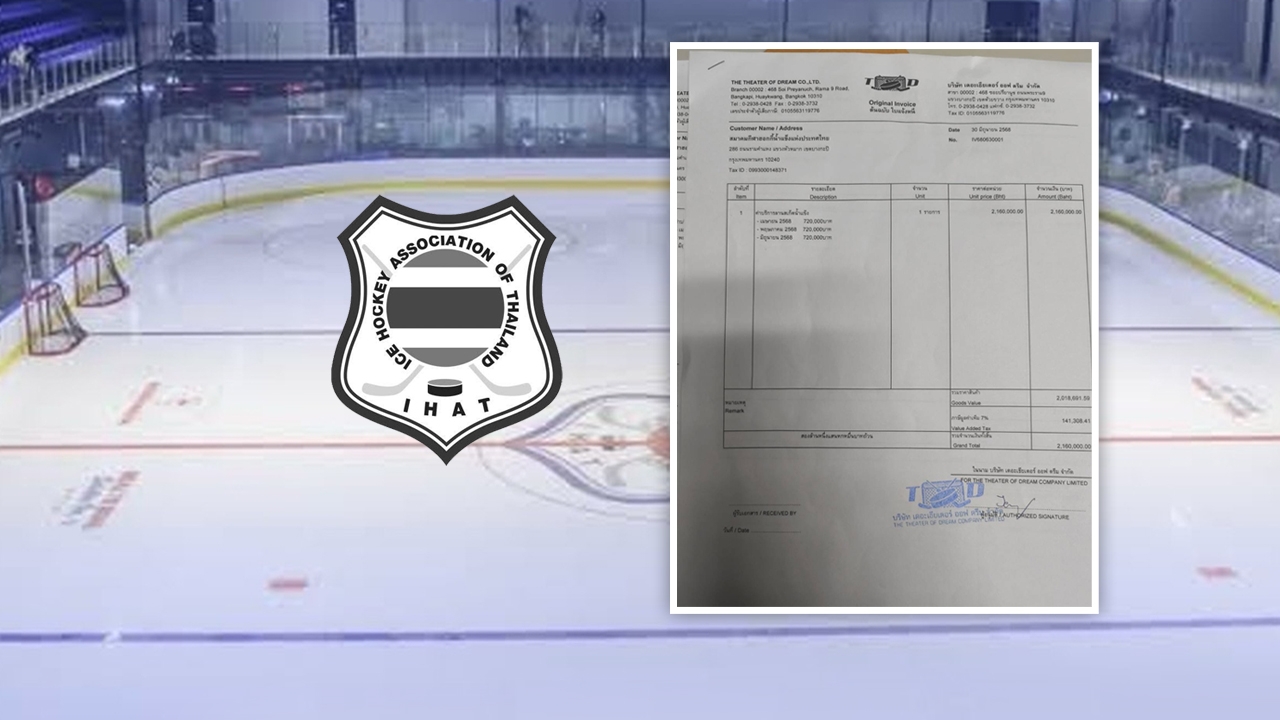
However, the Ice Hockey Association of Thailand released invoices showing not 300,000 baht as Mr. Jumphon claimed, but billing 720,000 baht for April, May, and June, each accompanied by signatures and company stamps from The Theater of Dream Co., Ltd., the official issuer of the invoices from the Thailand International Ice Hockey Arena.
Recently, the rink responded to this information with four points emphasizing that the inflated rental charges resulted from the association arbitrarily instructing rink staff to issue documents without informing management at all.
They also pointed out the core issue is the budget overclaiming, which has already been committed, with details as follows.
1. The rink issued a statement long ago clarifying that documents were issued because the association ordered rink staff to do so without notifying management. The rink never denied issuing the documents.
2. The tactic of lumping everything together by transferring excess claimed funds into a committee member’s account to keep everything under one umbrella is very old-fashioned. They even claimed 720,000 baht monthly given entirely to the rink. The question is, since when has the association been so generous? Previously, they falsely claimed financial hardship and withheld rink fees, including nearly eight million baht in advance payments owed for 2-3 years. Importantly, this money with questionable origins—did anyone ask if the rink wanted it? The transferred funds were likely intended to offset old outstanding debts unpaid for more than three years.
3. The process of working with the Sports Authority of Thailand requires setting a budget for approval first. The association proposed 720,000 baht from the start, clearly showing their intent. Or is the association saying they consulted the rink before setting the budget?
4. Ultimately, the heart of the matter is the wrongdoing of budget overclaiming, which has already occurred. Or will the association claim ignorance even about the true cost of training sessions? (The rink has consistently submitted usage summaries.) Budget claims must comply with the Sports Authority’s regulations and reflect actual figures only. Whether the document issuance was intentional, unintentional, or collusive is a secondary issue.