

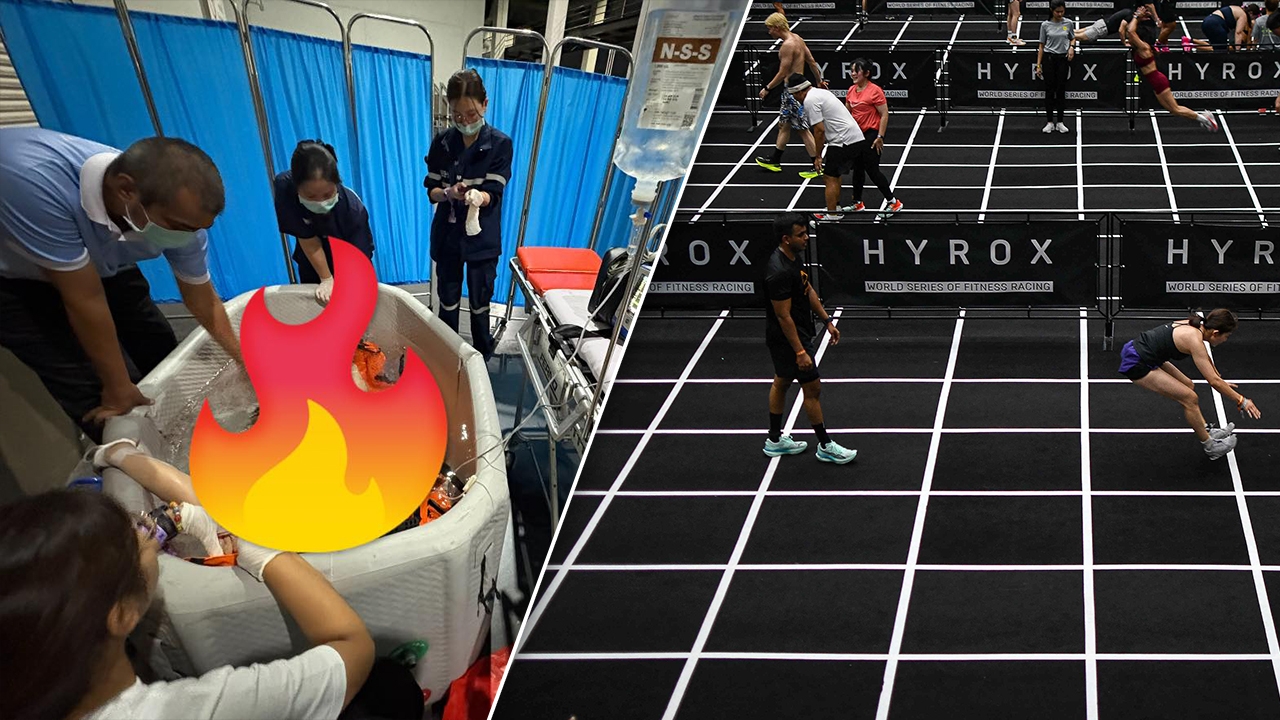
At the global fitness competition HYROX 2026, a dramatic emergency occurred when an athlete suffered heat stroke and lost consciousness during the event, which was held inside an air-conditioned hall, causing great alarm among staff and participants.
On 24 March 2026, reports from the on-site medical team stated that the incident began with a warning from sports science personnel who noticed abnormalities in the athlete. They immediately declared a “Code Red” to provide urgent assistance. Upon reaching the athlete, they found him drowsy with a very high body temperature measured rectally at 41 degrees Celsius, indicating severe heat stroke.
The medical team promptly administered initial care, including intravenous fluids and cooling with cold air, due to space limitations inside the venue. They then decided to move the athlete to an outdoor “ice bath” station with urgent support from staff and venue officials, amidst many athletes still competing.
At the advanced treatment point, the medical team immediately immersed the athlete in an ice bath, gradually lowering his body temperature to about 39 degrees Celsius, after which he began regaining consciousness and was able to communicate. However, the patient experienced "reheat," where his temperature rose again, accompanied by confusion and agitation, requiring initial sedative medication and a repeated ice bath.
After the second treatment, his body temperature decreased to a safe level around 38 degrees Celsius, vital signs stabilized, and he was safely transported to the hospital. The latest report indicates the athlete is stable and expected to be discharged soon.
This incident underscores the importance of monitoring systems and emergency response in sports. Even in a closed, air-conditioned venue, high-intensity events like HYROX carry a risk of heat stroke.
The medical team emphasized that the successful rescue was due to teamwork—from the rapid detection by officials, precise decision-making, to the readiness of equipment and cooperation among all parties at the event—turning what could have been a severe situation into a safe outcome for the athlete.
Photo credit: Mai Rossakorn