

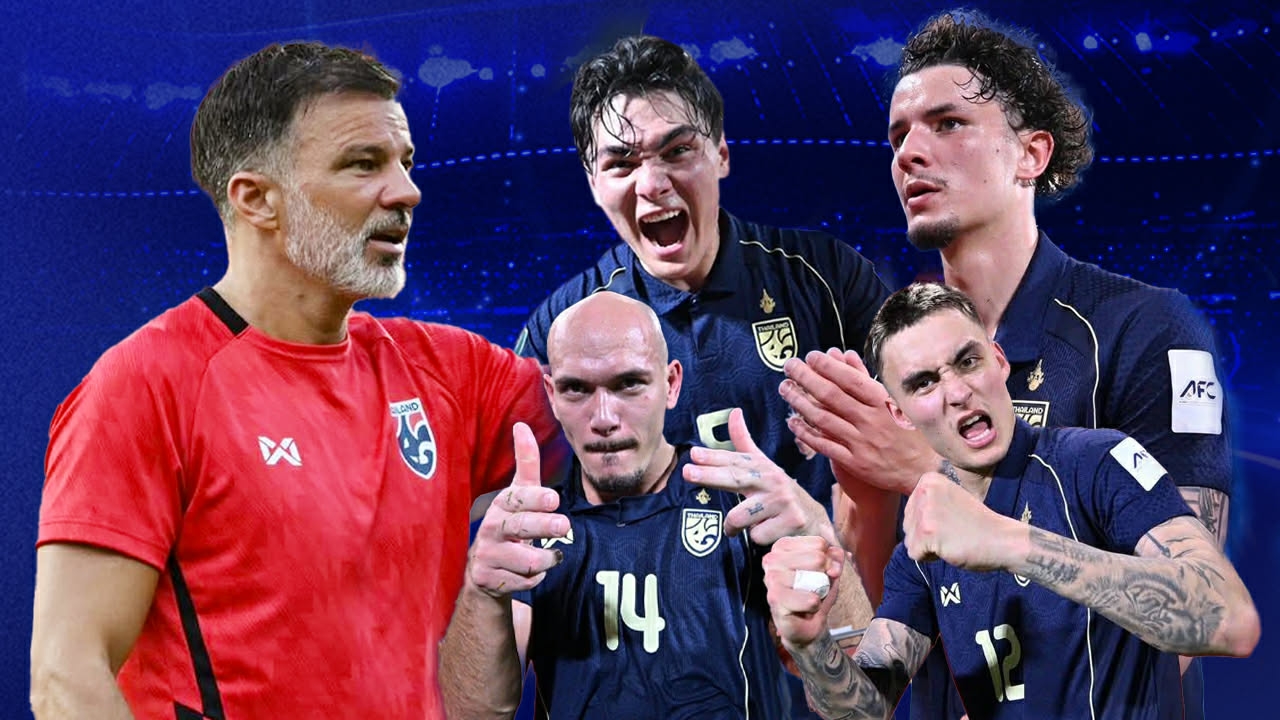
The Thailand national team narrowly secured a place among the final 24 teams to compete in the 2027 Asian Cup.
I must use the term "narrowly secured" because the final match, a 2-1 win over Turkmenistan, was truly a close escape.
What is past is past; the important thing now is to learn from mistakes in order to move forward better than before.
Over the next 10 months, Anthony Hudson has more time to refine the team ahead of the 2027 Asian Cup.
Whatever he wants to try or adjust, Hudson will have ample time to showcase his skills.
Along the way before the 2027 Asian Cup, the Thailand national team will have tournaments to test the squad comfortably.
There are three FIFA international breaks from 1-9 June, followed by 21 September to 6 October, and finally 9-17 November.
According to the FIFA international break calendar, Thailand can schedule up to eight friendly matches.
In addition, there are non-FIFA break games such as the ASEAN Football Championship, also known as the “Hyundai Cup,” scheduled for mid-year.
The key issue is that the Football Association must plan and manage these carefully.
Friendly matches during FIFA breaks should be of good quality, avoiding opponents ranked lower than Thailand.
Most importantly, the Thailand national team must work in perfect harmony with the clubs.
The Thai League schedule should support the national team but minimize disruption to clubs, creating a win-win situation.
Regarding team composition and player details, it is believed Hudson continuously does his homework.
Players performing well in the Thai League definitely have a chance to join the national team, regardless of age or other limitations, a point Hudson has clearly affirmed.
The ongoing discussion about "dual-nationals" is actually not a new issue.
Hudson appeared on Thairath Sport's “Clear Rim Sen” program and confirmed that contact and discussions have been ongoing.
Dual-national players abroad are on a list Hudson has information on and has already had some talks with.
Some have accepted to play for Thailand, while others are still in negotiation stages.
Hudson and the Football Association have been working behind the scenes on this issue; it’s just a matter of who will join the national team.
This approach has both supporters and critics, but frankly, it is a normal practice in today’s world.
If Thailand emphasizes including some dual-nationals, it is not wrong; all have Thai heritage, so there is no reason for drama.
However, naturalizing players is another matter, which is not recommended or supported.
Currently, there are several dual-national players in the Thailand national team, all of whom behave respectfully and have proven themselves as Thai.
Even if some cannot yet speak Thai, their emotions and involvement clearly show they are Thai national team members.
For example, Nicholas Mickelson, who plays in Europe, has never refused to play for Thailand when fit.
The latest player, Jude Bellingham, joined the Thailand team a bit late but has already won over fans.
Those based in Thailand, like Jonathan Khemdee, Manuel Tom Bihr, and Benjamin Davis, raise no questions at all.
Therefore, if more dual-nationals join the Thailand national team, the Thai people will welcome them openly.
It will be up to Hudson to plan how to call these players for trials to see how well they fit the team.
If they perform well and enhance the national team’s completeness, it will be positive; if not, they part ways without harm.
The strategy to bring in dual-nationals is worth trying but is not a guaranteed formula for Thai football success.
The most important thing is managing the entire system properly, not focusing only on the national team, which is just the “tip of the iceberg.”
Building a foundation from youth levels and the league with a continuous player development system is the correct approach.
Foundation and top-level success can be built simultaneously, but focusing only on the top without a solid foundation will eventually fail.
Bubble