

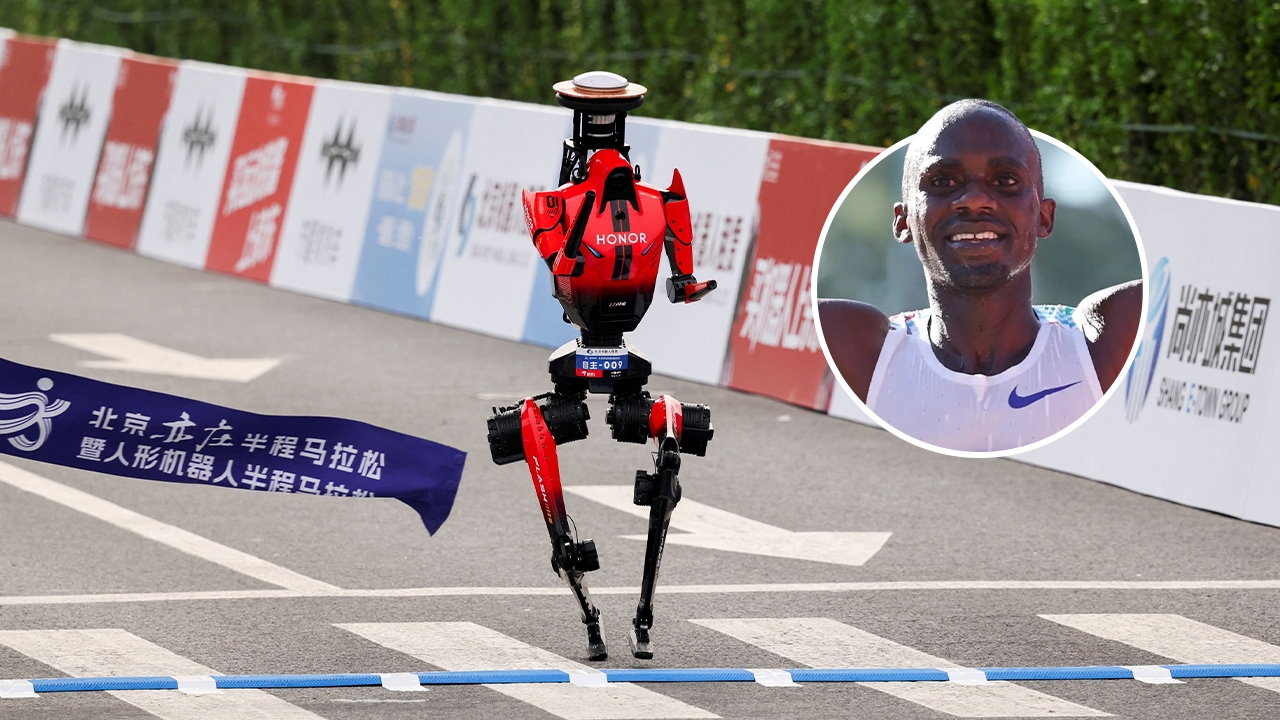
The Beijing E-Town Half Marathon became a historic milestone in technology when the humanoid robot "Flash" from Honor demonstrated superior ability by completing the 21-kilometer race in just 50 minutes and 26 seconds, beating Jacob Kiplimow's half-marathon world record by nearly seven minutes.
On 20 April 2026 GMT+7, the 2nd Beijing E-Town Half Marathon and Humanoid Robot Half Marathon held on 19 April 2026 was not just an ordinary race but a stage to measure the capabilities between "humans" and "robots," with results clearly showing technology emerging as a serious contender.
"Flash" was designed to mimic top-level runners, standing 169 centimeters tall with legs 95 centimeters long, equipped with liquid cooling and, importantly, a fully autonomous navigation system that allowed it to run the entire course without any human control.
Although another robot from the same manufacturer recorded a better time (48 minutes 19 seconds), it was disqualified from record consideration for using remote control, violating the rule requiring "100% autonomy."
Robotics expert Xie openly acknowledged that the world is changing: "Humans have ruled the world for thousands of years, but in sports using autonomous navigation systems, robots are beginning to take the lead."
This advancement is even clearer compared to 2025, when the champion "Tiangong Ultra" took 2 hours 40 minutes and 42 seconds to finish.
This year saw a significant leap with 112 teams from 26 brands and over 300 robots participating, nearly 40% utilizing full autonomy, reflecting that the competition is not just on the field but a global technological battle.
On the human side, Chinese runner Zhao Haijie won the men's category with a time of 1 hour 7 minutes and 47 seconds, still more than 17 minutes slower than the winning robot.
The scene in Beijing may not just be a race but a warning sign that the "line" between humans and machines is increasingly blurred, with robots starting to lead in some arenas.