

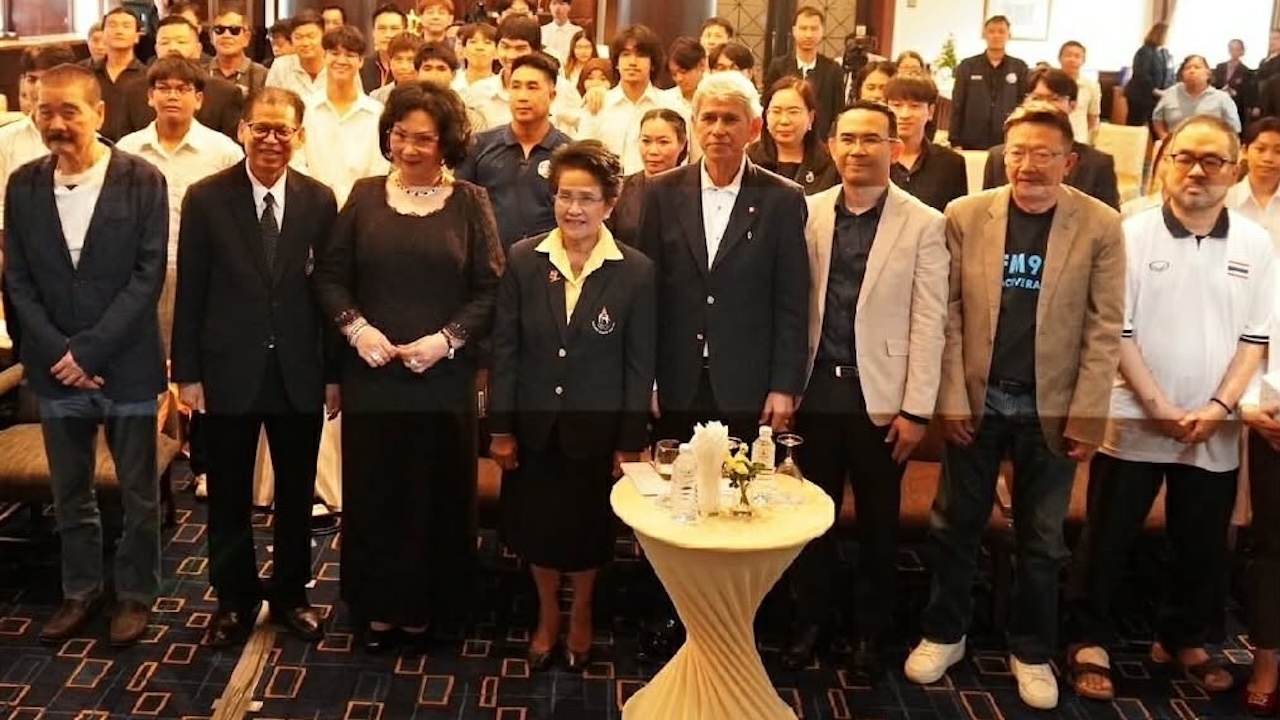
Last week, I was invited by Dr. Ratpong Boonyanuwat, Director of the Human Capital Development Innovation Center at Kasem Bundit University, to participate in an academic seminar titled “Thailand and the Ministry of Sports of the Future,” held at the Anoma Grand Hotel in Bangkok.
The event was honored by Khunying Patama Leeswadtrakul, Thailand's sole female IOC member and President of the Badminton World Federation, who graciously presided over the opening ceremony.
Personally, I was the only media representative given the opportunity to share my views during the panel discussion alongside distinguished speakers in social science, political economy, sports organization management, and representatives from all sectors of the Ministry of Tourism and Sports.
The panel included Sek San Ngowsuwan, Assistant Permanent Secretary of the Ministry of Tourism and Sports; Associate Professor Dr. Somchai Phakphasinwiwat, an independent scholar in economics and politics; and Dr. Supit Samahito, Vice President of the National Olympic Committee of Thailand.
Also present were “Big Pae” Thirachai Wutthitham, President of the Bangkok Sports Association and former Deputy Secretary-General of the National Olympic Committee of Thailand; Somchai Poolsawat, former President of the Thailand Kickboxing Association and former Director-General of the Excise Department.
“Ajarn Rang,” Dr. Chanwit Phonchiwin, Vice President of the Football Association of Thailand and former Senator; and “Lek” Chanathip Sonkham, Director of the Sports Center at Chulalongkorn University and former bronze medalist in Taekwondo at the 2012 London Games.
Also included was General Chaiwit Chayaphinan, former Director of the Volunteer Spirit Project at the Ministry of Defense and a 904 Volunteer Spirit lecturer, who is also the author of a book on sports law.
The insights shared by these speakers during the event are expected to be highly valuable for the upcoming establishment of an independent Ministry of Sports, which is anticipated to occur by the end of this year.
The Assistant Permanent Secretary of the Ministry of Tourism and Sports revealed that he gained extensive knowledge from many sports experts during the seminar, which he, as a practitioner, relies on to present how sports will develop.
He added that the plan is not just to separate the ministry but to take actions that ensure its effectiveness. Combining it with youth affairs is a good idea but may affect other government agencies, so discussions with authorities are necessary to determine feasibility, requiring careful study of legal separations.
After the seminar, I received information from a civil servant at a provincial tourism and sports office who shared issues hindering the development of Thai sports, summarized as follows:
1. Personnel issues: There is a lack of sports personnel in provincial sports offices. Of the 76 provinces, the staff are often not graduates in sports or physical education but come from technical or performing arts backgrounds. This raises questions about how sports can develop. Moreover, there are no physical education teachers in elementary schools, resulting in children lacking good and safe sports skills.
Proposed solutions include requiring physical education or sports qualifications for new hires in the sports promotion and development divisions of provincial tourism and sports offices, as well as for transferred staff.
Clear job responsibilities should be assigned to physical education officers, with work focused on sports development and oversight by the Department of Physical Education.
Physical education officers with teaching qualifications should be tasked with imparting sports skills in elementary schools, especially those lacking physical education teachers.
2. Budget problems: The Department of Physical Education, responsible for grassroots sports, receives insufficient and inconsistent funding for sustainable sports development.
The solution proposed is to amend laws related to fund management to allow the Department of Physical Education to access these resources.
The department should also integrate with other agencies or the private sector to seek additional support.
3. Structural problems in sports development: Currently, the 76 provincial tourism and sports offices have a total of 954 physical education officers (one per district and one per province). Though the Department of Physical Education pays their salaries, they are managed by the provincial tourism and sports offices under the Ministry of Tourism and Sports.
Suggested solutions include establishing provincial physical education centers as regional units of the Department of Physical Education.
Alternatively, setting up nine regional physical education centers to oversee sports development across regions—for example, one center for eight provinces in the central region, serving as a regional head office responsible for sports development within its jurisdiction.
Creation of agencies or working groups to monitor and follow up on sports development activities is also recommended.
This situation reflects issues within the Ministry of Tourism and Sports, the Office of the Public Sector Development Commission, and the Civil Service Commission concerning organizational structure and appropriate staffing.
Graduates from the 17 campuses of the National Sports University, other universities, and Rajabhat Universities with majors in physical education or sports face unemployment because sports agencies hire personnel from unrelated fields like technical, performing arts, or veterinary medicine to work in sports.
Even if the Ministry is separated, it will be ineffective if it does not employ graduates trained in physical education or sports.
This leads to wasted national budget and stagnant sports development as before.
- Bee Bangpakong -