

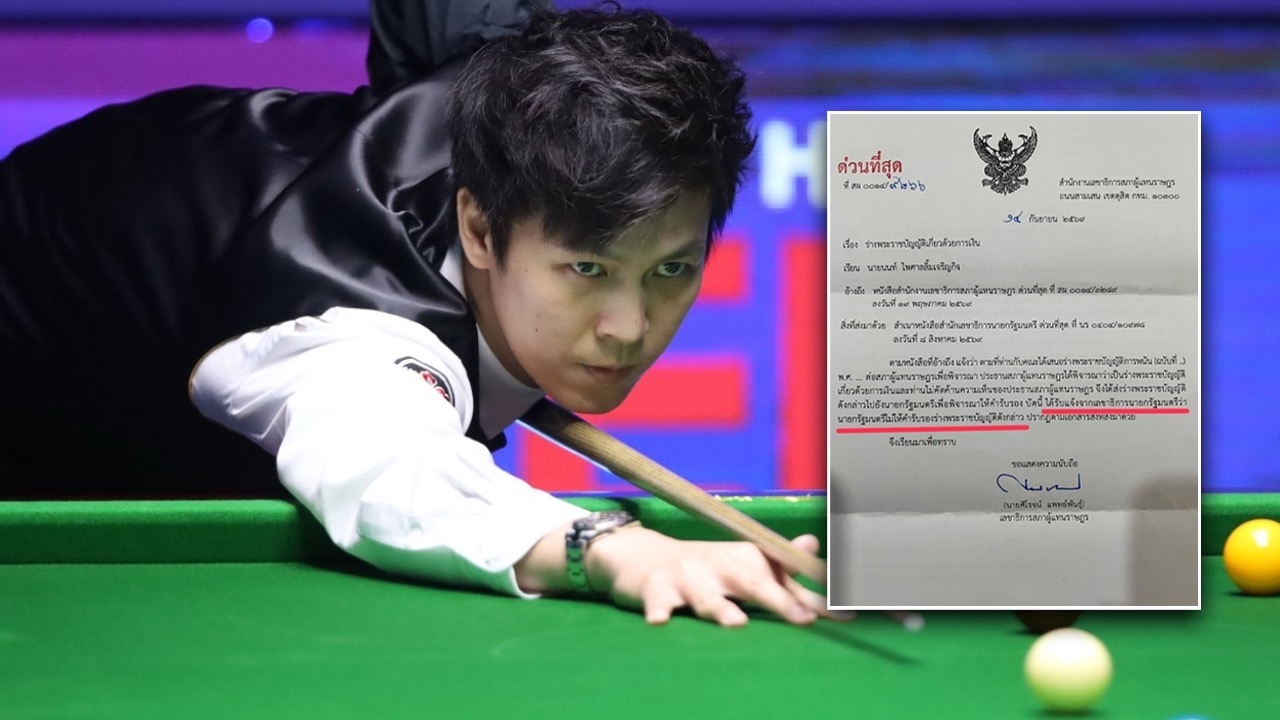
"Snooker" is recognized worldwide as a "sport," but why has Thailand yet to remove its gambling restrictions?
The victory of "Ef Nakornnayok," or Thepchaiya Un-Nooh, in the 2026 World Open in Yushan, China—where he defeated legend Ronnie O'Sullivan and made a maximum 147 break—has reignited debate in Thai society. People question why a sport in which Thai athletes have gained global recognition is still not fully recognized as a "sport" under Thai law. Recently, a draft bill to remove snooker from gambling laws failed after Prime Minister Anutin Charnvirakul did not endorse it. "Big Saraburi," Attasit Mahitthi, former world amateur snooker champion and one of the bill's advocates, posted:
"This is not about any one group but about the future of the sport and Thai athletes."
"If Thai snooker has world-class potential and athletes bring honor to the country, what reasons prevent Thailand from legally unlocking snooker as a proper sport? Why did the Prime Minister not endorse this bill?"
Root of the problem: a law nearly a century old
The core issue lies in the Gambling Act of 1935, which lists "billiards and snooker" under Category B, item 23. This has placed the activity under the Ministry of Interior’s control continuously. Although subsequent laws promoting professional sports in 2013 and the Sports Authority of Thailand Act in 2015 recognize professional athletes, in practice, training venues must still operate under restrictions that limit athletes' potential.
Another layer of the problem is that, although Category B allows for business licensing, the Ministry of Interior’s ministerial regulations have, since 1962, effectively prohibited such permits except in narrow cases: playing at home with no more than one table or in registered clubs with no more than five tables. Additionally, child protection laws prevent those under 20 from using these facilities, creating a major obstacle for talented youth who cannot conveniently train at standard clubs.
Conflicting policies within government
This situation reflects divergent views among Thai government agencies. The Department of Provincial Administration sees snooker as a gambling risk requiring moral and public order control, whereas the Sports Authority of Thailand regards it as a professional sport deserving promotion to develop skills and national pride. Some politicians have raised this issue publicly, noting that when Thai athletes reach the top globally but at home their activity is still seen as a vice, it harms the sport’s image and long-term morale.
Even advocates against gambling agree snooker should be elevated as a sport, proposing clear legal distinction between "sport" and "gambling." They suggest the key reform should be revising the Ministry of Interior’s regulations that currently forbid licensing, rather than rewriting the entire Gambling Act, which covers hundreds of gambling types and could prolong the process.
How is snooker viewed internationally?
Globally, snooker has advanced far beyond where Thai laws currently stand. It is recognized by the International Olympic Committee (IOC) through the World Billiards Sports Federation and has been part of the World Games since 2001. It is also included in the Asian Games. Although it has never been accepted into the Olympic program—having unsuccessfully bid for 2021 and 2024—it plans to try again for the 2032 Brisbane Olympics in Australia.
The United Kingdom, where snooker originated, uses the Gambling Act 2005 to clearly separate "gambling" from "professional sport." Venues with snooker tables are categorized: sports clubs receive tax benefits and local support but must strictly prohibit gambling on training premises. The World Professional Billiards and Snooker Association (WPBSA) has an integrity unit that cooperates with government gambling regulators to monitor suspicious betting patterns, with lifetime bans for match-fixing. Additionally, sports club licenses are completely separate from alcohol-serving venue licenses, allowing those under 18 to train in standard academies without violating service laws.
China takes a state-led approach, investing heavily in modern national training centers in Beijing and Shanghai. It integrates academic studies with training, granting youth official athlete scholarships. It also enforces strict discipline; the Chinese Billiards and Snooker Association banned 10 players involved in gambling scandals in 2023 to uphold ethics. China now has about 300,000 registered snooker clubs nationwide. Yushan, where Thepchaiya recently won, is developed as the "World Snooker City" with full manufacturing of tables and equipment, creating jobs and export revenue. Continuous investment has led Chinese players to recent world championships, encouraging the WPBSA president to note the IOC’s increasing attention to the sport.
These two models differ greatly but share a key feature: systematically separating "sport" from "gambling" through clear laws and regulatory bodies, unlike Thailand where the two remain mixed.
Proposed solutions
In Thailand, proposals include clearly categorizing club licenses—for example, one category focused on sporting excellence permitting youth access while strictly banning gambling and alcohol, and another for general recreation still under gambling law control. It is also suggested that relevant agencies—the Ministry of Interior, Ministry of Tourism and Sports, Sports Authority of Thailand, and the Snooker Sports Association—collaborate to resolve legal barriers accumulated over nearly nine decades.
Ultimately, the question "Is snooker a sport?" already has a clear answer internationally. What remains is how quickly Thailand will update its laws and governance structures to align with the reality that its own athletes are creating on the global stage.