

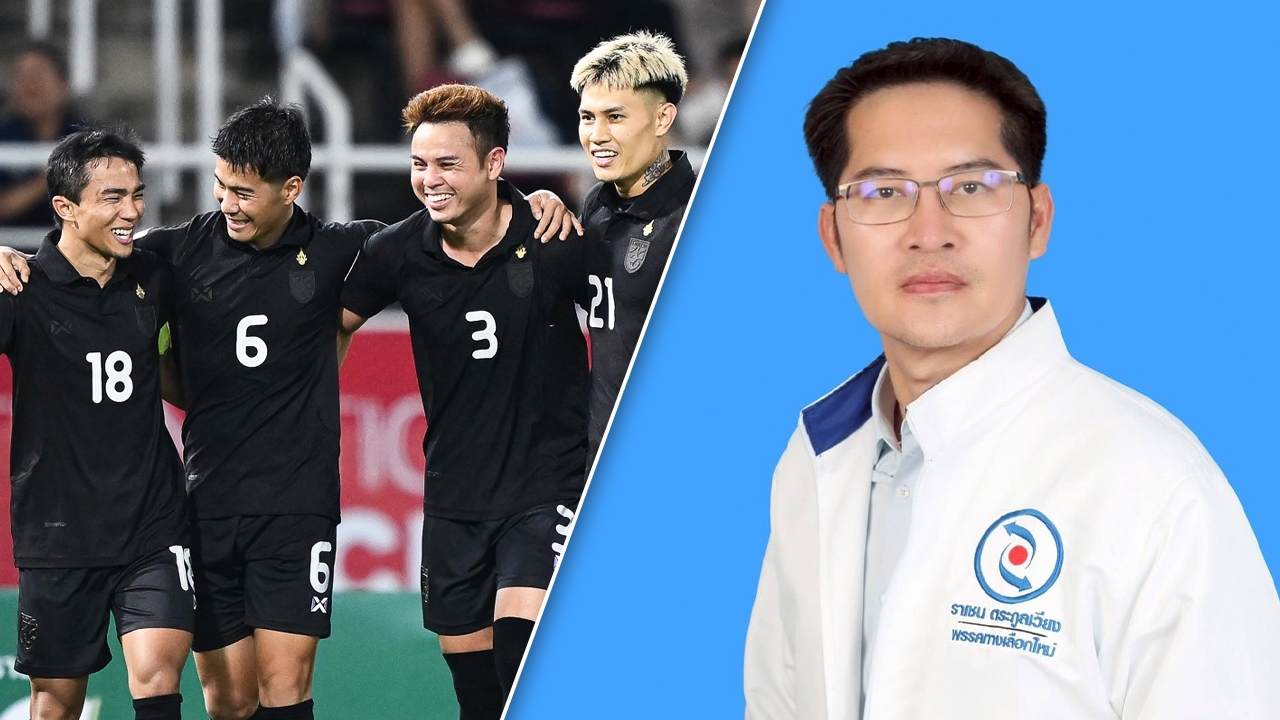
The 2-Billion Baht "Thai Football to the World Cup" Policy: Election Dream Selling or a Real Possibility? The Columnist By Hua Na Bo, The Columnist by Hua Na Bo (Hua Na Bo is a pen name).
"Thai football to the World Cup"—a phrase anyone can say, but until now hardly anyone has clearly explained how, by what method, or by which target year this would happen.
Te Mongkolkitti, as a prime minister candidate for the New Alternative Party, proposed that "the government will inject a budget of 2 billion baht per year" to push the Thai football team into the World Cup finals, with a long-term goal of "reaching the final match." This budget would be a mix of government funding and private sector support.
Many see this as just an election tactic, dream selling, fantasy, or mere rhetoric for attention. Whether this is true depends on perspective. However, reviewing data shows that in countries where football thrives, the government and political sector play a crucial role in driving the entire football system so that the dream of "going to the World Cup" can become reality, not just a dream stirred every four years during elections.
• Indonesia: Recently, the government approved a support budget of 400 million baht per year for the 2026 World Cup qualifiers, marking the highest budget ever for a country that has never reached the final tournament.
• Vietnam (VFF): Has an operational budget around 370–380 million baht per year (including association revenue). Indirect government support for other development projects lacks clear figures.
• South Korea: Allocates 3.5–5 billion baht annually focusing on developing school systems, universities, and a strong professional league. The result is consistent World Cup qualification.
• Saudi Arabia: Invests 15–30 billion baht under the Vision 2030 policy, using football as a global Soft Power tool, attracting superstars, building world-class infrastructure, and preparing to host a future World Cup.
• Japan: Exact figures are unclear but receives massive government and private sector support through tax incentives and sports policies. The JFA structure has long-term goals from 2005 through the current 2023–2026 plan to expand the player base, develop coaches, improve league structure, and nurture players from childhood. Funding is invested across the system rather than directly into the national team, producing consistently high-level teams.
England: The FA's 2023-24 annual report states total turnover of £551.2 million (about 25 billion baht per year), reinvesting over £169.3 million (~7.6 billion baht) into football. Since 2000, over £780 million (more than 30 billion baht) has been invested in infrastructure like stadiums and equipment nationwide. The FA invests comprehensively in English football systems (national, youth, grassroots, infrastructure, etc.).
Thailand's national team lacks publicly disclosed figures or a clear national policy.
Government funding from the National Sports Development Fund covers training allowances and occasional bonuses from events like the SEA Games or Asian Games.
For organizing competitions or youth leagues to develop young players, plans must be submitted. While proposals exist, limited budgets prevent full implementation. This is a key reason football fans protest, questioning why the Football Association does not lay youth foundations or provide developmental platforms. Part of this is due to insufficient funding support.
Additional info: The National Sports Development Fund's 2026 fiscal year report states a total budget framework of approximately 4.13 billion baht for sports projects and expenses across all sports (not football-specific).
Suppose... the government actually injects 2 billion baht annually?
If the goal is to elevate the entire system over the next 8–12 years:
• If the 2 billion is spent only on the senior national team: it is "insufficient and unsustainable."
• If the 2 billion is invested in the "structural system": then "there is a real chance."
What should this money be used to develop?
1. Youth structure: build a strong, continuous Youth League system.
2. Personnel: develop coaches and sports scientists to meet international standards.
3. Lower leagues and regions: support grassroots leagues as local economic centers.
4. Infrastructure: create national football training centers and standard stadiums nationwide.
In countries where football thrives, it is an "industry" generating huge revenues from broadcasting rights, tourism, and transportation. If Thailand can define its market positioning clearly and the political sector seriously supports with planned efforts, the phrase "Thai football to the World Cup" would no longer be just a dream sold during elections. Someday, it must come true…