

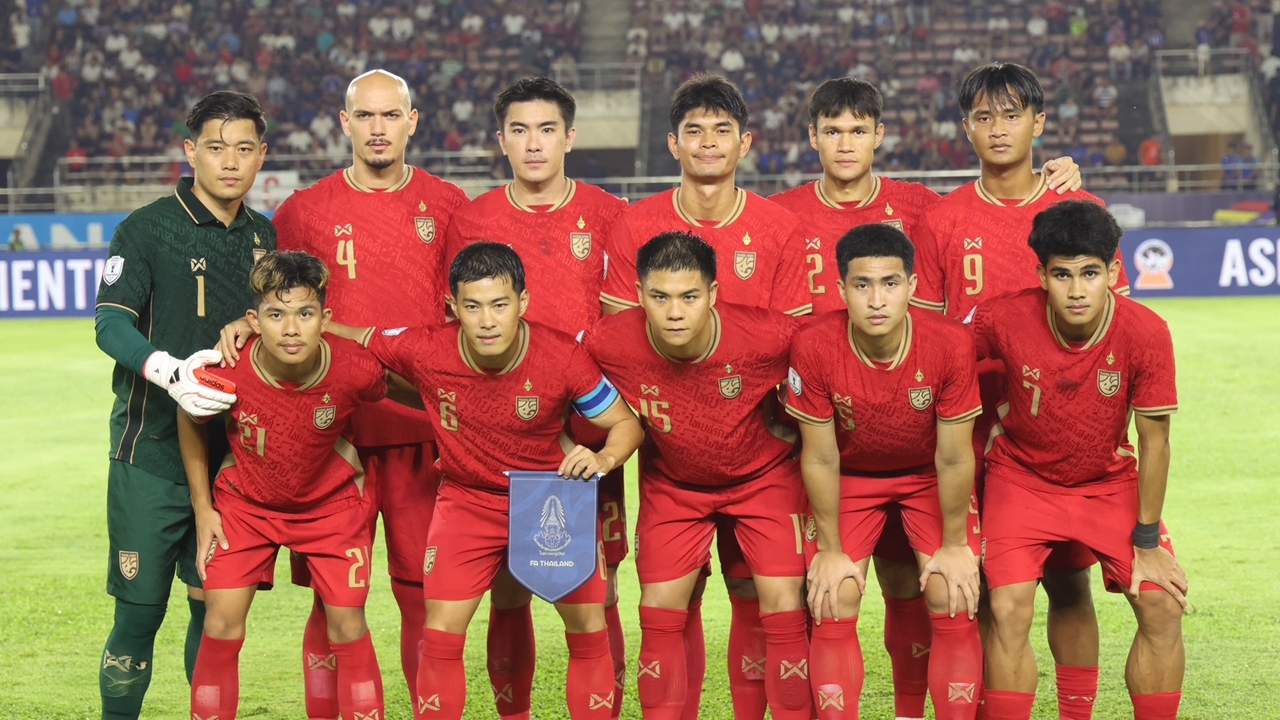
For many years, the ASEAN Football Championship, commonly known as AFF, has been a tournament that has captured the hearts of Thai football fans and neighboring countries since its founding in 1996.
It is the only trophy that ASEAN nations realistically have a chance to win, earning it the nickname "the World Cup for ASEAN people."
Looking back 10–20 years ago, the term "ASEAN champion" (whether called the Tiger Cup, AFF Suzuki Cup, or Mitsubishi Electric Cup) was not just an ordinary football tournament but one where "you could lose to anyone but never to a neighbor."
When the Thai team won, they returned with open-top bus parades from the airport, tickets were harder to get than gold, and the champions received cash bonuses of 10–20 million baht!
Returning to the present in 2026, the popularity of the AFF football tournament has significantly declined.
Normally, sports news agencies from Thailand send large teams from almost every TV station, newspaper, and online outlet to closely follow the Thai national team in every match across ASEAN. But recently, only Thairath Sport and the KID SIDE KONG page sent reporters to cover the match in Laos.
Even though the Thai team won Laos 5-0 and the mood should have been positive, only 2–3 media representatives were present over the past few days at the national team's training camp, reporting daily updates rather sparsely.
The arrival of FIFA ASEAN is a disruption to AFF in business terms, meaning a rapid change that destroys or replaces the old system, methods, or business model as obsolete.
The World Cup era has entered a phase where every match must officially count within the FIFA Day system.
AFF, however, has become a tournament that "runs counter" to this. Its major weakness, often discussed, is its overly long schedule requiring teams to play up to eight matches, which not only tires players but also frustrates their clubs since the tournament is not held during FIFA Days, so clubs are not obliged to release players.
This was the starting point for FIFA to step in and address the problem directly by launching a new tournament in 2026 called FIFA ASEAN.
Why is FIFA ASEAN interesting and superior to AFF in every respect?
- Full FIFA ranking points (x10): Each match earns ranking points equivalent to a standard friendly match multiplied by ten, twice that of AFF.
- Uses the new FIFA Day calendar: FIFA has combined the September and October breaks into one roughly 20-day period, allowing four matches to be played quickly without leagues having to awkwardly reschedule.
- Elevated level by inviting non-ASEAN nations: Not limited to the 11 ASEAN countries, it includes South Asian zone teams. The first edition has 14 teams divided into 2 divisions, with Thailand in Division 1 as the top-ranked team.
- A very compact competition format: Division 1 is split into 2 groups, with 3 points for a win and 1 for a draw (head-to-head results break ties). Thailand is in Group B with Vietnam, the Philippines, and Pakistan (replacing China).
- A ranking system that tests teams: After 3 matches in the first round, teams with the same position from Groups A and B face each other in the final match (e.g., first place vs. first place to decide the champion).
- Relegation intensity: The 4th place team in Division 1 is relegated to Division 2. Given Thailand's world ranking of 94, relegation would force serious self-reflection.
- Guaranteed official medals from FIFA: The champion receives a gold medal directly from FIFA President Gianni Infantino, adding historical prestige.
- Football associations thus have the right to call their best players without worrying about clubs refusing to release them, as has happened before.
If this model also works in ASEAN, it is quite possible that in the future AFF will gradually diminish in size while FIFA ASEAN will become the new stage to determine the "true ASEAN champion," replacing the longstanding trophy that has been part of the scene for over three decades.
Huana Bo