

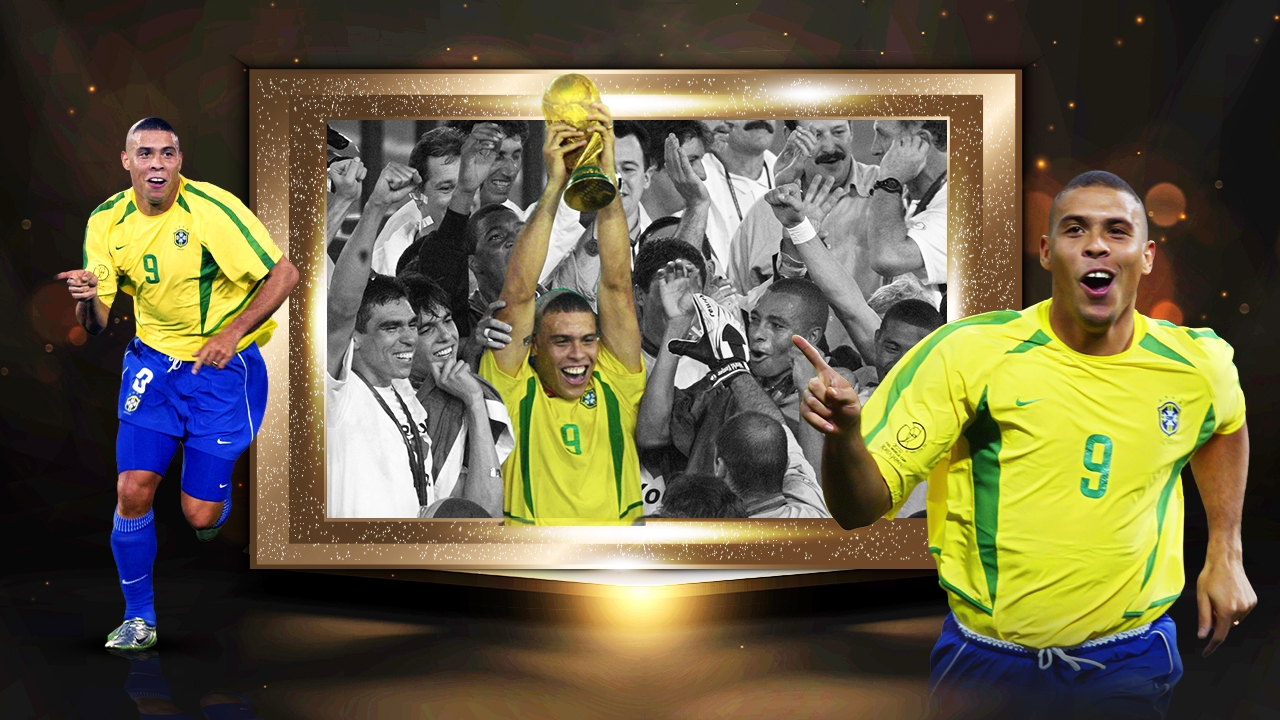
Hall Of Fame: “Ronaldo” R9, Brazil’s national team striker and one of the greatest forwards the world has ever seen,
During Brazil’s golden era, one of the forwards who epitomized the Brazilian style—agile, fast, and highly skilled—was “Ronaldo,” also known as “R9.” He led Brazil to two World Cup titles. Today, we revisit the greatness of this player, exploring why football fans continue to admire him and why his name remains prominent. Follow along in Hall of Fame.
Ronaldo Luís Nazário de Lima, known as “Ronaldo R9,” joined the Brazil national team at just 17 years old but was not yet a key player when he was included in the 1994 World Cup squad.
In 1994, the Samba team won their fourth World Cup title, remaining unbeaten throughout the tournament. Ronaldo, part of the squad, secured his first World Cup championship.
Ronaldo then became a key player, helping Brazil win the 1997 Copa América, scoring five goals in the tournament. He also played a vital role in winning the 1997 Confederations Cup. With his quick play and sharp finishing, his outstanding performance throughout the year earned him the FIFA World Player of the Year and the Ballon d’Or, establishing him as the new symbol of Brazilian football following legends Pelé and Romário.
The 1998 World Cup in France saw Brazil enter as defending champions and favorites, featuring stars like Cafu, Roberto Carlos, Rivaldo, Bebeto, and Ronaldo himself. The “Samba team” performed excellently, reaching the final again with a chance to claim their fifth World Cup title.
Reports surfaced before the final that Ronaldo experienced seizures, nearly preventing him from playing. Ultimately, he did take the field but was not at full strength. Many believe he played while not fully fit or forced himself to play. Brazil lost the final 3-0 to France.
Despite the loss, Ronaldo’s four goals in the tournament earned him the Golden Ball as the best player, cementing his status as one of the world’s best and confirming his position as a global superstar.
After battling serious injuries, Ronaldo made a remarkable comeback at the 2002 World Cup co-hosted by South Korea and Japan. He became Brazil’s main striker again, scoring eight goals to win the tournament’s top scorer award and leading Brazil to their fifth World Cup. He scored twice in the final against Germany. His exceptional year earned him the FIFA World Player of the Year and Ballon d’Or once more, transforming his story from a player many thought was finished due to knee injuries into a legendary comeback in football history.
The 2006 World Cup in Germany was Ronaldo’s final major tournament with Brazil. Though not at his peak physical condition, he remained an important attacking figure and broke the all-time World Cup scoring record at that time by scoring his 15th goal against Ghana. Brazil’s journey ended in the quarterfinals after a 1-0 loss to France. Despite the disappointment, this World Cup marked the conclusion of the international career of one of football’s greatest forwards.
Ronaldo R9 played 99 matches for Brazil, scoring 62 goals and providing 32 assists. His honors include the 1997 Confederations Cup, 1994 and 2002 World Cups, and Copa América titles in 1997 and 1999. He held the World Cup all-time scoring record with 15 goals until it was surpassed by Germany’s Miroslav Klose with 16.
At club level, Ronaldo played for many top European teams. He began in Brazil with Cruzeiro before moving to Europe to join PSV Eindhoven, where he scored 54 goals in 58 matches and won the 1995–96 KNVB Cup.
He then elevated his career at Barcelona, scoring an impressive 47 goals in 49 matches and winning three trophies in a single season.
At Inter Milan, he helped secure the 1997–98 UEFA Cup despite recurring injuries, scoring 59 goals in 99 matches. He later joined Real Madrid during the Galácticos era, scoring 104 goals in 177 matches, winning La Liga and the Intercontinental Cup, before a stint at AC Milan, where he scored nine goals in 20 games.
Ronaldo retired at Corinthians in his homeland, scoring 35 goals. Over his club career, he played 518 matches and scored 352 goals, closing his career as one of the most dangerous and complete forwards in football history.